Monthly Archives: September 2012

Back to the Bay

19 September: Chesapeake Chuckles

It’s been three months to the day since the keel of Steadfast last slid through the water of Chesapeake Bay.  She generally doesn’t have much to say but on this day, you could hear her sing.  This evening,  she wears a discernible smile. After all the warnings and wind, last night turned out to be fairly mundane.  A couple of 40-knot gusts around midnight, a light sprinkle of rain off and on, but that’s about it.  And no one in Chesapeake City was complaining.

The air this morning was crisp, the sky cleared early and a cool 12-15 knots blew down out of the nor’west.  All that was needed to start the day in earnest was for the C&D Canal to reach high tide and the dozen or so southbound boats in the basin would be on their way, Steadfast and Patience, among them. The crew of a 48-footer apparently grew tired of waiting for the tide to turn, cast off from the pier and promptly put her 7-foot keel in the mud.  There she sat for the hour-and-a-half it took for the tide to rise sufficiently to lift her off the bottom.

The C&D's an easy trip, unless you meet a big girl like Ocean Challenger.

The C&D’s an easy trip, unless you meet a big girl like Ocean Challenger.

The tide was not a problem for the two 27-footers that cast off at 1256, just as the water was at its highest and ready to start its westward ebb.  Even at idle speed, Steadfast was making five-knots, which became more when a reefed main was hoisted a half-hour later.  By 1337,  where the canal joins the broad, shallow and muddy Elk River, the genoa was unfurled and Little Red took a break altogether.  The rest of the day was spent just under sail, and Steadfast loved it!

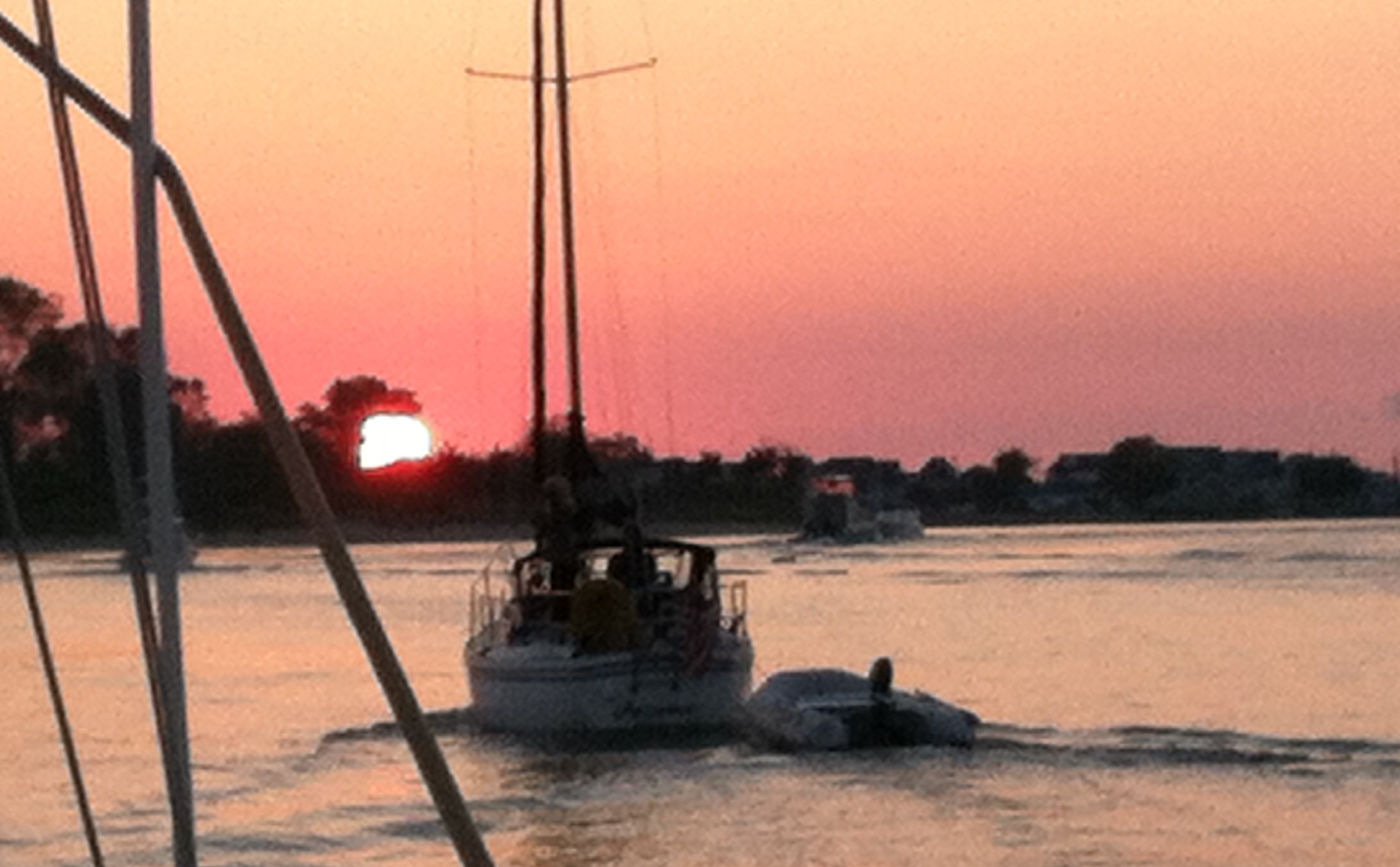
She heeled to the blustery nor’westerly, dipping her port rail to the water from time to time and ripping along at times at more than seven-knots over the bottom!  Patience, of course, had no trouble keeping pace. The farther south they went, the more the wind moved aft, to a reach and then a broad reach until an easy gybe to port and Steadfast led the way through the field of crab pots that guard the entrance to the Sassafras River. The wind by then had all but disappeared.  The setting sun soon striped the horizon with bands of pink and orange.  The only sound was the shlurp-shlurp of the dinghy bobbing a few feet off the transom.

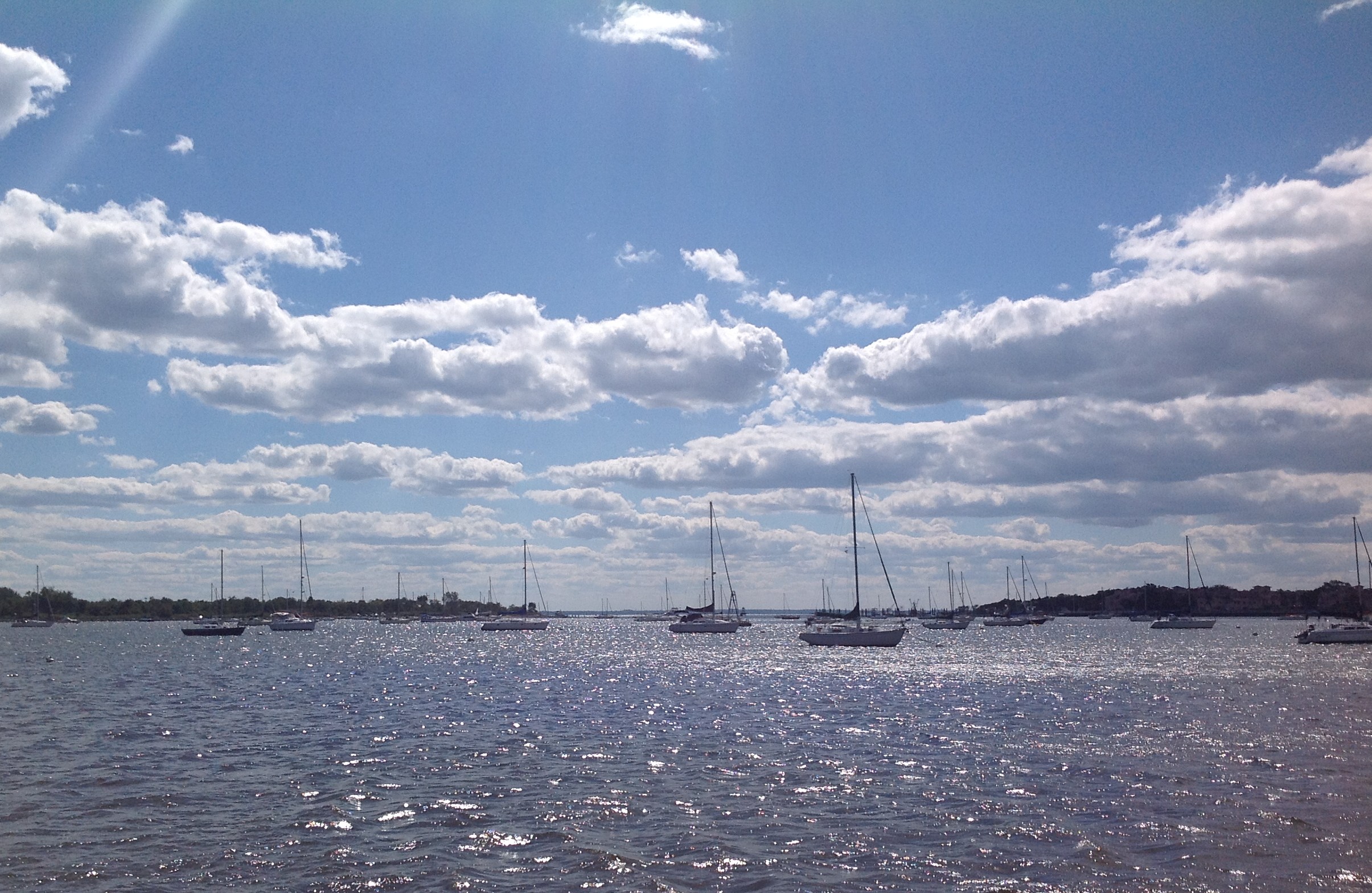
Sassafras River, our first stop back in the Chesapeake Bay, proved to be a quiet anchorage and a quick jumping-off point for the next day.

Sassafras River, our first stop back in the Chesapeake Bay, proved to be a quiet anchorage and a quick jumping-off point for the next day.

Or wait.  Is that the satisfied sound of Steadfast chuckling? It’s too chilly tonight to go check.  Steadfast, out.

21 September: Slings & Arrows: Part I

Sailing–sailing, not motoring–right up to the point where the anchor goes down, letting the boat coast to a stop and then letting the anchor slide over the roller and down to the bottom.  Paying out the rode, snubbing it off and then feeling the anchor settle, dig in as the boat swings gently to the breeze. It’s the way it was always done, of course, “back in the day,” but it’s somewhat of a lost art that’s fun to practice now and again.  The simplicity, the quiet of it.  There can be no more perfect way to end a day underway.

That was the experience Wednesday night off the north shore of the Sassafras River, summed up succinctly in the photo Jane got with the moon high in the sky as last rays of the sun colored the horizon. It’s nearly as much fun to sail off the anchor in the morning, and the five or six-knots of easterly that rippled the Sassafras early Thursday were just enough to allow that to occur.
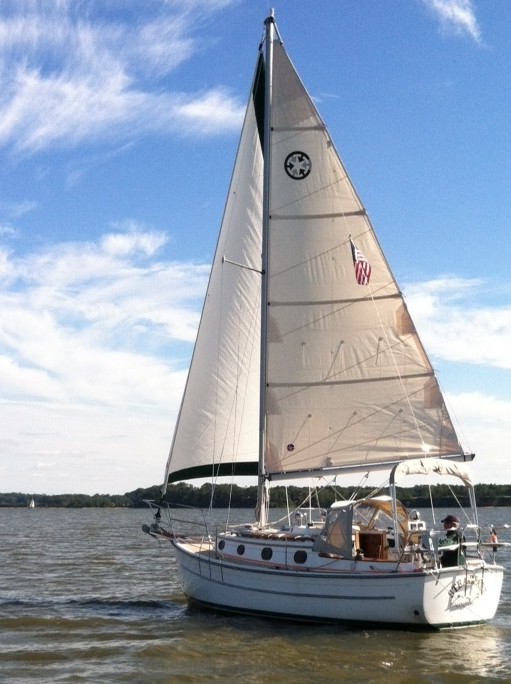
With a favorable tide, it doesn't take much wind to sail the muddy water of Elk River.

With a favorable tide, it doesn’t take much wind to sail the muddy water of Sassafras River.

There were several tacks to get out of the river and into the Bay where Steadfast and Patience turned to port on a heading of 215 magnetic, hoping to continue sail on a broad reach.  The wind, however, had other ideas as to how to spend the day.  It elected to back first to the nor’east, then north and nor’west and right around counterclockwise, ’til a steady 10-knots was blowing up the bay from the south which meant, of course, sails furled and engines on. Right about then…

“Bill, would you like to join us for lunch?  We’re having salad.”

Oh, that Jane has a sense of humor.  You see, Steadfast and Patience were underway at the time, motoring just east of the shipping channel on the upper Bay, somewhere south of Worton Point.

“No, we’re serious, Bill.”

Now it’s Tony’s voice on the VHF, explaining that Jane’s fixing a big salad, will put some in a ZipLoc bag and he’ll use his new 12-foot boat hook to pass it over.  Well, what the heck?  Worth a try! And so it was that Patience slowed, Steadfast came alongside, Tony extended the salad in a bag tied to the end of his brand new, never been tested boat hook and the salad, in fact, DID make it aboard Steadfast as intended.
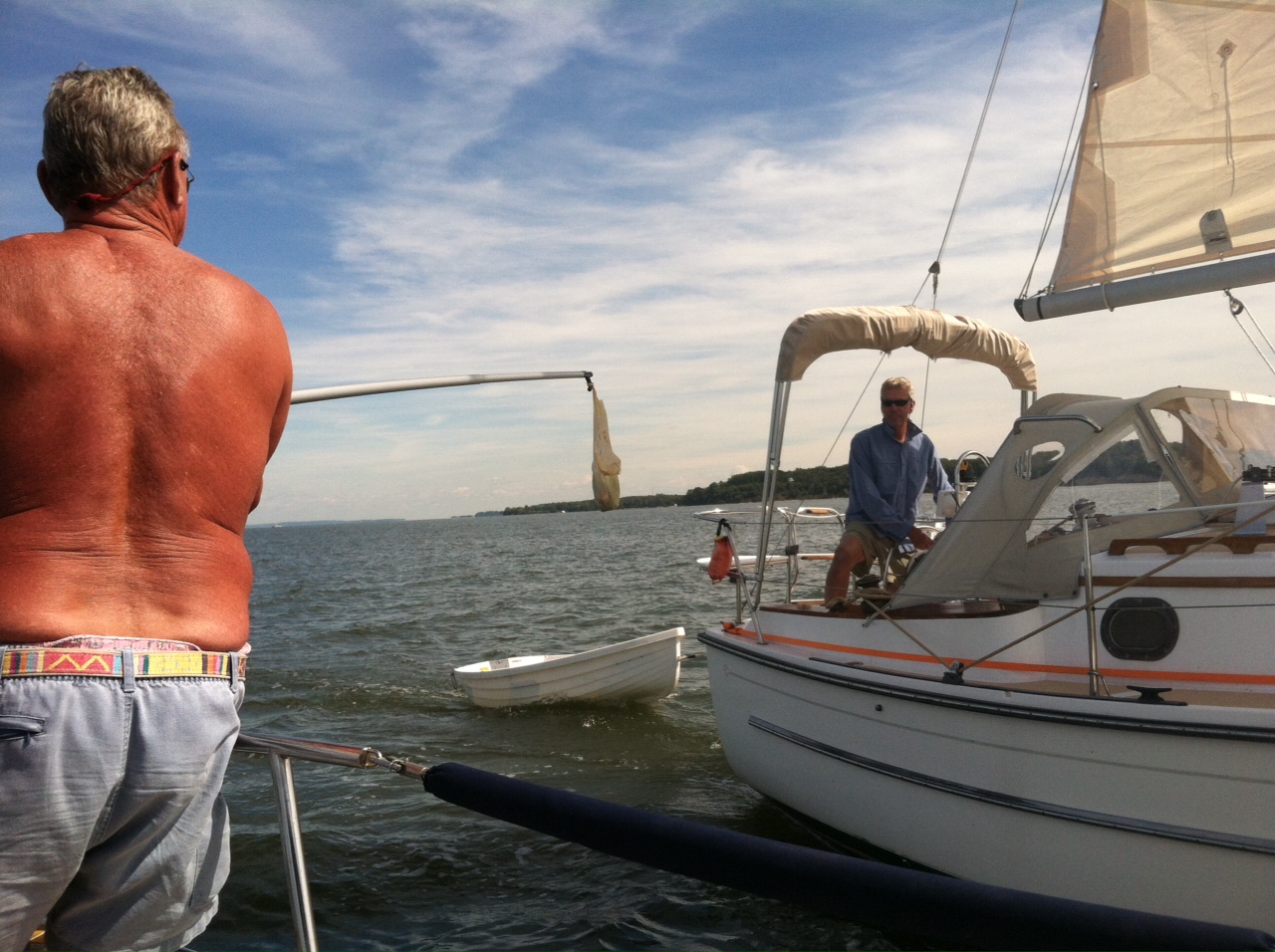
You may not find this maneuver recommended in Chapman's but it worked and  lunch was delicious.

You may not find this maneuver recommended in Chapman’s but it worked and lunch was delicious.

What you don’t see in the photo is the nifty new boathook, after making the transfer successfully, then snagging a lifeline on Steadfast, thereby being yanked out of Tony’s hands and splashing into the Bay.  Neither will you hear the associated narration which went something like “Oh, golly gee whiz.  Isn’t that a shame” or words to that effect. However, both boats quickly reversed course, the boat hook from Steadfast–which had been baptized, twice in one evening, in New London–was put to work and it quickly snagged the runaway! And if that were the end of the day’s adventures, that would be sufficient.  But wait!  There’s more… (to be continued)

22 September Slings & Arrows: Part 2

So, after the day’s idyllic start, the comedy of the salad exchange (and by the way, it was perfecto!  Mmm, mmm good.) the two little yachts continued to motor down the Bay toward Rock Hall, a snug and lovely harbor on Maryland’s eastern shore that lists heavily toward rag-boaters.

“So, Bill,” says Tony on the VHF, “I’m thinkin’ we can cut across Swan Point Bah where the chot shows…  Uh-oh.  Bill, I just heard a big clunk!  I’ll have to call you back.”

Ah, outrageous fortune strikes…literally.  Patience has just struck something submerged, out of sight, probably large and definitely heavy.  The good news is she’s not taking on water.  But Tony reports she’s lost all thrust.  Going nowhere.  Drifting.  After a quick assessment of the situation, he calls the man in the red shirt, AKA TowBoatUS, who is on the scene in 20-minutes.  Within moments, the tow line is deployed and Patience is being towed–at seven knots!–toward Rock Hall.

TowBoat was quick to respond when Patience needed help getting into port at Rock Hall.

TowBoat was quick to respond when Patience needed help getting into port at Rock Hall.

The next morning, the able crew at Sailing Emporium had her up in the slings of the travel lift, identified the problems–damaged prop, broken prop shaft–and got to work finding parts and completing repairs.  The plan had been for Steadfast to spend Thursday night there, too, but given the opportunity, arrangements were made Friday for the yard to do some needed fuel system maintenance.  Kudos to Sailing Emporium for extending dockage Friday night at no charge and then, with the wind howling out of the south and seeing Steadfast at anchor in the harbor, inviting her back in for Saturday, too!
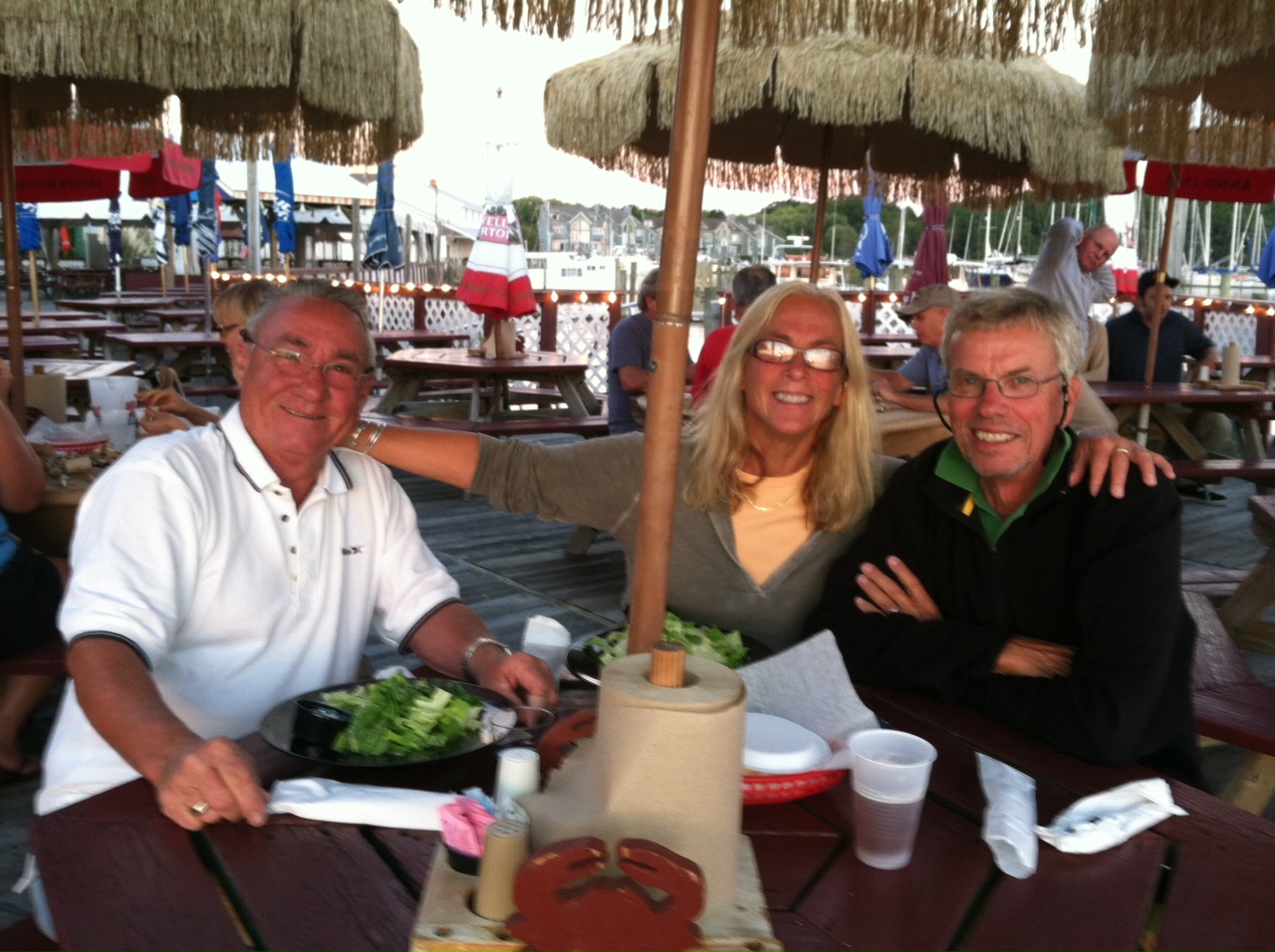
After pulling into Rock Hall for repairs, the crews of Patience and Steadfast make the most of it at the Waterman's Bar & Grill.

After pulling into Rock Hall for repairs, the crews of Patience and Steadfast make the most of it at the Waterman’s Bar & Grill.

Patience was back in the water early Saturday afternoon, all systems “go,” and the plan is for both boats to head to the western shore Sunday, maybe Annapolis.

Steadfast out.

25 September

The half-moon is surrounded by wispy puffs of cloud cast in the color of a pale rose, a perfect halo.  Certainly, that means something, a la “red at night, sailor’s delight” or some such.  But the only signal on Steadfast this night says it’s time to “splice the main brace.”  It’s a dark and stormy night, for sure. And the day?  It was a day like any other day, just a lot more of it.

A southerly wind in the upper teens, unrelenting in its determination to stack up a three-to-four-foot on Chesapeake Bay and Tangier Sound.  While doing its work, it whined or howled or screamed, however that constant wail might be categorized, as if to say “I’m still here!” Not that anyone on the Bay yesterday could forget.
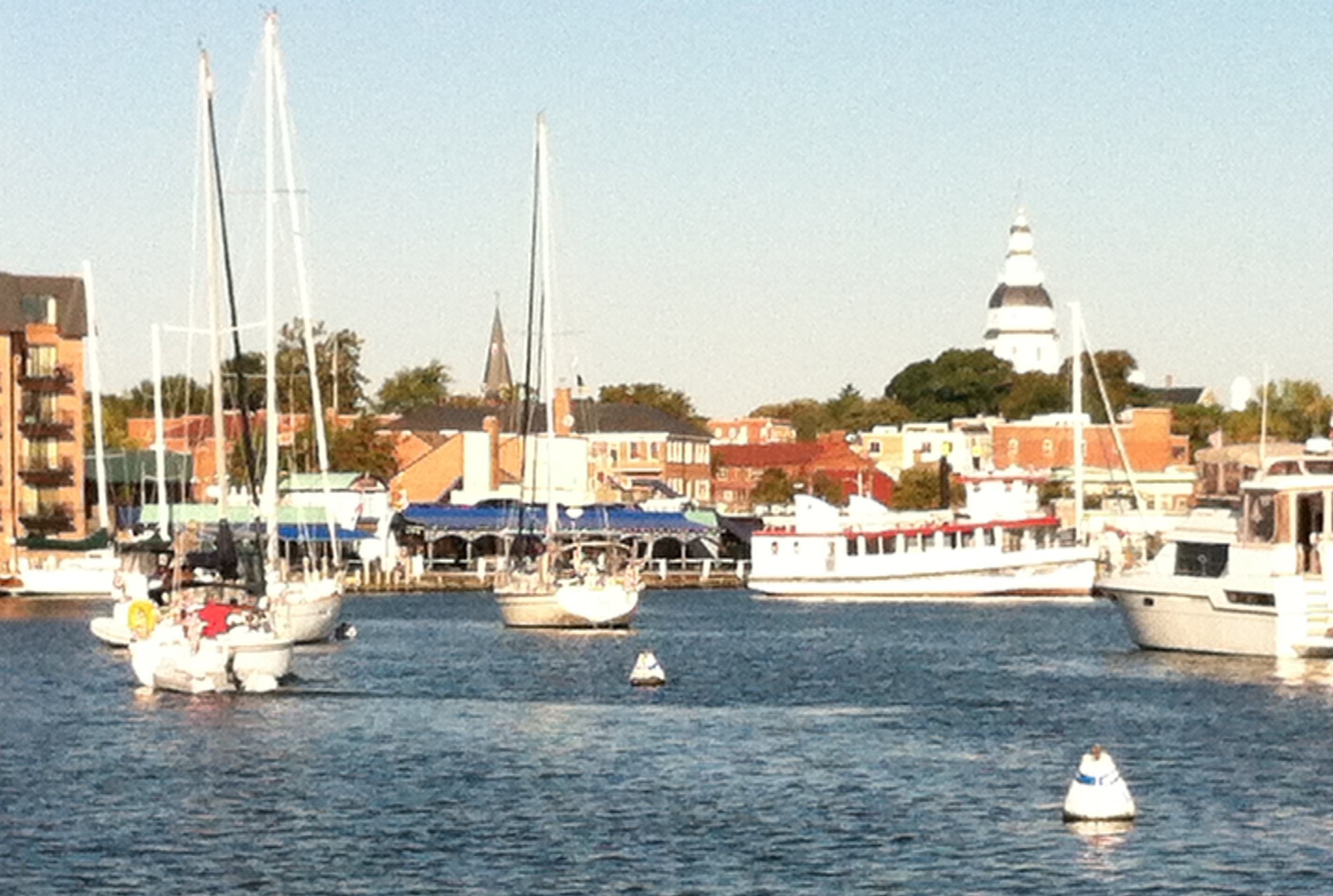
It's always a relief to spy an open mooring close to the action at the City Dock in Annapolis.

It’s always a relief to spy an open mooring close to the action at the City Dock in Annapolis.

All this, in total contrast to the experience of sailing Sunday and Monday. Shoving off Sunday from Rock Hall, there was a nifty little breeze out of the north, gusty, too. But given that Patience and Steadfast both were headed across the Bay and 16 miles to the so’west, it made for a pleasant mid-morning reach across Swan Point Bar that became more of a broad reach when the boats headed toward the Bay Bridge.  Wending their way up the Severn River among yachts of all descriptions, including a classic yacht regatta, the two seemed pleased to call it a day earlier that usual as each rode to a city mooring just off “Ego Alley.”  There was a trip to Pusser’s, a stroll around town, good eats at Federal House and an all around great day. Monday meant more blue, sunny skies with temperatures again in the mid-70s.  But this day, the wind was in the mood to tease a sailor.

The Thomas Point Light may be the most famous and photographed on Chesapeake Bay.

The Thomas Point Light may be the most famous and photographed on Chesapeake Bay.

Off Thomas Point, enough blew up to coax out the main but it soon was luffing and came down again.  From the west, what wind there was clocked to the north, then east and eventually south before dying out altogether, only to wake up and blow right down the Patuxent River just as Patience emerged from the lee of Cove Point with Steadfast off her port quarter. Not that this was a problem, by any means.  After running for more than 38 miles, Red looked forward to getting the final five behind her.  And a more lovely fall evening could not be had.  The two anchored up Back Creek, just off the Calvert Marine Museum among several other sailboats that appeared to be cruisers headed south.

Crisfield seemed a good target yesterday, what with the forecast calling for 12-14 out of the south, so’west, meaning–in theory–the two little yachts could beat across the Bay to Kedges Strait and then motor the few miles down Tangier Sound to the Little Annemessex and into the snug harbor at Somers Cove.  ‘Cept it didn’t work out that way (go figga!).

Aeolus decided to work the early shift,  earlier than NOAA expected, and blow from an angle that preempted sailing to Kedges Strait.  Instead, the more northerly Hooper Strait became the alternative.  Snaking the way through that passage between Bloodworth and the Hooper Islands, depths ranging from 54 to 12 feet and with beam to the wind and waves, took more time–and effort–than anticipated.  Emerging into Tangier Sound and turning south, the chop was dead on the bow, slowing progress at times to a crawl. The half-mile before the turn to the Little Annemessex leading to Crisfield, that last little bit took nearly half-an-hour to negotiate.

Visitors to Crisfield enjoy the sunset over Tangier Sound, regardless of regulations posted on the town pier.

Visitors to Crisfield enjoy the sunset over Tangier Sound, regardless of regulations posted on the town pier.

By then, the sun was below the horizon.  All that was left of the day’s light was a glimmer.  The moon was up and that helped.  But it was, ahem, “interesting,” as they say, groping through the dark for the channel markers. Sometime after 2000, the howling stopped as the boats motored slowly into the basin and up to the tee-head at “D” dock, salt caked on the foredeck, stanchions, deckhouse, dodger AND the crews. But again, what a day.  What an experience.

And praise God, no damage to the boats, no injuries to crew, just another memorable day on the water!

Steadfast out.

26 September

“Thar ain’t no NAPA staw heeyah but Tee’s is ’bout three, fo’ mile up the ro-edd.  You finished breakfas’?  I kin tike ya up they-ah, if you wont.  Gla’ to do-it.”

And thus began Jane, Tony and Bill’s next day-long adventure. It started with Tony’s desire to get a couple of things–oil, fuel stabilizer, feeler gauge–to tackle the starting issue with the engine on Patience, a venerable four-cylinder Atomic-4 gas engine that has been a bit balky the last few days.  So the question was put to the gentleman seated on the stool next to Jane at Gordon’s Diner on West Main, just a couple of blocks from Somers Cove.

The gentleman turned out to be Tangier-native and former island policeman (police department, if truth be know) Chip Parks.  You may know his uncle Milton.  It’s Milton’s “marina” where boats tie-up for the night when visiting Tangier.  So anyway…

Chip leads the three sailors to his Grand Marquis and on a ninety-minute tour of Crisfield to include three hardware stores, the Legion Post, town pier, and-ah, the shop at Chesapeake Boats, Inc.  In progress this day are two 46-foot power boats, a 27 and the bottom of a good-sized fourth.

The up-close introduction to boat-building in Crisfield was a real education.

The up-close introduction to boat-building in Crisfield was a real education.

David Mason, the owner, came out to answer questions.  The hulls are plywood over pine stringers and ribs, the keelson a run of 8X8s, all of which then is glassed over, making them impervious to rot, all-but indestructible and…not inexpensive.

On the way back to the marina, the question naturally arose–us being sailors and all–as to dinner recommendations, it then being nearly lunch-time.

“Well, that’s not a bad place, they-ah.  But ah like to go ta the Legion Post.  They have sof’ shells now and the best crab cakes you’ll evah have.  I’ll be happy to brang ya ovah they-ah, if you’d like,” Chip offered.  “What time’dja wanna go?”
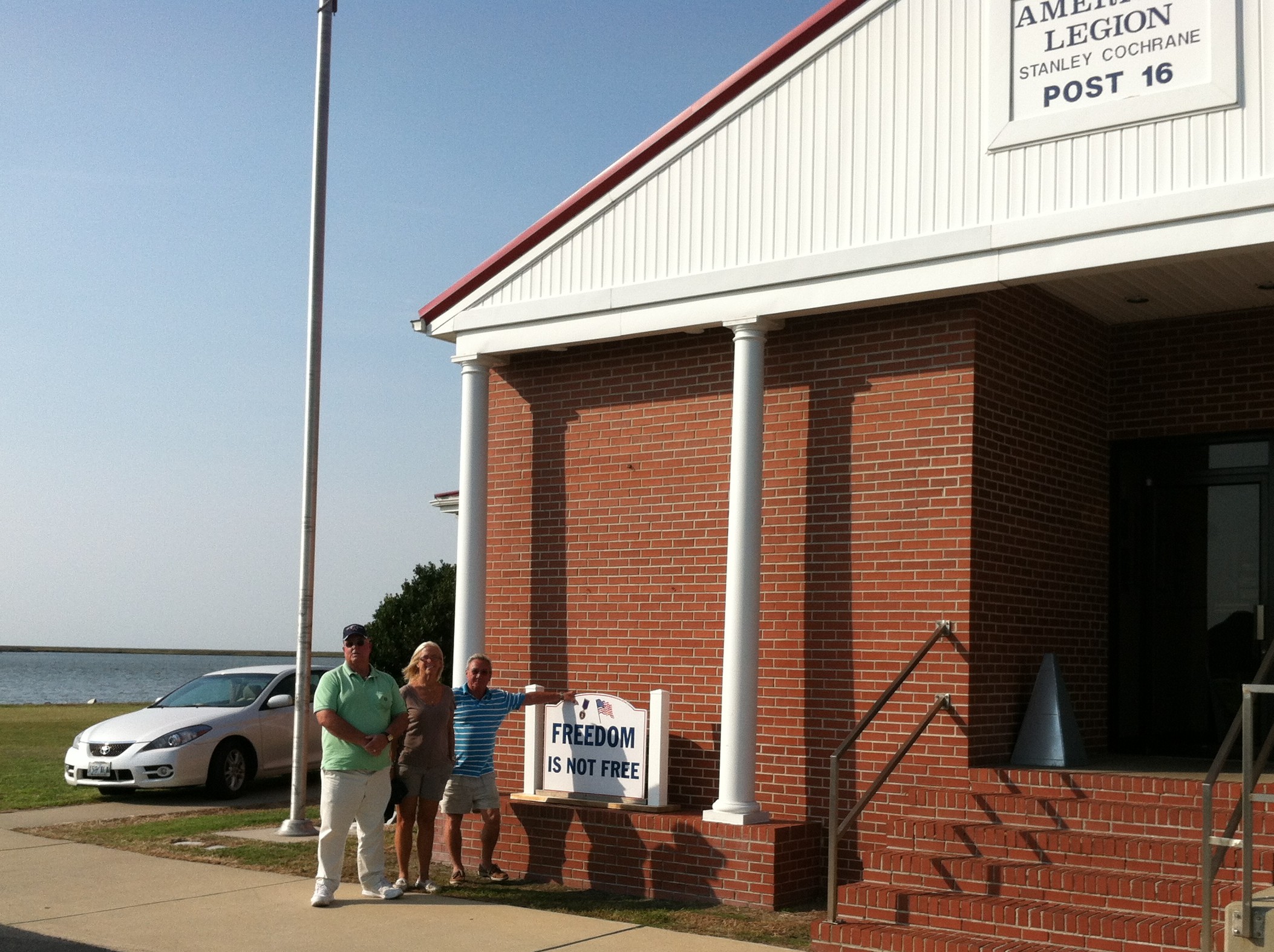
Chip, Jane and Tony pause on the way to dine at the American Legion Post on the Crisfield waterfront.

Chip, Jane and Tony pause on the way to dine at the American Legion Post on the Crisfield waterfront.

A wonderful experience, meeting Chip, getting the grand tour, dining at the Post.  But it’s a pleasure to report, based on the hospitality offered this stranger the last many weeks, not a unique experience by any means.

Does the heart good, it does.

Steadfast out.

27 September

There are six or seven 35-40-plus-foot boats anchored a quarter-mile upstream from here.  “Here” is a lovely 12-foot deep cove just nor’west of green number-five, the last marker on Mill Creek.  This Mill Creek, one of a half-dozen or so on the Bay, is off the Great Wicomico River and miles from anywhere.  It’s a couple of miles up a dusty road to the nearest crossroads, Wicomico Church.  Not town or even village, mind you.  Crossroads.  So this is fairly remote.  But then, it’s been that kind of a day, somewhat off the beaten path, so to speak.

It started, remember, in Crisfield, Maryland, at the state park that is Somers Cove Marina.  It is a huge marina with most of its hundreds of slips vacant.  Crisfield is not huge but is mostly vacant, too, since it’s raison d’etre–the crab business–is, shall we say, not what it used to be.  Neither is Crisfield. So after yesterday’s grand tour, and an afternoon spent cleaning up and drying out the boats, Patience and Steadfast shoved off this morning at 0945, out the Little Annemessex and into a decidedly more placid Tangier Sound than was the case the previous two days.

Turning south to 220 magnetic, the boats motored easily in the slick calm toward Tangier Island.  Once into the thorofare, Jane was busy snapping photos as Tony let me know what might’ve been expected of a first time visitor, “I’ve nevah seen ANYthing like this!  This is unbelievable!”
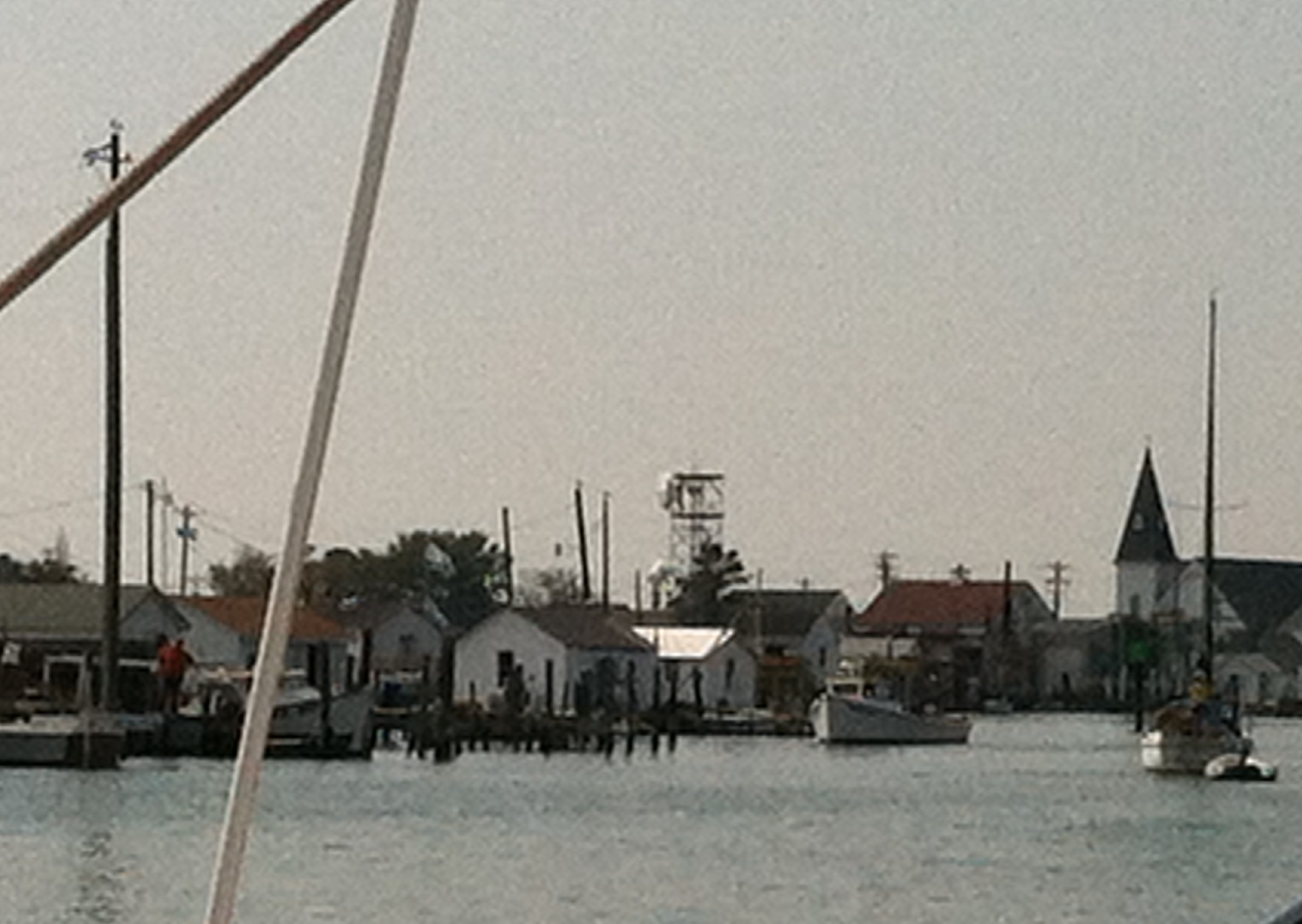
Patience glides slowly past the crab shacks that line the east channel into Tangier Island, VA.

Patience glides slowly past the crab shacks that line the east channel into Tangier Island, VA.

Passing the oil dock shortly after noon, Patience turned to port to meet Chip’s uncle Milton Parks, proprietor of Parks Marina, who then helped her tie-up and her crew get oriented to their unique surroundings.  Dinner at Chesapeake House awaits.

Steadfast, however, wants not to be tied to a pier again ’til she’s in her own slip at home.  So, waves were exchanged and she motored on through the Island’s  western entrance to cross Chesapeake Bay to the western shore.  The crossing was easy, a light southerly cooling the cockpit under the warm afternoon sun that beat down on the opened Bimini.

And so she sits quietly now in Mill Creek, another 27-nautical miles under her keel.  It’s not clear why others choose to anchor farther upstream and not here but it’s nice that they don’t.  It adds to the sense of seclusion, despite the quaint little farm on the cove’s west bank and the three homes that stand on the other shores.  This place feels far away.  Previous nights in this spot have all been pleasant and memorable, for the simplicity and solitude more than anything, and it’s expected that this night’ll be the same. Home beckons, but not for another night or two.

Steadfast out.

28 September: Odds On

Hard rain on a tin roof is a sound unlike any other, certainly any other rain.  Somehow, despite the volume and tenor, it’s a sound that soothes, comforts.

Rain falling on a fiberglass boat deck, when you’re below, is something like that.  Not an unpleasant sound at all.  That’s the rain. The lightning strikes could be done without, were there a choice, but there’s not.  You spend time on the water, you will encounter a thunderstorm.  So one assures oneself by contemplating the mathematical odds–fairly remote–of a bolt striking a sailboat mast.  Or tries to persuade oneself that lightning, a notoriously unpredictable force, will choose to strike the taller trees on shore or the taller masts of the larger boats nearby, not the inconsequential aluminum pole that serves as the mast on Steadfast.

One does that even now, as the rain falls and thunder and lightning punctuate the evening sky, and one sits a couple of feet away from the base of the mast. But then, setting off on a three-and-a-half-month sailing “adventure” to Maine, on a boat of 27-feet on deck, is not among the more reasonable undertakings a person might consider. Nor is trying to pilot said boat toward her intended destination in five knots of wind with two-foot seas on the bow, as one attempted this morning.

Steadfast was underway shortly after 0900 with NOAA’s promise of 10-to-15 knots out of the so’west, enough to move her smartly toward Indian Creek and a re-fueling stop at Chesapeake Boat Basin.  Despite the boats anchored nearby last night in Mill Creek, there was little traffic on the Bay, although it appeared the lunch whistle blew early for the Menhaden fleet.

The menhaden fleet from Reedville trolls the length of the Chesapeake Bay.

The menhaden fleet from Reedville trolls the length of the Chesapeake Bay.

Six of these left their posts just off the Great Wicomico and headed into Reedville all at the same time, their holds full, no doubt, and the Bay fishery a little less so.

The wind seemed enough to lift the boat southward, and Steadfast certainly tried her best.  But by 1100, the GPS calculated she was still ten miles from Indian Creek.  That’s after being just 7.5 NM away when she weighed anchor. Go figga. So Red was called into service yet again and performed admirably as she’s done for nearly 400 hours on this trip.  What a gal!  Patience, meantime, motor-sailed on to Broad Creek to spend the night there.

Martha and George brought Quintan up to rendezvous off Long’s Cove, across from ICYCC, and here we sit. The front now has moved on.  The rain has abated, for now, and so, of course, has the pleasant drumming on the deck along with the calculating of odds. But then, what are the odds?

Steadfast out.

01 October: Home

The hum of the refrigerator flows faintly down the hall from the kitchen, much like the sound of the compressor that keeps the icebox cold on the boat.  But there’s no rhythmic lapping of water on the bedroom walls, nor is the floor rocking slowly and steadily, side to side.

One would think those last two facts would be reassuring.  The cottage is designed to be both stable and dry.  But Saturday night, the first back home in three-and-a-half months, the stability and lack of harbor sounds made for fitful sleep, at best.  It is so good to be home, no question, but it will take a few days to re-acclimate to life ashore.

The final 15-mile-leg of the trip started early, not long after the showers ended at dawn and gave way to another dramatic sunrise, this time with Quintan anchored in the rosy glow.
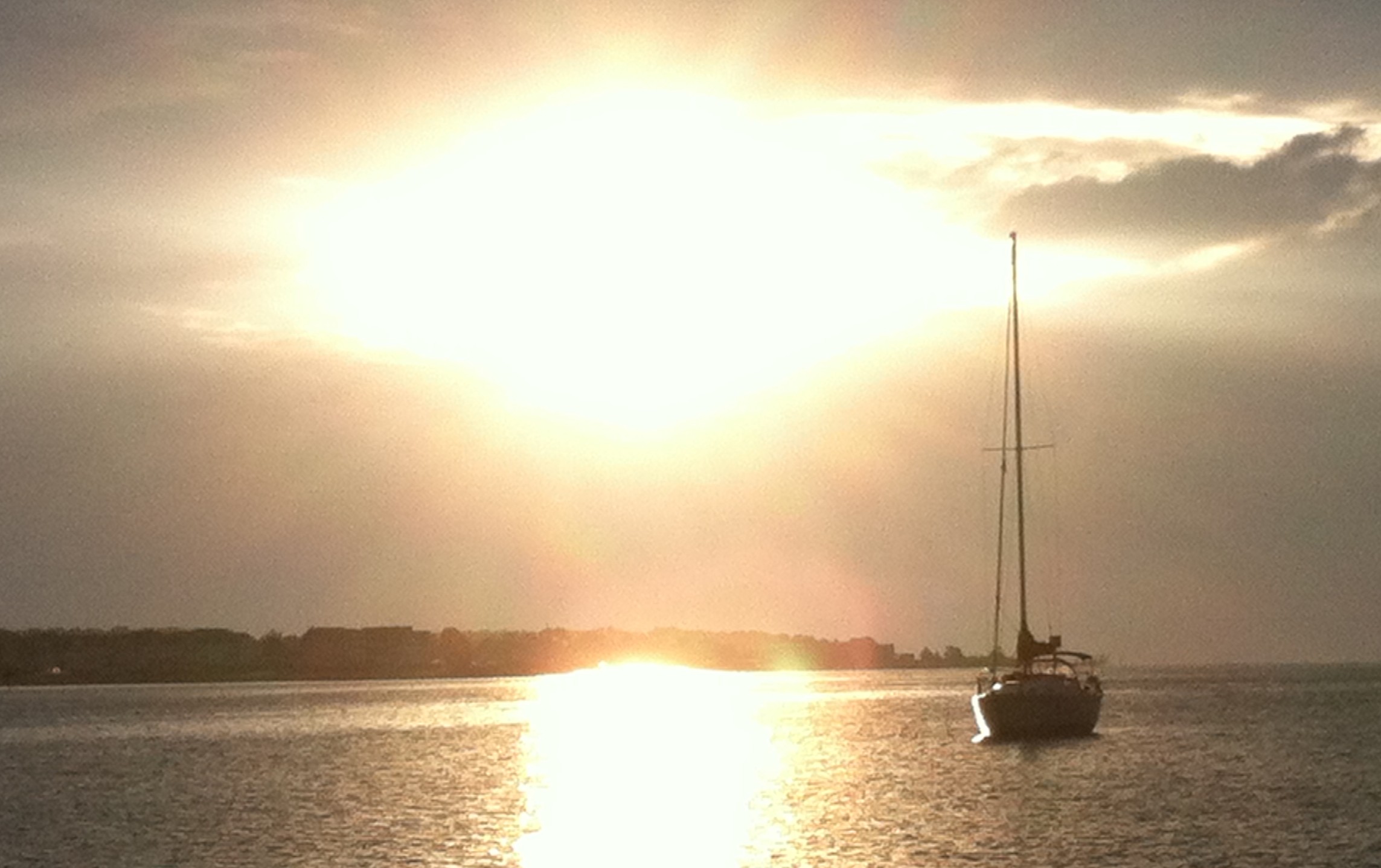
A quiet evening with the crew of Quintan was the perfect prelude to the final few miles home. Quintan lay silhouetted against the morning sun.

A quiet evening with the crew of Quintan was the perfect prelude to the final few miles home. Quintan lay silhouetted against the morning sun.

The nor’west wind, such as it was, came over the starboard quarter, offering no help for the day’s first six miles.  But once rounding Windmill Point, it was a steady ten knots, so the genny unfurled, Red took a breather and Steadfast reached across the mouth of the Rappahannock and down into Hills Bay.

It was good to finish off the cruise under sail, almost right up to the entrance markers for Queens Creek. Chris and Bill Burry brought their dinghy across the creek, Kate joined them and they buzzed down the creek, saluting Steadfast’s return with a blast from the signal horn.
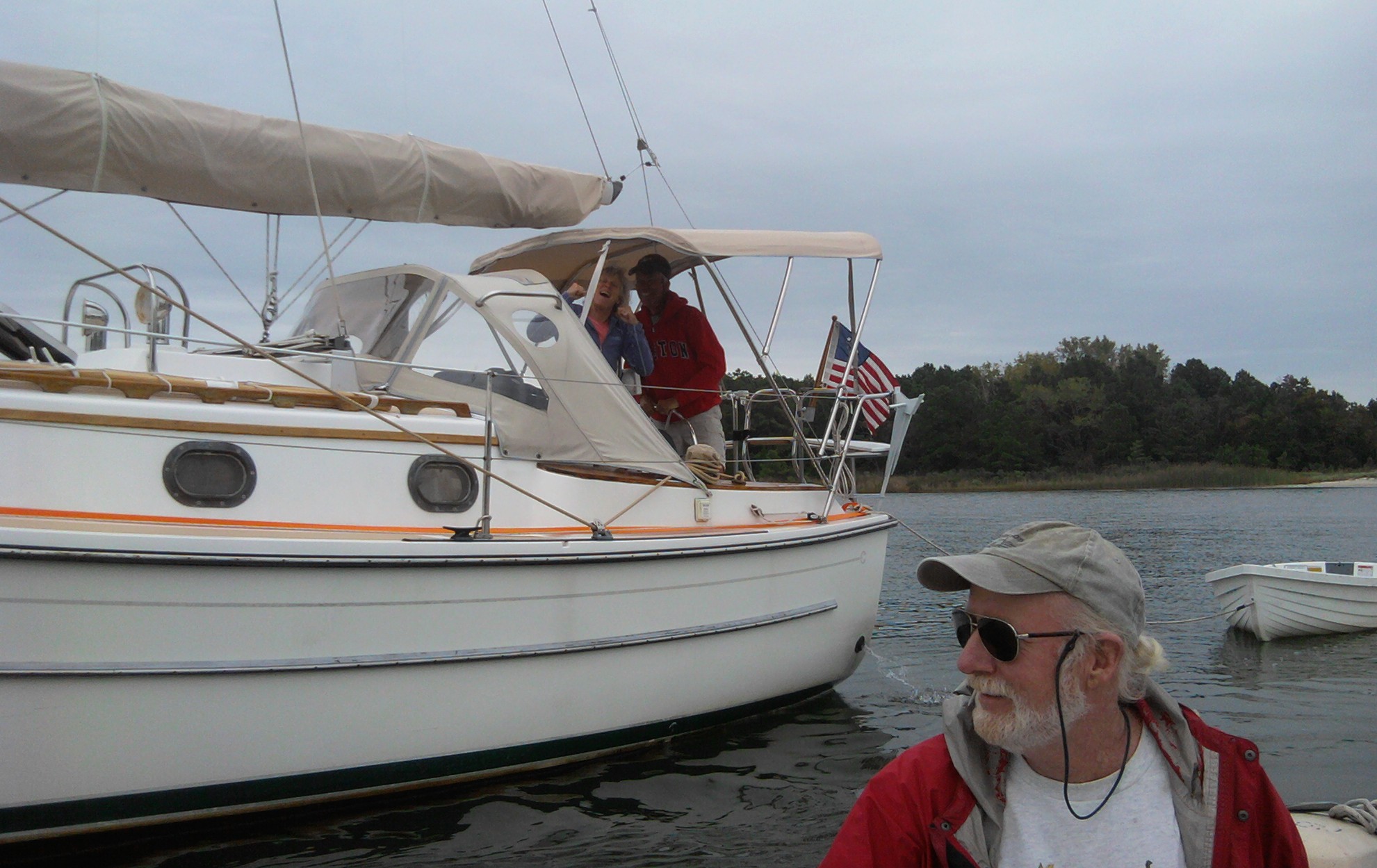
Cap'n Burry helmed Plover's dink down the creek, Chris saluted with the signal horn and Kate climbed aboard Steadfast for a welcome home!

Cap’n Burry helmed Plover’s dink down the creek, Chris saluted with the signal horn and Kate climbed aboard Steadfast for a welcome home!

Many smiles and waves all around, as you might expect, as Kate climbed aboard for the last few hundred yards and all hands helped with lines ’til Steadfast once again was secure on her own pier.

After all these past weeks and miles and places and people, there are so many thoughts and memories.  Sorting through them will take a few days, probably a good bit longer.  But one thought is clear: it’s good to be home.

Now, if I can just get used to walking again on solid ground.

Steadfast out.

Epilogue What I Learned on Summer Vacation

“So, how was it? Was it everything you expected it to be?”

The natural questions come now as the holidays bring us together, family and friends not seen in six months or more.  How does one explain to a ‘lubber, “No, it was NOT everything I expected.  It was so many things I NEVER could’ve expected!”

So your tolerance is asked with these random thoughts, none profound, few if any original:

First, you can do stuff you didn’t think you could do, but, you have to start; most of us are capable of more than we do, more than we think, even. As daunting as it may seem to cast off and leave, one quickly settles into routines on a boat; life is simplified, pared down to the basics.  The hard part is getting reacclimated to the complexities of life ashore.

Once home, one hopes to retain some of the “boat life” mindset, as in: Simple entertainments. Heightened awareness of the natural world. A keen sense of the day. Self reliance. When you’re on your own, you’re not really “on your own.”

Tom in Sandwich, Bill and the 1630 Club in Rockport, Chip in Crisfield.  There’s a long list of those who lent a hand along the way.

Perhaps the Harbormaster in Plymouth offered the best description of how it is out there, traveling up the coast.  You may remember, Steadfast was without power that evening, piloting a narrow twisting channel as the wind faded.  When advised that Steadfast would be under sail the 8 miles in, the Harbormaster came out to check, offered a tow, arranged a mooring, cautioned ferry captains to throttle back when passing.  Certainly, he deserved a statement of thanks but when it was made, his response was “That’s what we’re here for.”

Ain’t that the truth.  That’s what we’re here for, to help whoever, wherever, whenever we can.

So with that in mind, thanks go to each of you. Above all, Kate who asked “Why not?” and offered constant encouragement. Jim, with whom this wacky plan was hatched on a ride aboard Miss Ella across Blue Hill Harbor. John Schnoering whose advice went something like “Go.  I’ve never seen anyone’s epitaph that said “I wish I’d gone to more meetings.” Waddy whose “local knowledge” helped in so many ways Down East.

And Tom and Bill and David and Bob and Steve and all those whose support made all the difference.

Thank you!

Steadfast out.  ‘Til next time.
Categories: Uncategorized | Leave a comment

Southbound Currents

07 September: What would Jimmy Buffett do?

The rigging howls.  A halyard slaps unceasingly on the mast of the neighbor’s otherwise tidy 45-foot Beneteau.  That’s what happens when a southerly blows at 20-plus knots up the Hudson River at whose mouth Steadfast sits tonight.  She’s on the Jersey side, in a slip not far from the Statue of Liberty.  The thought was the train ride(s) for JB to get from here back home to Connecticut would be fairly straightforward, and, likewise for me to visit Bowe in Brooklyn. The storms brewing this morning on the western horizon only confirm the wisdom of that decision.  Whether it’s an RV park with a marina or a marina with an RV park doesn’t matter at the moment.  It’s just a relief to be secure.  The view across to lower Manhattan is a bonus.

Steadfast arrived uneventfully (always a plus) but not with as much dispatch as had been anticipated.  This leg, keep in mind, was to include the rush through Hell Gate and down the East River.  After three days idle, waiting for the weather to settle, Steadfast was itchin’ to get underway again.  JB was most gracious in opening her home as base of operations for these days in Stamford but there remained a few last minute tasks (stocking perishables and ice in the ice box, for instance).

It was 1242 by the time Steadfast cleared the Stamford breakwater, later than planned but still in time, it seemed, to ride the favorable current down the East River.  A heading of 240 would take her to the Old Hen, on the Queens side, just east of City Island.  The bimini was much appreciated as bright sun sent temperatures into the upper 80s.

For the first 15 miles, Little Red was working hard to push Steadfast at just five knots.  Finally, passing under the Throggs Neck Bridge at 1600, there was a discernible one knot boost.  Clouds began to roll in, skies darkened but there’d been no mention of rain in the forecast so Steadfast pushed on.  A so’east wind coaxed out the genny for a while and speeds moved past 6-and-a-half.  It didn’t last long–not that it’d be needed–since rounding Lawrence Point to port put the wind dead ahead.  That’s when the current took over.

Once into the East River, speed through the water fell to just 3.5; speed over ground was more than 7!  The turbulence increased, too, and not just from the passing ship, tug, motor yacht and Police boat traffic.  Swirling eddies tried to exert their will on Steadfast, briefly changing her heading first one way, then another.  And the now strong southerly blowing up river against the ebb current pushed up a four-foot chop.  All the same, the speed over the bottom kept climbing – 8.3, 8.8 and then approaching Hell Gate, into the 9s.

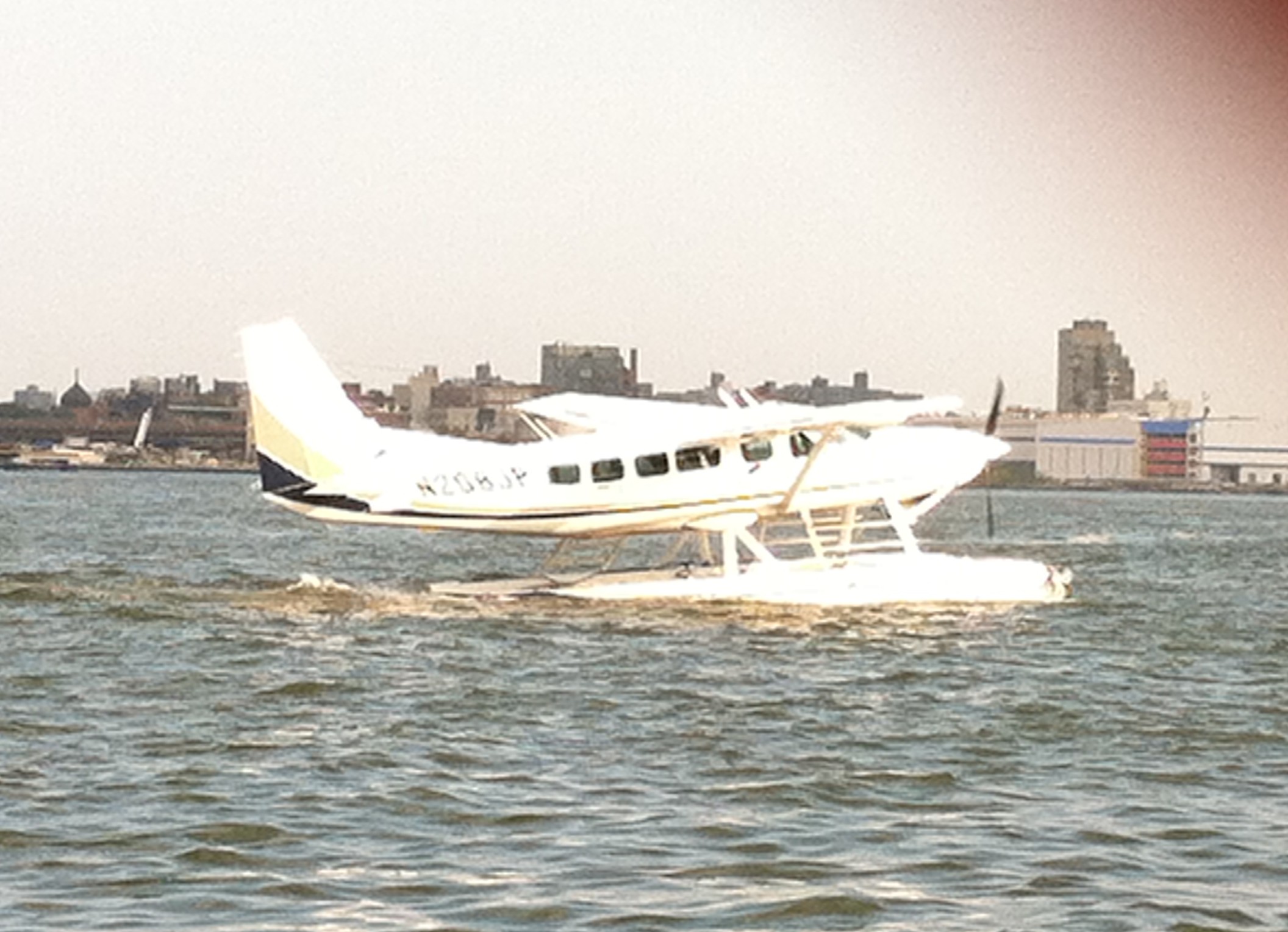
Those speeds held down past Roosevelt Island and the UN.  A quick glance to starboard and there was the Chrysler Building, then the Empire State.  Right about there, with boat traffic of all kinds around, the sound of a loud engine grew to a roar as the sponsons of a seaplane plowed into the waves about 100 yards to port!

It's easy to ignore the seaplane port on the Lower East Side until one sets down a hundred yards off the port quarter!

It’s easy to ignore the seaplane port on the Lower East Side until one sets down a hundred yards off the port quarter!

It was hard to see the pilot through the glass. It might’ve been Joe Merchant, who knows?  At a moment like this, I can’t help but wonder, what would Jimmy Buffet do…after he changed his shorts, that is.

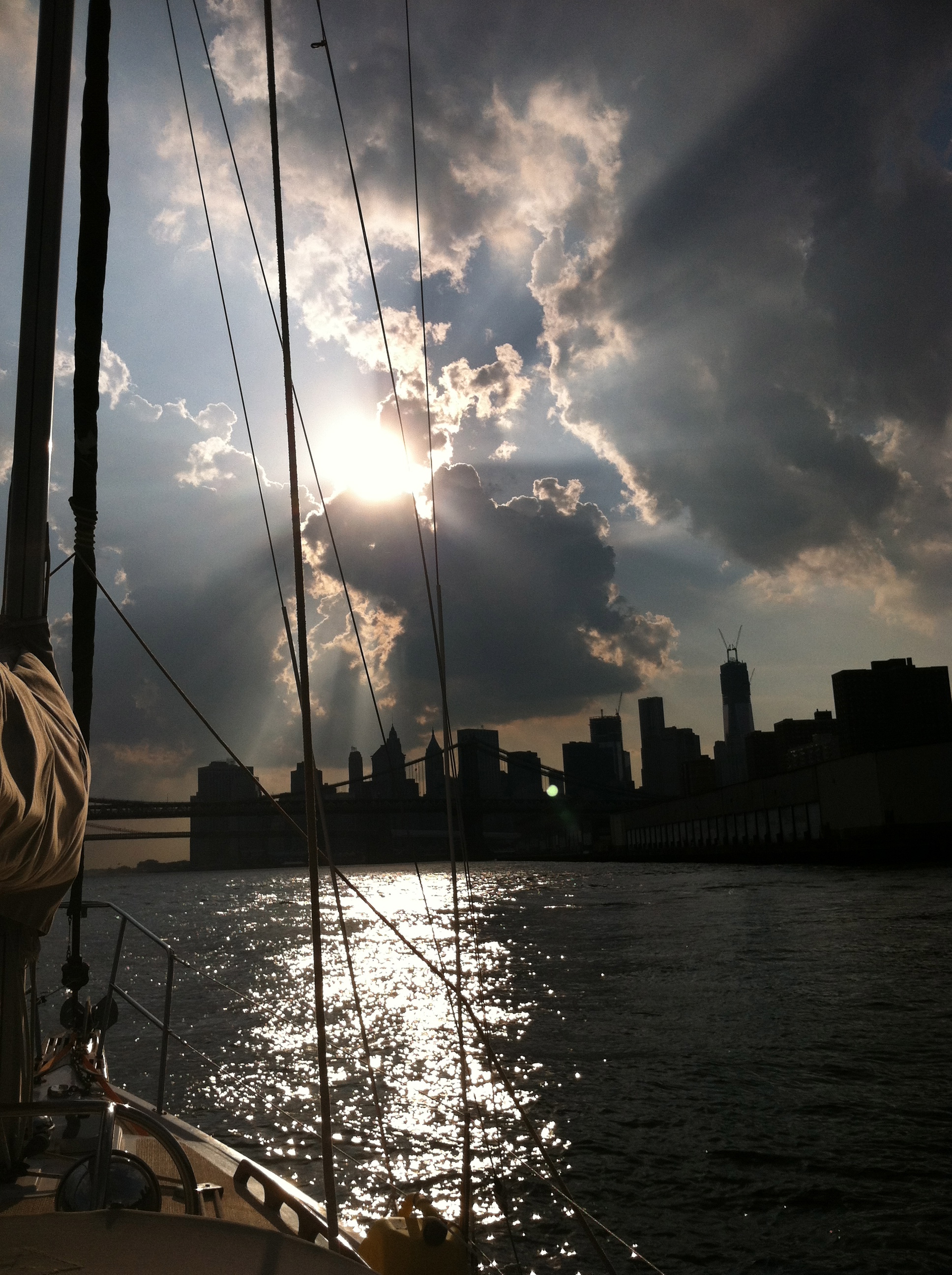
A passing front shielded the setting sun for a dramatic close to the trip down the East River.

A passing front shielded the setting sun for a dramatic close to the trip down the East River.

Despite threatening clouds and the occasional spritz, it had now become apparent that as long as Red kept up her steady thrum, Steadfast would make Jersey City before dark.  And she did!  Rounding The Battery, at Manhattan’s southern tip, the ferry traffic multiplied–it was rush hour, after all–and the speed quickly dropped.  Other than dodging the Staten Island ferries and the high speed ferries from who-knows-where, it was a straight shot across the mouth of the Hudson, past the big “Colgate” at the water’s edge and into Morris Canal.

Once tied up, Jimmy’s voice could be heard telling his tales at the Surf City Megabar looming over the pier.  Dogfish IPA proved a more than worthy substitute for Landshark and the toast was raised to Steadfast, her crew and another successful 34 mile leg on her way home.

Steadfast out.

09 September: Another Island

“Good morning, Captain.  Where ya headed?”

The question is shouted across from the helm of a Coast Guard boat patrolling the entrance of Morris Channel.  Once assured that Steadfast is headed to Staten Island, he nods.

“That’ll be fine.  Just take a right and follow the Jersey shore.”

Simple enough, as simple as any attempt to pilot New York Harbor can be.  This day, for instance, Coast Guard, NYPD and fire boats are on patrol directing vessel traffic away from the area off The Battery.  It’s closed ’til after 1500 for a J-24 regatta.  This causes some inconvenience for those transiting between the Hudson and East Rivers, their irritation apparent on the marine radio.

Steadfast, however, is taking this warm Sunday morning to slide south.  After tending to Little Red, coiling the power cord, walking the key to the office and other routine tasks, it was 1057 by the time Steadfast backed away from the pier at Liberty Harbor Marina & RV Park.

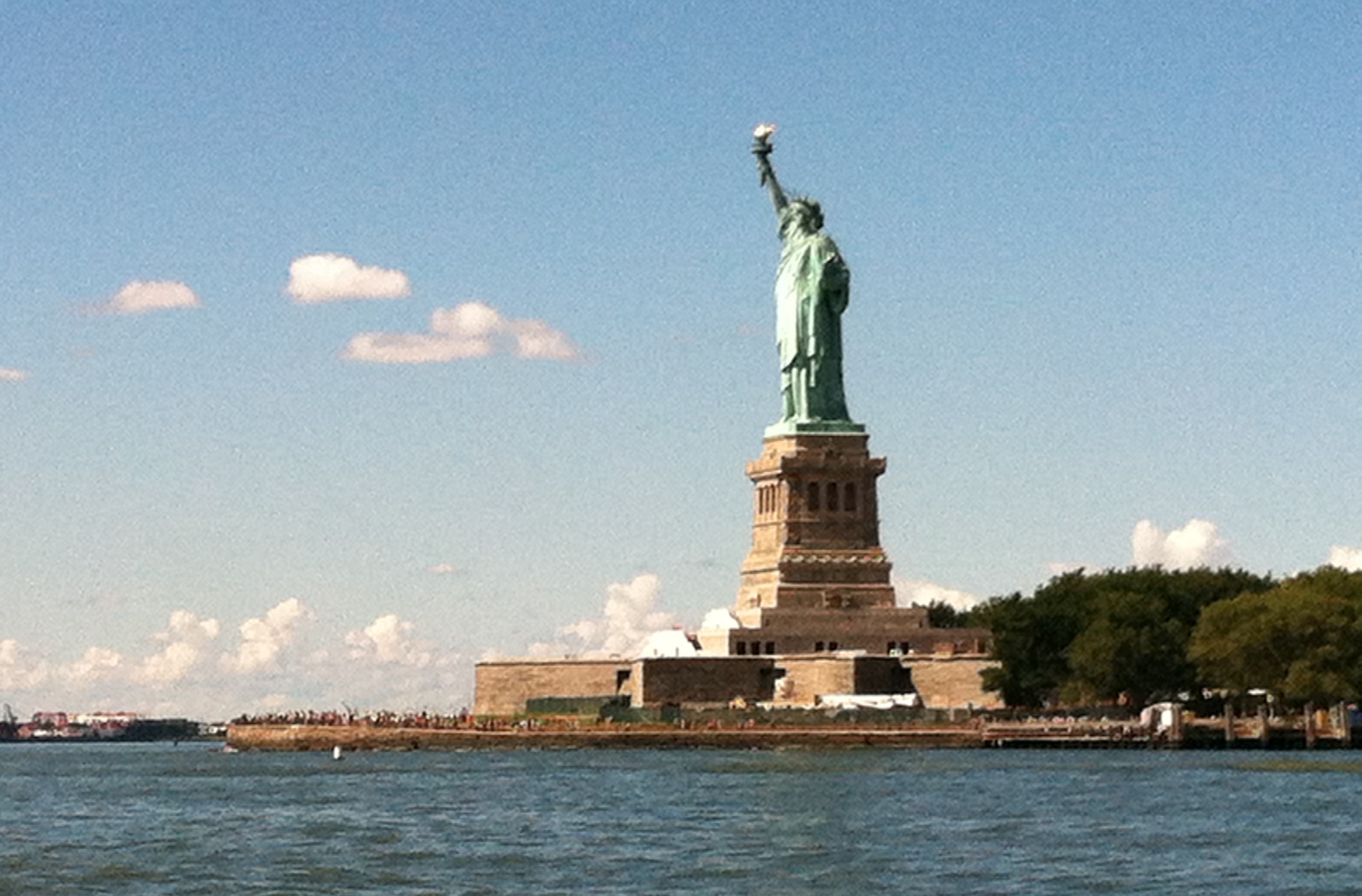
Morris Canal is just about a half-mile north of Ellis Island.  As familiar as the image may be, it is difficult not to pause when passing the small island to its south.

The image may be familiar but seeing her up close, she is impressive, nonetheless.

Don’t pause long, though.  While waves on the Upper Bay were barely a foot, the steady flow of ferries, tour boats and tugs keep the waters churning.  Ships, yachts, fishing boats and, this day, the patrol boats make vigilance the by word.

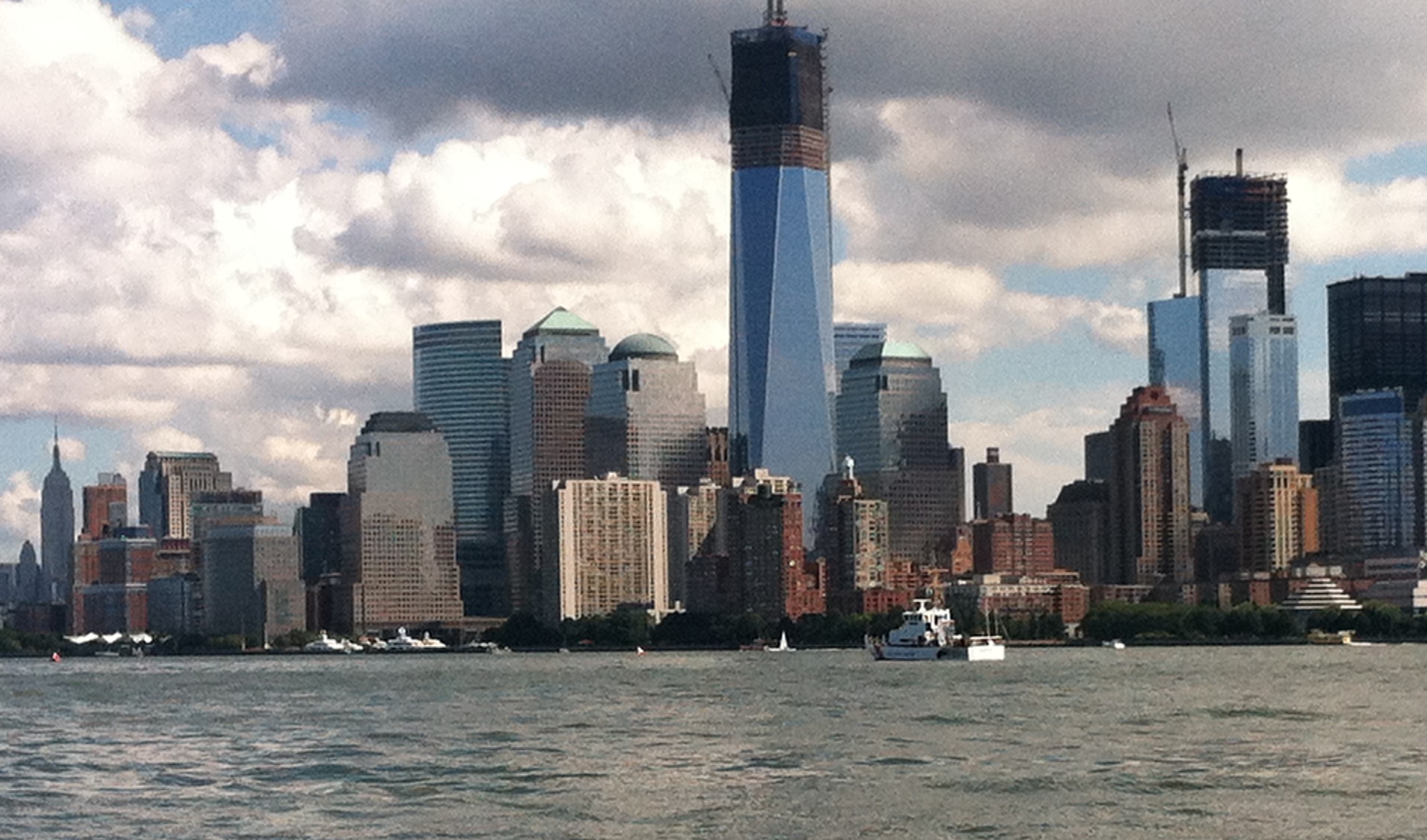
Still rising to its full 1,776 feet, the Super Tower at Ground Zero was easy to spot heading south from Jersey City.

Still rising to its full 1,776 feet, the Super Tower at Ground Zero was easy to spot heading south from Jersey City.

Once under the Verrazano-Narrows Bridge, the waters of the Lower Bay are wide open, flat and quiet, a striking contrast with the hectic pace just a few miles to the north.

At 69-feet, it’s easy to spot the West Bank Light.  From there, the heading shifts from 200 to 270, due west to the entrance to Staten Island’s Great Kills Harbor.  A narrow channel opens to a harbor less than a mile long and roughly a half-mile wide.  There’s plenty of depth, plenty of room to anchor and there’s shelter from wind and seas in every direction.  Bill, driving the launch for Richmond County Yacht Club, says this is “The best kept secret in New Yawk City.  It’s two-fifty fa da bus to da ferry, then da ferry’s free.  Ya can’t beat it!”

Simple, too.  A welcome respite before heading down the Jersey coast.

Steadfast, out.

10 September: Harbinger of Fall

The experience of being underway in a small boat for an extended period provides the opportunity for many lessons.  For instance, you may not have tried yet but, take it from one who knows, when you hang towels outside in sun and 30 knots of wind, they will dry quickly and smell fresh when you take them in!  That is, assuming the towels are still there to be taken in.

Bill, the retired New York cop who now drives the launch at Richmond County Yacht Club,  saw the blast of northerly wind as “a hint of fall in the air.”  Hardly.  More like getting hit with a club!

NOAA had posted a small craft advisory for Monday and it’s forecast was spot on: northwest at 15 to 20 knots, gusting to 30.  Battalions of thick clouds marched in step across an otherwise blue sky, as if led by John Phillip Sousa and the Marine Band playing “Stars and Stripes Forever.”

Though pinned down by a persistent northerly, Steadfast was well protected in Great Kill Harbor.

Though pinned down by a persistent northerly, Steadfast was well protected in Great Kill Harbor.

Below, the boats on Great Kills Harbor were listening to the Glenn Miller Orchestra.  They were “In the Mood” to swing, first one way, then the other.  Steadfast took the lead, in her little fox trot, and the dinghy followed.

It went on that way, all day and into the night.  It was, in other words, a good day to stay in harbor.  The following day, nine-eleven, too.  A similar forecast gave the opportunity to try the Staten Island ferry for a quick run into Manhattan for the day.  It turned out to be much warmer than forecast, as long as the sun was high in the sky.

Once the sun closed on the horizon, that “hint of fall” was in the air once again, wind or no.

Steadfast out.

12 September

“Hey, Cap’n!  Come in this way,” the instruction yelled out into Manasquan Inlet from the fuel dock at Hoffman’s Marina. Mike, the dockmaster, moved one arm  in horizontal circles suggesting Steadfast lay her port side to the pier.  Fenders and lines already were on the starboard side, but he insisted.

“It’ll be betta faw ya this way.  Thaihs a strawng curren trunnin in heeya.”

That’s typical with the inlets on the Jersey shore, the current running two, three or more knots with the tide, ebb or flood.  Of little concern to the 30, 40 and 50-foot power boats that are the vessel of choice here but a big deal to Little Red and her 18 horses.  On this Wednesday evening, near closing time at Hoffman’s fuel dock, Steadfast was “on time” with the tide running in.  She ripped through the inlet hitting a surf-and-tide-assisted 7-plus knots.  And Mike and his crew, of course, were correct about tying up port-side to the pier.

Manasquan is about the only navigable inlet for the 80-miles between Sandy Hook and Atlantic City.  That entire run can be made in daylight during June but not in September, so Manasquan becomes an important stop over for boats bound for the Chesapeake and beyond.  Hoffman’s is a first-class operation bisected by the Conrail tracks that cross the inlet on a bascule bridge that’s just 13-feet off the water when it’s closed.

Bells ring whenever the railroad bridge lowers for the frequent commuter trains that cross the Manasquan Inlet.

The siren sounds whenever the railroad bridge lowers for the frequent commuter trains that cross the Manasquan Inlet.

The bridge closes only when a train approaches.  That’s the good news.  Less pleasant is the realization that the commuter trains are frequent and, as is appropriate, a warning siren sounds whenever the bridgetender readies to open or close.  A loud siren.  Throughout the night.  Steadfast tied up about 70-feet upstream from this bridge.

But that’s okay!  Manasquan has all the appearances of a charming New England seaside town and, as noted above, has the added attribute of being a convenient and safe stop over between Sandy Hook and Atlantic City.  The run south from Great Kills Harbor had been straightforward, Steadfast laying a mile or two offshore, moving easily over the Atlantic swells at close to 6 knots while Red chugged along at her usual 2200RPM.  By midafternoon,  off Asbury Park, the southerly wind had built to around 10 or 12 knots, pushing up a chop that sent spray over the bows.  So when, after more than 34 nautical miles and six hours underway, Manasquan Inlet came into view at 1650, it was a welcome sight.

(to be continued)

13 September

Mike the Dockmaster wasn’t kidding about the strong current in Manasquan Inlet.  The water gurgled and slurped around the hull and the pilings of the pier ’til slack water, took about an hour break, then started to flood in, gurgling in the opposite direction, the sound of a round-the-clock fountain.

Slack tide came just before the sun was due to rise over New Jersey’s shore.   There was enough light, though, to cast off from Hoffman’s pier and move, with a half-dozen other boats of various sizes and designs, toward the actual Manasquan Inlet.  The Catalina 27 Patience, homeport Fairhaven, MA, motored under the bridge and into the tangerine sun just ahead of Steadfast.

Patience leads the way under the Manasquan (NJ) bridge for an early start into the Atlantic.

Patience leads the way under the Manasquan (NJ) bridge for an early start into the Atlantic.

A lovely start to what would be the longer run down the Jersey shore, nearly 54 nautical miles, meaning roughly ten hours underway.  But then there’s that current-thing: a knot or knot-and-a-half push from a favorable could cut the time of the trip by about 20-percent.

It did appear to be just about ideal conditions for motoring – sunny, clear, 70s with little wind and virtually flat seas.  Then to confirm expectations, the sailors’ companion, the porpoise, appeared in numbers, dozens dancing and playing in the swells just off to starboard almost as soon as Steadfast cleared the breakwater and turned to a heading of 205 magnetic.

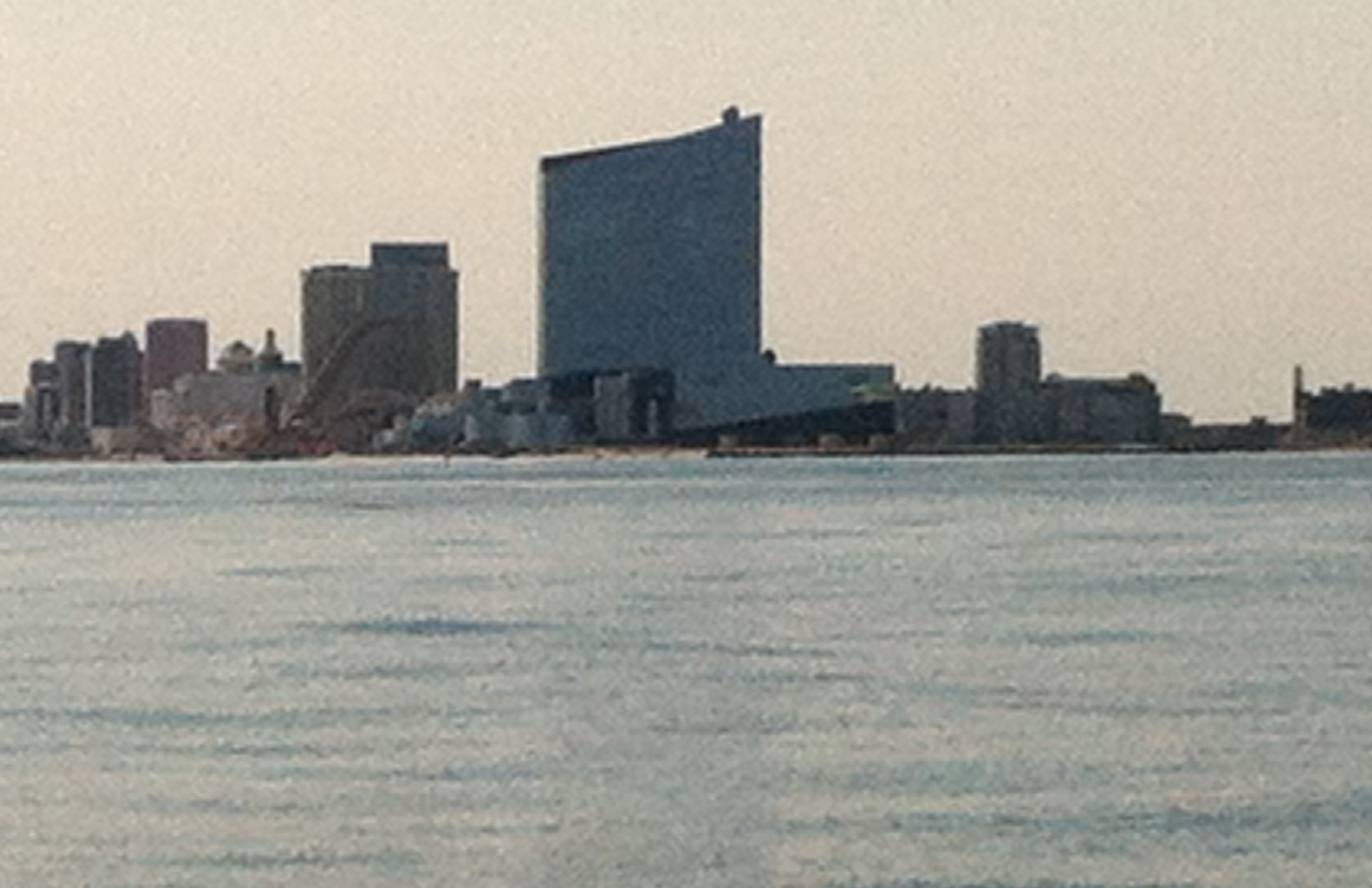
The hoped-for knot-and-a-half current kicked in to boost speeds to near six over the bottom.  The inlets appeared in sequence off to the west – Barnegat, Beach Haven, Little Egg, Brigantine and finally Absecon, the inlet to Atlantic City.  For the last thirty miles or so, maintaining the proper heading was fairly easy – just aim for the enormous slate gray monolith that looms on the horizon, the $2.4-billion Revel casino that now guards the Boardwalk.  And yes, even on a hazy day, it can be seen from 30-miles away.

A new ocean-front casino towers over the boardwalk, making it easy to steer to Atlantic City.

The then-new Revel ocean-front casino towers over the boardwalk, making it easy to steer to Atlantic City.

There’s much less traffic on the water on a weekday in mid-September than a weekend in June.  That means the Absecon Inlet waters are far more docile, even riding the flood tide into Clam Creek.  Once at the creek entrance, a turn to port put Steadfast — and Patience — on the pier at Historic Gardiner’s Basin, without question the best value in Atlantic City: 25-bucks a night versus $4-a-foot at the state-owned piers across the way.

Another gorgeous day followed for the relatively short 37-mile run south to Cape May, again motoring all the way.  Then a weekend in port to tend to Red, re-provision and other tasks to get Steadfast ready for the last big hurdle on the way home: Delaware Bay and the Chesapeake & Delaware Canal, and the promise of yet more “current events.”

Steadfast out.

18 September: Anticipation

The marine VHF radio screeches like a startled heron, then screeches at a higher frequency, a signal that shrieks through the cabin.  It does its job.  It gets your attention.

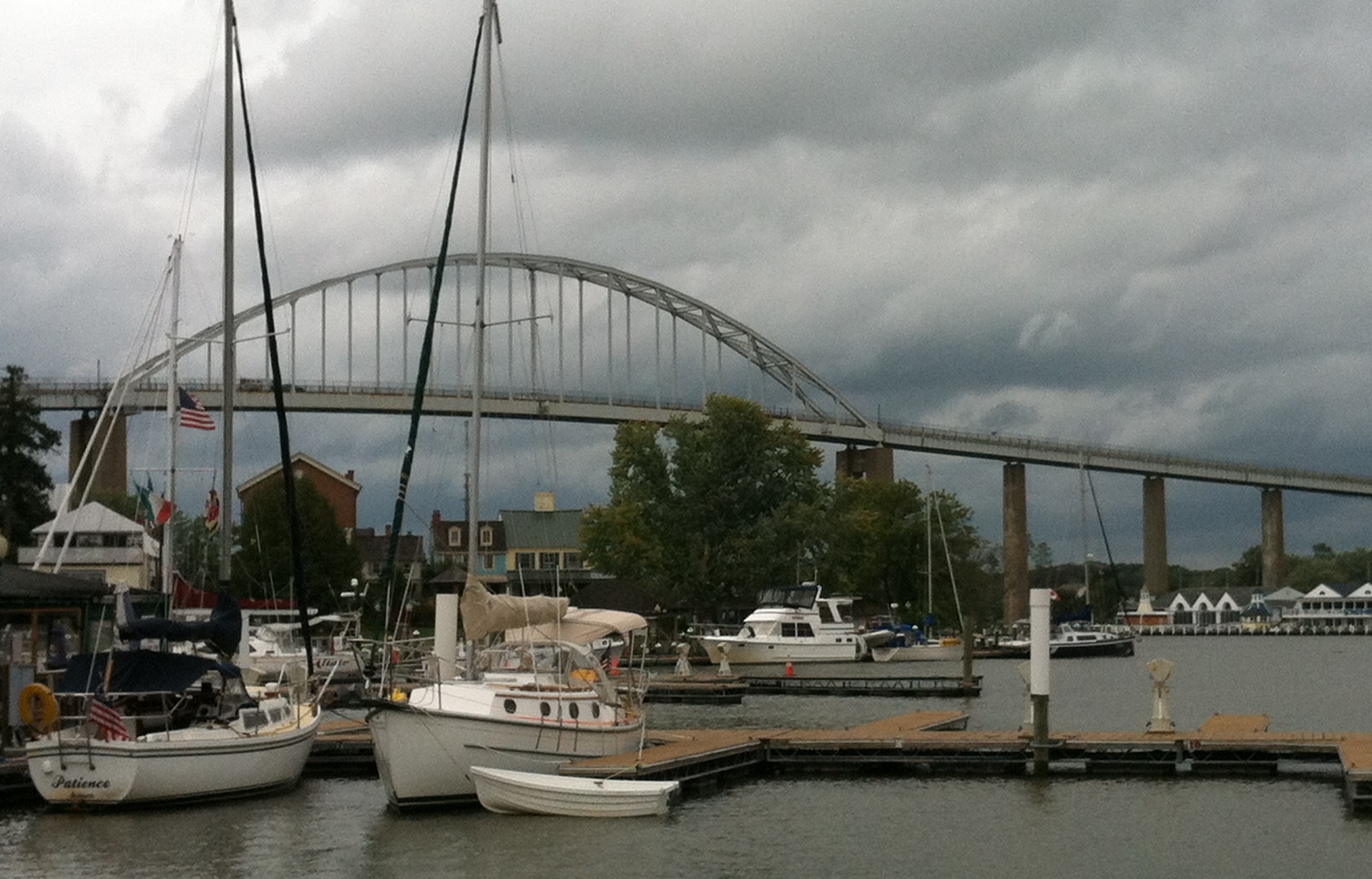
“The National Weather Service has issued a severe thunderstorm warning…”  The digitally-generated voice adds that a tornado watch exists for the same areas of Maryland and northern Delaware, areas bisected by the Chesapeake and Delaware (C&D) Canal.  That happens to include the pier where Steadfast lies this day, tied securely (one hopes!) in the snug boat basin about three-quarters of the way through the canal.

There's not much room to anchor but with dockage on both sides of the canal, Chesapeake City is a good place to wait out the weather.

There’s not much room to anchor but with dockage on both sides of the canal, Chesapeake City is a good place to wait out the weather.

At the same time, dark clouds race eastward over Chesapeake City.  Thirty knot gusts roar through the rigging, the boat rocks and docklines squeak.  They also cause skippers and crews to gather on the pier, swapping some tales but mostly just waiting.  Waiting to see how much more the weather may have in store.

All this is in stark contrast to the benign conditions that prevailed yesterday on the passage up Delaware Bay.

Kate had surprised, suggesting she drive up to Cape May for the weekend to spend a couple of nights on board.  The timing couldn’t have been better.  There was a lot to do to get Steadfast ready for the final legs of the trip and, of course, being in Kate’s company buoyed your correspondent’s spirits to be ready, too.  Delaware Bay is a big day in the best of conditions and can be a bear in weather.

But the forecast looked good for Monday and the flood tide would provide a boost, assuming the boat was there to meet it.  So Kate helped cast off the lines at 0600 and Steadfast motored off into the still dark Cape May Canal in concert with Jane and Tony aboard Patience.  The two boats sailed serendipitously at the same time from Manasquan, remember, and have continued in tandem since.  When you’re alone on 27-feet of deck, it is of great comfort knowing another crew is traveling nearby at the same pace and able to lend a hand, if needed.

With flat water and a favorable current boosting speed to 7+, the trip up Delaware Bay was all "down-hill."

With flat water and a favorable current boosting speed to 7+, the trip up Delaware Bay was all “down-hill.”

The boat’s actual speed in the canal waters was less than 4 knots but tidal current boosted the velocity to more than seven (7!).  What a great start.  The bay was all but flat with a light northerly that clocked later to the south.  Once through the western breakwater and turning to the nor’west, the speed- made-good continued to be north of six all day.  An early haze lifted under what became a bright sunny day.

There was a good bit of company for a while from bigger, faster yachts heading for the C&D, including Queens Creek neighbors Chris and Bill aboard their ketch, Plover.  Tankers, container ships, tugs and barges completed the procession.  A sharp watch was maintained and Steadfast was well out of the way of the latter group at all times.

The current lost some of its oomph just as Steadfast approached the entrance to the C&D but then, as soon as she passed green #1, she was on her way again at bottom speeds at or above 7 for most of the roughly 14 nautical miles she transited yesterday (another five or so remain for tomorrow).

Now, at the pier at Chesapeake Inn & Marina, the total 62.2 NM seem like a blur.  Of the entire cruise, only the June leg up the Jersey shore–some ninety miles–has been longer.

Home waters await, the Chesapeake Bay just an hour or so west.  Tomorrow.  Right behind the weather.

Steadfast out.

Categories: Uncategorized | Leave a comment

On Alone

29 August: Can’t Beat the Price

“Naw, naw, naw.  Don’t go to Manchesta.  Theyah’s nuthin’ theyah, Bill!”  The speaker is none other than Cap’n Bill Lee.  You remember Bill: presiding officer of the 1630 Club and Rockport’s resident expert in all things nautical.  “Just pick up a moorin’ at Thatcher Eye-len.  Theyah free, ya know.”

Bill has pulled his Ocean Reporter alongside to refuel Steadfast.  (There  being no fuel dock in Rockport, this is one more reason Bill is a popular guy on the harbor.)  He then proceeds to pull up Cape Ann and Thatcher Island on the chartplotter in OR’s wheelhouse, pointing out the moorings.  In answer to the question posed cautiously, he responds.

“Oh, yeah!  They-ahs plentya wawtah in theyah!  Look – 8, 12, 13 feet.  You kin get in theyah easy with yaw boat!”

True.  The trick, with an unforgiving rock bottom, is to be sure to find the “8, 12, 13-feet” and not the granite lurking just below the surface.  But, it would shave off a couple of miles from the trip to Manchester–don’t tell Bill–to go through that narrow passage instead of going all the way around Thatcher.  So, buoyed by the experiences of the last few days in Maine, Steadfast leaves Rockport at 1112, rounds the northern tip of Cape Ann and bends around the shoal to 210 degrees to make the passage Bill described.

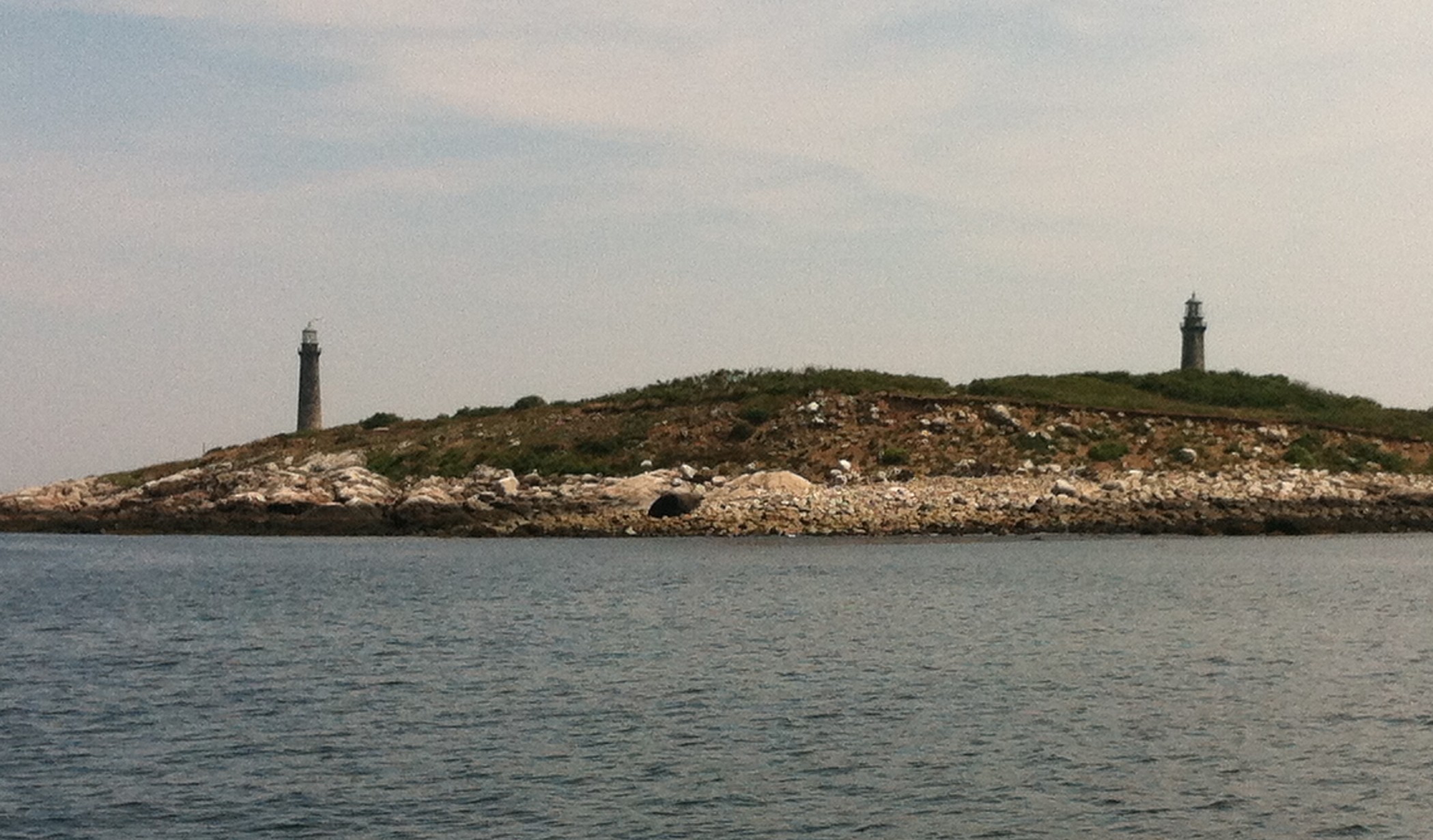
Identical twin lights leave no mistake that this is Thatcher Island.

Identical twin lights leave no mistake that this is Thatcher Island.

Closing on Thatcher, the depth sounder reads 68, 72, 68…then 16, as in feet.  After readings in the hundreds through much of the coast, 16 feels slim even though it’s more than four-times the depth Steadfast needs to safely clear.

This passage affords a unique perspective on what may be a unique arrangement of two (2) lighthouses on a single small island.  The reason for the decision to build oh-so-long-ago awaits a future conversation with Cap’n Bill.

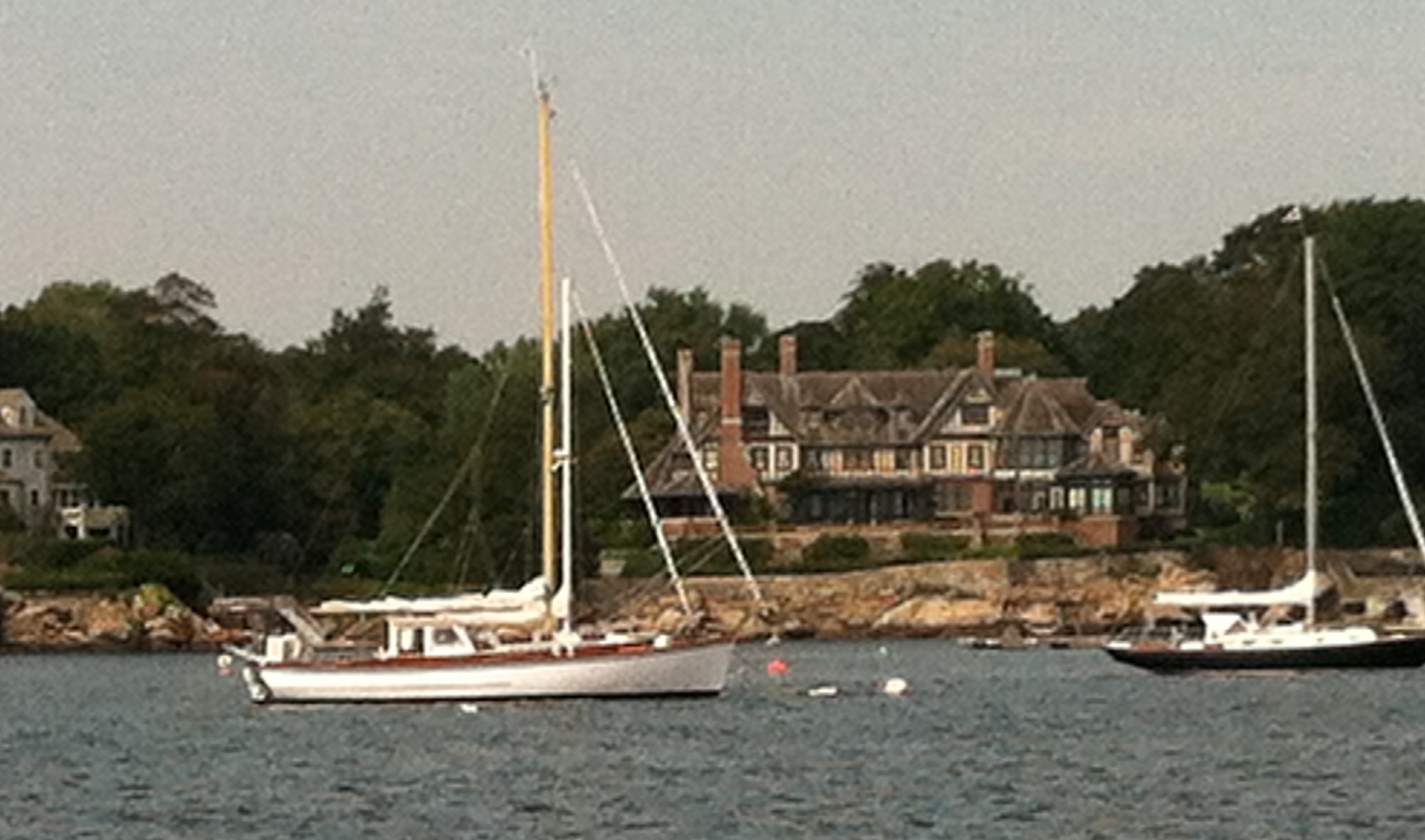
Sails deployed, Steadfast runs wing-and-wing before a light northerly, hugging Cape Ann closely enough to hear the surf crashing on the rocky shore.  Rounding Eastern Point, she passes the entrance to Gloucester harbor and turns due north for the channel into Manchester-by-the-Sea.  It’s a short day–just 15.5 nautical miles–but another in a string of beautifully sunny days capped by arrival at a long, narrow and equally stunning harbor.  The homes that line the banks of Manchester harbor rival those along Ocean Drive in Newport!  Architecture, landscaping, each a gorgeous waterfront estate.

Gorgeous homes line a snug harbor filled with classic yachts at Manchester-by-the-Sea, MA.

Gorgeous homes line a snug harbor filled with classic yachts at Manchester-by-the-Sea, MA.

And then there’s Manchester Yacht Club, whose launch driver explains, “Well, one night or two, doesn’t matter.  We have plenty of moorings so the club stopped charging.  It’s free.”

Just like Thatcher Island, but…15 miles closer to Hallieford.

Steadfast, out.

28 August: Whale of a City

“Call me Ishmael.”  Well, not me, you understand.  It’s just that, standing on the pier in New Bedford, it’s hard not to think of Ishmael, Ahab, Moby Dick and Melville.  This, after all, once was the “whaling capital of the world” and remains one of the major fishing ports in the country.

There was little notable about the two days before Steadfast’s arrival in New Bedford, and there’s nothing wrong with that!  “Uneventful” makes for a good day on the water.  There was a straightforward hold the wheel at 200-degrees for the 25-miles from Manchester to Scituate; followed by a bit longer leg past Plymouth and on to Sandwich at the east end of the Cape Cod Canal.  Then the fun started!

“Be advised, captain.”  The voice on the VHF was that of Canal Control.  Note that it is never good to be the person to whom the words “be advised, captain” are addressed.  “The speed limit in the Cape Cod Canal is 10-miles-an-hour.  That is 8 knots.  Slow down and watch your wake!”

When your vessel is a small, slow moving, relatively under-powered sailboat, it is of some comfort to know Canal Control is watching to make sure big boats behave themselves.  So after a quick stop at the fuel dock in Sandwich–it doesn’t take long to load five gallons–Steadfast nosed her way out into the canal and immediately went from motoring at 4.5 knots to 7.5.  No change in engine RPM, understand.  It’s all in the ebb current that had begun about an hour earlier.

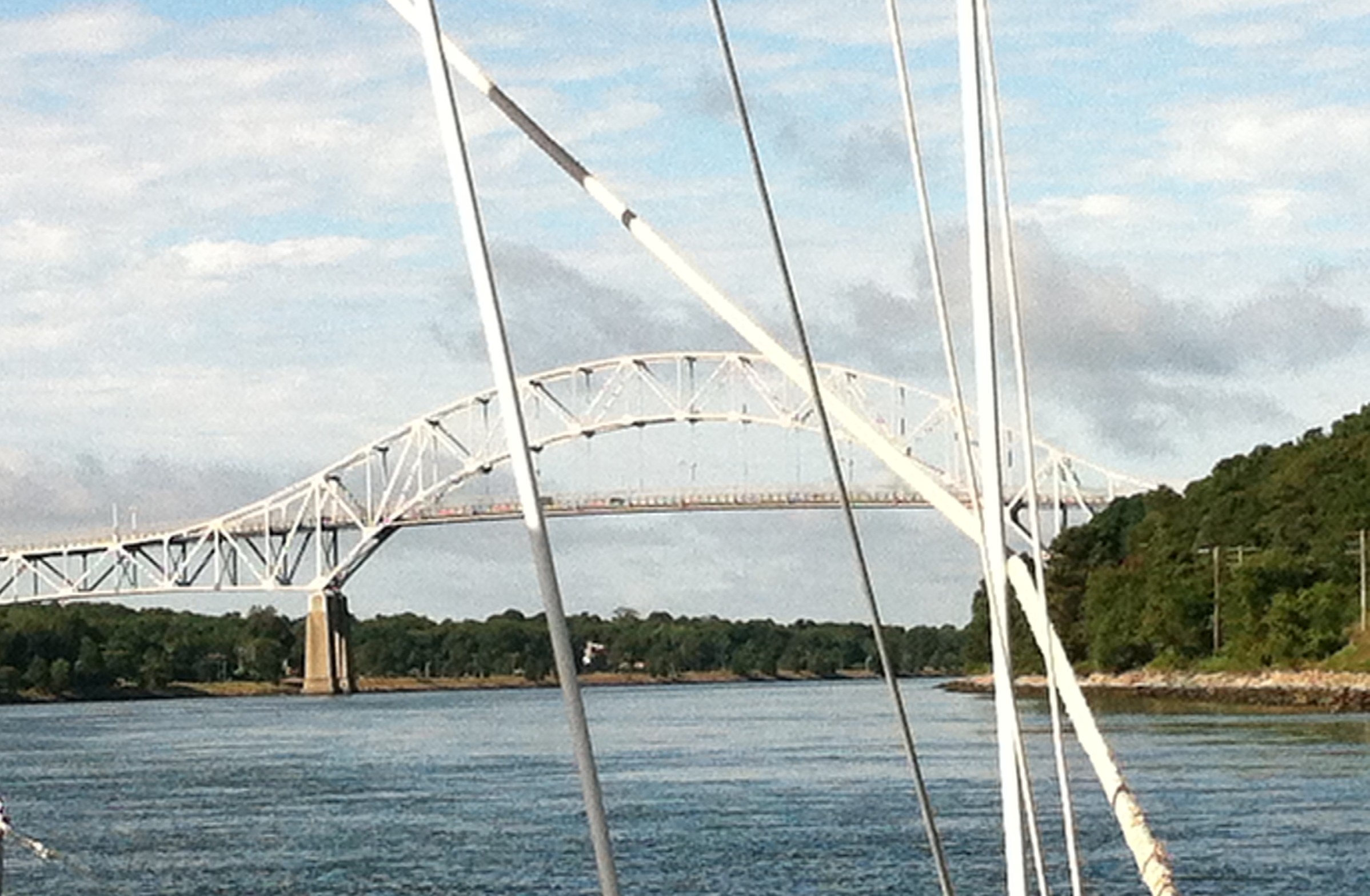
One of three bridges that pass quickly when the current's astern through the Cape Cod Canal.

The Bourne Bridge is one of three spans that pass quickly when the current’s astern through the Cape Cod Canal.

But wait – it gets better.  When Steadfast reached the point where the current was greatest, she was moving over the bottom at better than 9-knots!  Speed through the water–what Control monitors–was still just 4.5.  But she was on a sleigh ride through all the swirls and eddies.  Even through the 3-foot chop that built at the west end, under the railroad bridge, that speed held at plus-9.

It was good to see the sights along and over the canal banks, sights that were missed in the clouds and rain that punctuated the first trip through.  This day, it was sunny and, once through the canal, a so’westerly wind coaxed the sails to be unfurled and Steadfast tacked down Buzzards Bay, turned to starboard at West Island and into the five-mile channel to the busy New Bedford Harbor.

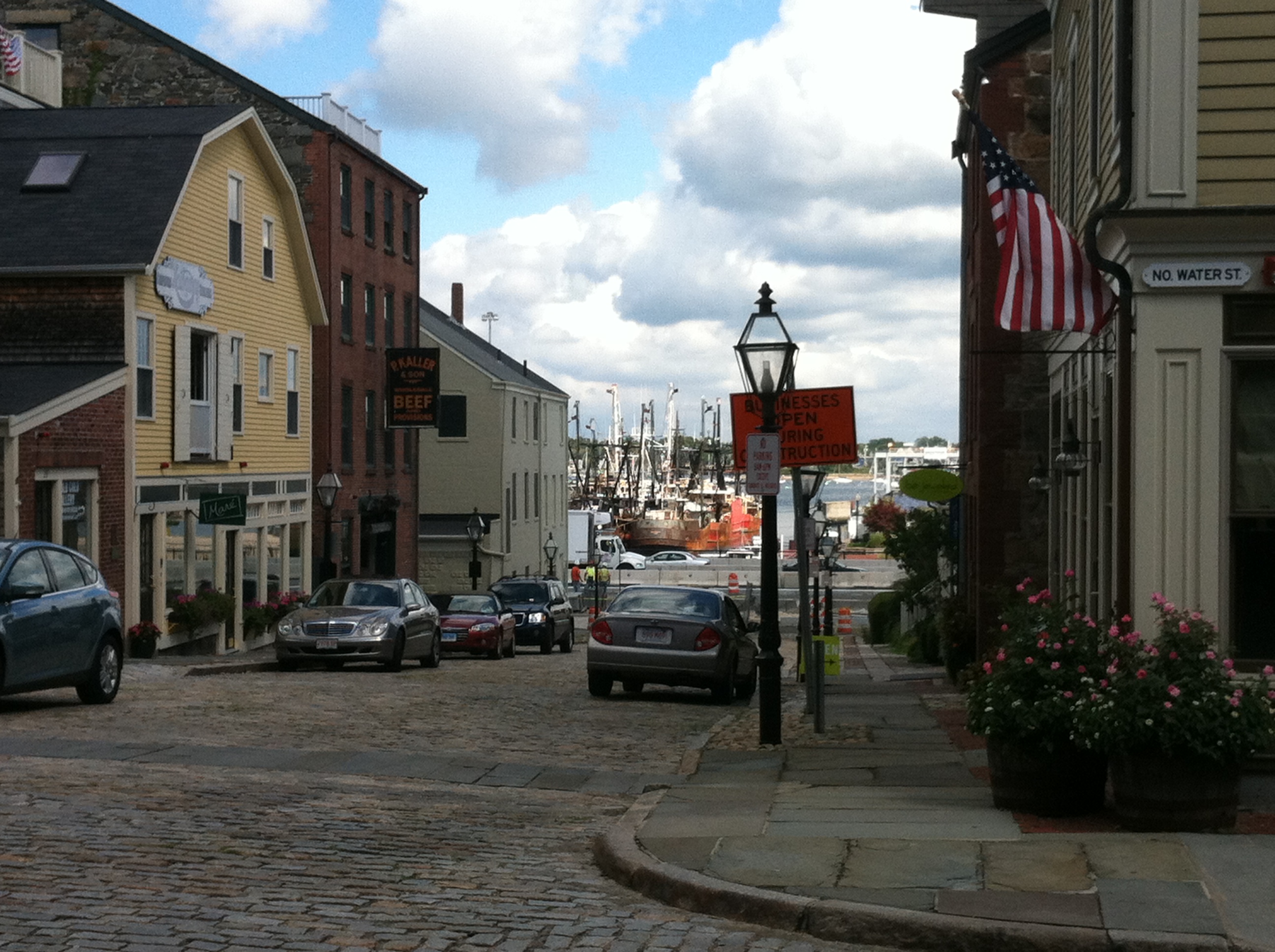
New Bedford's cobblestone streets lead to the waterfront where whalers once departed for the hunt.

New Bedford’s cobblestone streets lead to the waterfront where whalers once departed for the hunt.

The city’s done–and continues to do–a great job of making the waterfront attractive and accessible to visitors while retaining much of the history and character of this harbor.  There’s a photo op at every corner it seems.

Ishmael was not seen, may still be at sea.

Steadfast out.

29 September

“Securi-tay, securi-tay, securi-tay. Hello, all stations.”

The voice on VHF channel 16–the marine channel on which to call another boat or to call for help–was loud and clear.  It was just 1000, still fairly early in this clear, sunny day, so maybe this was just a routine alert of some kind.  But the voice continued.

“This is TowBoatUS New Bedford assisting a sailboat that has grounded at the Dumpling Rocks.  All mariners in the area are requested to proceed with caution.  TowBoat, out.”

Hmmm.  Grounding on rocks.  That’s not good.  And to think, that being the most direct route out of Buzzards Bay to Newport, that was the plan for Steadfast this morning.  But, as lovely as it was sailing on a broad reach, the two-foot seas on the starboard quarter made it a challenge to steer, read the chart AND pick out the distant markers, so the decision was made to take the “safe route” and skirt the main shipping channel instead of ducking past Dumpling Rocks.  Prudence prevails.

These women practice for their next dory race, a popular sport in New England harbors.

As Steadfast motors out of New Bedford Harbor, these women practice for their next dory race, a popular sport in New England harbors.

Steadfast had been tardy in shoving off from Pope’s Island and New Bedford Harbor at 0845.  Still, other than the commercial fleet, she was about the first boat out past the hurricane barrier this day.  The light northerly was dead astern but with the tide running, she was making better than six knots while Ms. Wes churned over at 2200 RPM.

As the wind picked up, prudence–there’s that word, again–dictated putting a reef in the main, still on a reach, wind over the quarter and Ms. Wes took a well deserved break.  The wind abated, the full main was up and shortly after noon, Ms. Wes was called on to enhance the wind, as it were.

Unlike the eastbound passage, Steadfast this time stayed closer in shore and with the bright sun, familiar landmarks from the past were easy to pick out.  The enormous boulders at Tiverton Point where a college boy perched and dreamed of sailing oceans.  Sachuest, the favorite beach.  Marble House, The Breakers and all the other mansions whose “back yards” spill down to the Cliff Walk.  Then finally, Brenton Reef, Castle Hill Light and Fort Adams, home of the Newport Jazz Festival.

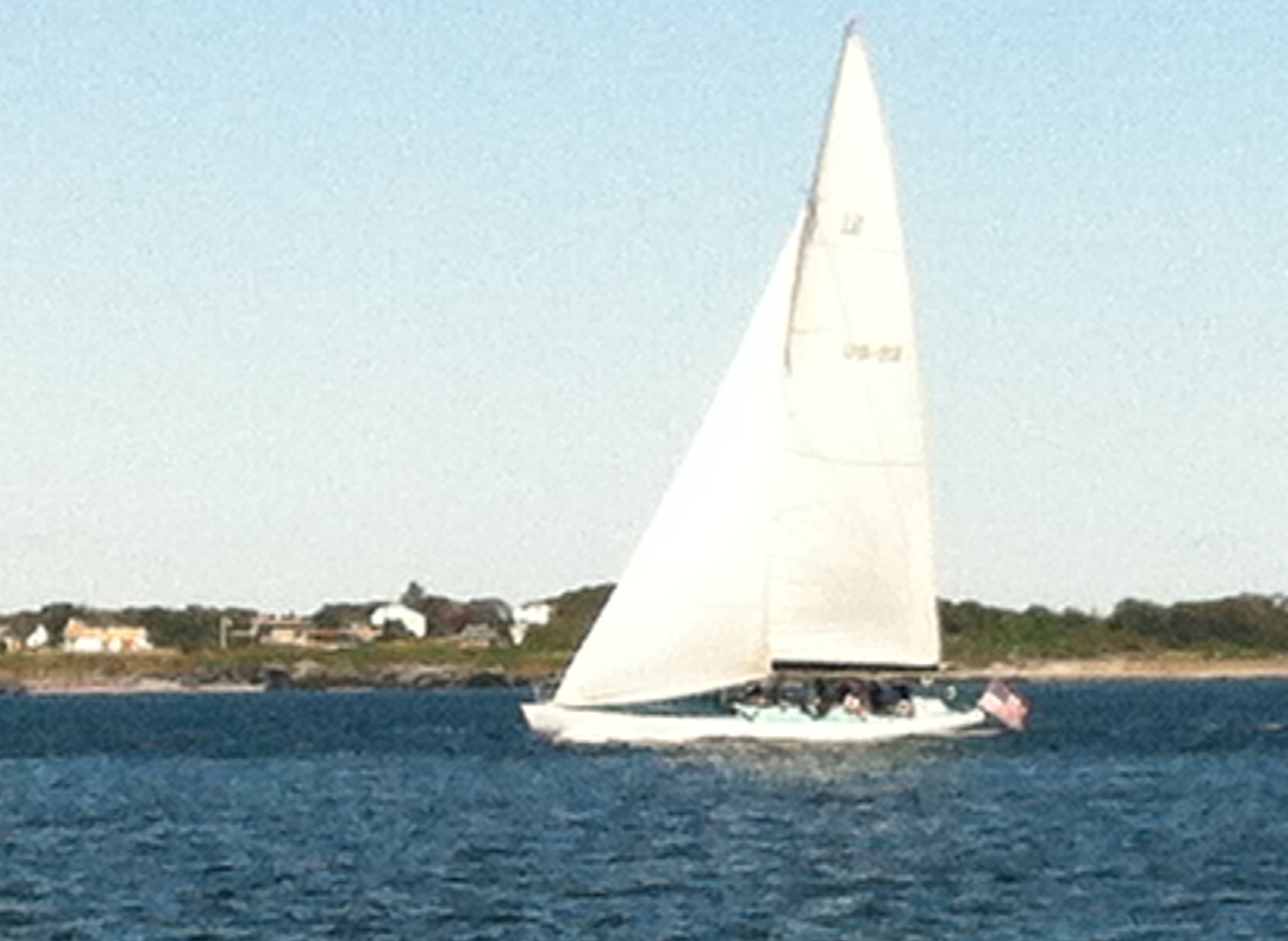
One of the several classic America's Cup veterans thrills a crew of tourists out for a day-sail.

One of the several classic 12 Meter America’s Cup veterans thrills a crew of tourists out for a day-sail past Aquidneck Island.

A beauty day, 35.4 nautical miles averaging 5.5 knots along the way.  And this time, with the miles that lie ahead, the night will be spent aboard, not ashore.

Prudence dictates.

Steadfast, out.

01 September: Plans

Spartina is on the prowl.

Spartina is a well-cared for 31-foot Pearson sloop of mid’80s vintage whose skipper reported yesterday, “I left home this morning at four-o’clock so I could get a mooring and look: nothing!”

That’s because, as noted previously, Labor Day weekend began Thursday on Block Island.  A few of those town moorings opened early Friday but not many.  So when Spartina got there late Friday morning, he was out of luck.  His  expression was one not so much of disappointment–although he clearly was disappointed–as simple disbelief.  How could this be?

So now, 0600 Saturday morning, he is on high alert for that first mooring that becomes vacant.  As Spartina slides by, he is informed that Steadfast will cast off soon, will call to let him know and, hearing this, his sense of relief–and appreciation–are clear.

Once through the channel and into Block Island Sound, clouds begin to consume the morning sun to create the cover image for volume from Deepak Chopra.

No description needed for the view looking back toward Block Island and Great Salt Pond.

No description needed for the view looking back toward Block Island and Great Salt Pond.

The nor’east wind picks up enough to make sailing a reality and the Sound waters froth off the bow and hiss past Steadfast’s beam.  It only gets better when a dozen porpoise swim from their pod of a hundred to say hello.  They criss-cross under the keel, streak along side and briefly cavort in the bow wave.  Then they’re off to entertain the crew on another boat.

The crossing goes from the sublime to the ridiculous at Watch Hill Passage, the easternmost entry to Long Island Sound.  It is jammed with boat traffic of all kinds–workboats, families out fishing, a regatta of one-design sailboats and big yachts–underway to their holiday destinations.  Combined with the suddenly strong current, wakes from powerboats, a bloom of seaweed and an attack of biting flies, the traffic makes it easy to forget that this is supposed to be fun!

Stonington slides by to starboard, a great harbor to visit but it’s too early in the day to stop.  Steadfast presses on and is rewarded with a freshening breeze that carries her by mid-afternoon, instead, to New London.  She spends the night on the Thames River in the shadows cast by the Coast Guard Academy and the Cutter Eagle.

There was little about this day that was planned, including the destination, but it seems all to have worked out, moving Steadfast another 35 miles closer to home while Spartina and many others move toward a memorable holiday.

Steadfast, out.

02 September: What’s the Hurry?

The Thames River is barely rippled by the light zephyr that comes from the east.  There are some clouds but more of the sky is blue when Steadfast sets off downstream making 5.5 knots as Ms. Wes hums along at her now familiar frequency of 2200 revolutions a minute.  It’s just a few minutes after 8 o’clock when the holiday morning calm is shattered by an angry voice calling frantically from some nearby harbor, seeking justice on channel 16.

“Hey, buddy! SLOW DOWN!  It’s a ‘no wake’ zone, you know.  Watch what you’re doin’!”

There’s no indication of where the call is made but it appears the intended recipient did hear.

“Kiss off!” is the simple suggestion offered, one assumes, by the perceived offender.

And so this last Sunday of the summer season begins, fellow boaters enjoying their time together on the water.

For Steadfast, the combination of favorable current and a rising so’easterly push her speed over ground to a fairly startling 7 knots.  Eights then become fairly frequent and she ultimately starts hitting speeds in the nines!  For a couple of hours, motor sailing this way, the miles click off in most encouraging fashion.  A course change passing Faulkner Island moves the wind astern and the speed backs down into the five-and-a-half range but, had it not been for the earlier numbers, five-and-a-half would feel pretty good!

By 1400, she slides south of Branford Reef and shortly afterward turns for the breakwater guarding New Haven.  Forty-four nautical miles, in all, at an average 5.9 knots, make this one of the most productive days of the summer.

The thought had been to anchor in Morris Cove, a broad bight on the eastern shore just north of the breakwater that’s home to New Haven Yacht Club.  At 1500, there’s no way there’d be an open mooring but, hey, what the heck – give ’em a call.

The first try on 16 yields no response.  Nor the second.  Nothing comes back after calls on channel 68, either.  So anchor it…

Then a faint voice announces “Na Haven Yot  Club.”  The mooring inquiry quickly follows.  “What size boat?  Yeah, we got a moorin’ for ya.  Come on in.”

Once on the mooring, the club “launch”–a somewhat tired flat-bottomed skiff adorned with a half dozen formerly white fenders on the port side–arrives with Phil–an 80-year-old in navy polo and matching Kangol cap–at the helm of the outboard.  “I’ll need ya life hist’ry now,” he chuckles.  “We need to know if tha police ah lookin’ for ya.”

Once he’s made note of the usual info, Phil is asked about amenities.

“Sorry.  No dinin’ room.  Not even a bah!  Can you believe that?  A yot club with no bah!” and he chuckles again.  “No showha, eitha.  They just tore it out to replace it.”

Hmmm.  So what exactly is the charge, then, one wonders?

“Oh, thayh’s no chahj.  The moorin’s free.  And let me know if you need any ice.  No chahj for that, eithah.   I’ll bring some out for ya.”

There’s a lot to like about the New Haven Yacht Club.  Just the basics.  With apologies to Kenny Chesney – no shower, no bar, no problem.  And there’s no hurry, either.  Phil likes to take it slow, the way life on the water ought to be.

Steadfast, out.

05 September

Redheads have a reputation, so it goes, for being, well, explosive, might we say?  Think Maureen O’Hara in “The Quiet Man,” Rita Hayworth in any role and, of course, Lucy.  But the redhead on boat Steadfast has been hard-working and, as long as the skipper does his part, dependable.  You know her as Ms. Wes but, as much time as we’ve spent together this summer, that now seems a bit stilted, impersonal.  So she’s become “Little Red” or just “Red.”  And she’s given no indication she minds in the least.  For Red, Labor Day, as it turned out, was no holiday.

By 0714, as Steadfast slipped her mooring, the thick cover of dark, forboding clouds had given way to bright sun over “the second oldest yacht club in the country.”  Phil proudly proclaimed this tidbit about New Haven Yacht Club the evening before, adding offhandedly “Some club in New Jersey is the oldest but I don’t know what.”

Nosing out into Long Island Sound, there were ripples on the two-foot swells rolling in from the east but not much wind to speak of, maybe five knots. So it would be up to Red to get us to Stamford, some 34 miles away.  The main went up in hopes it would help counter some of the rolling motion induced by the seas moving under the port quarter.  With the main drawing and a favorable current, Steadfast was making six-and-a-half knots or better by the time she crossed the bar at Stratford Point.  She still need Red to run her 2200 RPM, though, or she’d end up wallowing in the troughs.  Not pleasant.

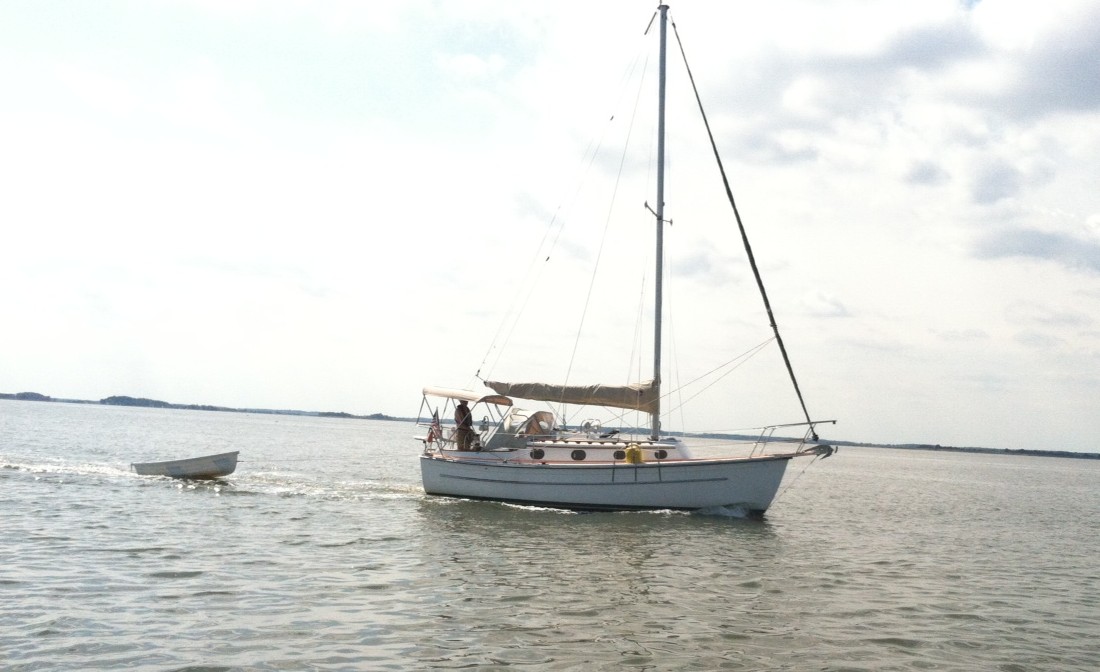
Motor-sailing along the Connecticut shore, the dinghy strains at her painter.

Motor-sailing along the Connecticut shore, the dinghy strains at her painter.

Two miles south of the South Norwalk Light, the wind had built into the teens, brewing Guinness-like seas: dark and foamy.  The motion had become much like a ride at Kings Dominion, going side-to-side, up-and-down and forward all at once.  All this while speed over ground hovered near 7 knots, maxing out at plus-9 along the way!

Turning a few degrees to starboard at the rocks known as The Cows, it became clear the couple of miles into Stamford Harbor would be a wild ride.  Catching on the beam what by then was a steady 20 knots, gave Red a chance to catch her breath as Steadfast sped along at plus-5 under just the main!  Once past the breakwater, the water immediately flattened out, enough to allow the main to be furled even though the wind continued to howl.  Red took over from there completing the day at an average speed of 6.2 knots, probably the fastest overall run yet.

With the threat of rain and thunderstorms through mid-week, Red gets some well-deserved rest.  And attention.  A clean fuel filter, fresh fuel, a little more coolant, maybe, and a thorough check of all her clamps and fittings.  This in preparation for the run down the East River and through New York City when, once again, it’ll pretty much all be up to her!

Since departing in mid-June, Red now has been on the job more than 300 hours.  That’s a lot of work for her two little cylinders with another couple of weeks still ahead.  With that resume, she deserves an Oscar!

Steadfast, out.

Categories: Uncategorized | Leave a comment

Blog at WordPress.com.