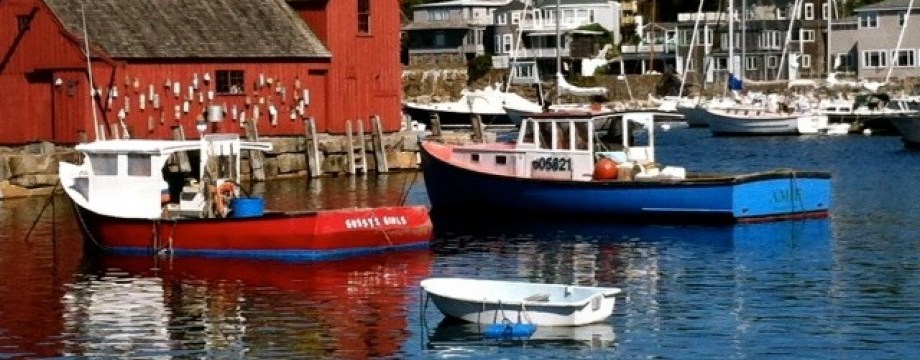
4 October 2012
“Ya know, Bill, Steadfast is already packed.”
We ambled slowly down the pier, my arm over Tony’s shoulder, when he added the invitation, “You could just come along with us.”
We’d met just weeks before via VHF as Steadfast followed his Catalina 27 Patience under the bascule bridge at Manasquan, New Jersey. It was quickly established that we both aimed to spend the night in Atlantic City. Over dinner that night, Tony and Jane, his crew, talked about their trip down from Buzzard’s Bay in Massachusetts and their plan to take Patience all the way to Fort Myers, Florida. Now, after sailing in tandem this far, and a couple of day’s rest at Ouatcha Point, it was time for Tony and Jane to cast off. It was October, after all.
“C’mon, Bill. Waddya say? We’d have a great time, ya know!”
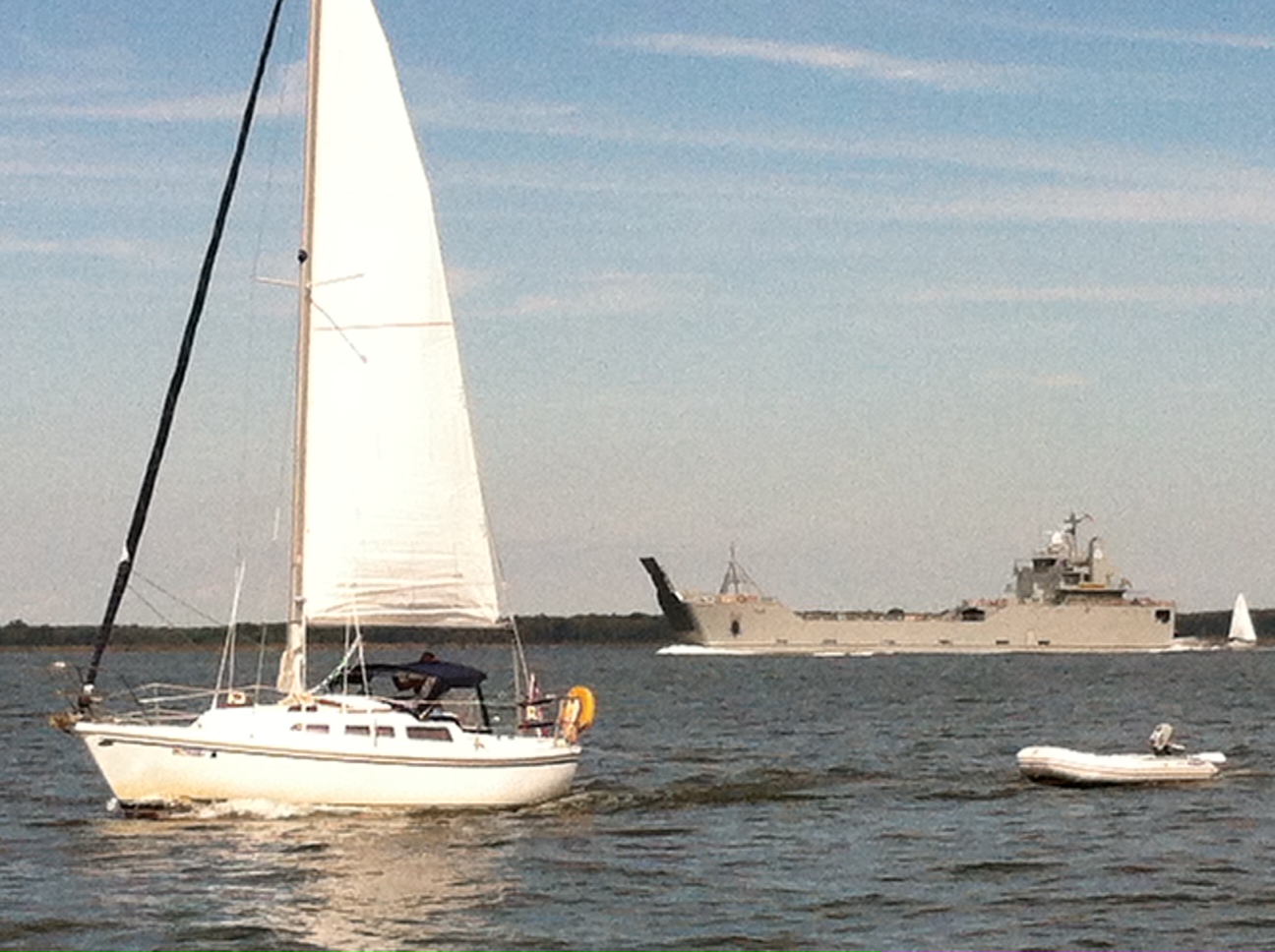
With Tony at the helm, Patience briefly escorts a landing craft down the upper Chesapeake.
No question about that. We’d had a great time already, from “AC,” round Cape May, up Delaware Bay and down the Chesapeake. But Kate was still working, so all but a couple of the past 14 incredible weeks were spent single-handing. After putting more than 2,000 nautical miles under her keel, for Steadfast and for me, it was time to stay put for awhile.
Looking back, it’s not that big a deal, right? I mean, John Smith sailed the Chesapeake in an open 18′ shallop. Henrik Hudson and how many others had sailed Long Island Sound and the coast of New England hundreds of years ago. No charts never mind GPS. No cell phones. No TowBoatUS. All would be in play for this trip so no big deal, right? I mean, it’s not like we were crossing the Atlantic or something.
No, we weren’t but still it was kind of a big deal, as you may agree, if you get on board with the story that follows. Not so much a ship’s log as a series of vignettes, these are the assembled “post cards” home from those fourteen weeks, and more than 2,000 nautical miles, and countless nautical “smiles.” The story begins at https://steadfastsail.net/2014/02/13/up-chesapeake-bay/ or check out different legs on the trip as collected under “Recent Posts.” Enjoy!
14 June 2012: Getting Ready
Today’s forecast is right on target. The 30% chance of a shower has been pretty much a steady rain since 0600 which means about 30% of the day. It seems to be letting off now.
Not to be deterred, however, I made use of the time by going through the bag and cartons of little stuff that, prior to 1 June, had filled drawers and shelves in my office. Some trash, some sorted and stored. And this is hard to believe. I just stowed on board $150 worth of canned / box foods. (That includes the case of ginger beer and six fifths of Goslings Black Seal.) But here’s the kicker: there’s space for still more stuff!
Not knowing when the next opportunity may arise, I did a brisk 45-minute walk up to Johnson Point and back. Later, Jim Crawford called just to check on progress; given that we’re still in the slip, not much to report but a nice chat, regardless. Confirmed with Burrys that I’m hanging here ’til the northerly shifts or settles down. Bill OKed hooking up the Army-surplus solar charger that Jerry offered and we agreed to try to rendezvous near Annapolis.
I talked with the sail man, too. He’s on his way to get the new main right now and says he can get that wrinkle out of it and back on tomorrow! Busy morn. And wouldn’t you know it: now that the boat’s more or less set, the forecast has changed again. Now it calls for rain thru Thursday with winds out of the north, so it doesn’t look like I’ll get underway for another couple of days.
Gotta stay flexible when you sail a small boat. And this being a boat, there’s always more to do, so I’ll be busy with those little things that didn’t get done and be ready to go once the weather cooperates.
Standing by, this is Steadfast. Out.
18 June: Are the glasses half full?
There’s a point at which “pier fatigue” sets in and you say, “Aw, the heck with it. I’m goin’.” There are those whose boat is never ready, who never leave the pier. They seem not to Blog about it, typically, so the record is incomplete. But if you’re gonna go, ya gotta GO! So with the boat ready, me beyond ready, a sunny sky and reasonably favorable so’westerly, we cast off.

It was tough saying ‘good-bye’ but a great adventure lay ahead when Steadfast cast off down Queens Creek.
Crossing the mouth of the Rappahannock–with a whopping six miles under the keel–the wind died to a whisper and the decision was made to round Windmill Point, cross Fleets Bay and anchor for the night in Indian Creek. The night became two when the wind the next morning started stomping down from the nor’east but NOAA promised better for the day that followed. Back out on Fleets Bay, there turned out to be more of a chop than I’d understood NOAA to have foreseen but nothing terrible. Uncomfortable, perhaps, but manageable for sure. Reefed down, taking spray over the bow and, on occasion, the dodger (a couple of times, giving my face an unexpected rinse), we made our way toward Smith Point. The day had dawned bright, the sun urging us to get going again. But out here, the sun seemed to be hidden away behind an ever-thickening haze. It wasn’t that encouraging, after all. About that time, the wind moderated somewhat and with it, the waves, too. So it was possible to let go the wheel for a minute and wipe that slimy salt crystals from the lenses of my sunglasses. Ah! Waddya know? It’s a beautiful day! The sometimes daunting stretch across the mouth of the Potomac turned out to be without incident this time. There was a wardrobe change along the way to take advantage of the sun and we motored up the Patuxent, past Solomons Island and up to a pleasant little anchorage in a cove off Mill Creek. We’re really on our way. And remember: things aren’t always the way they may appear. If your glasses are half-full of salt slime, you gotta clean ’em!
24 June: Where in the world…?
When last seen (as in, anyone who knows her having a visual, below), Steadfast was motoring out the channel from Lake Ogleton, just downstream from Annapolis. That was last Tuesday morning, 0800, after a lovely dinner and restful night rafted with Chris and Bill Burry. After a quick stop in Back Creek to re-fuel (the wind was a light southerly, not enough to sail north)…
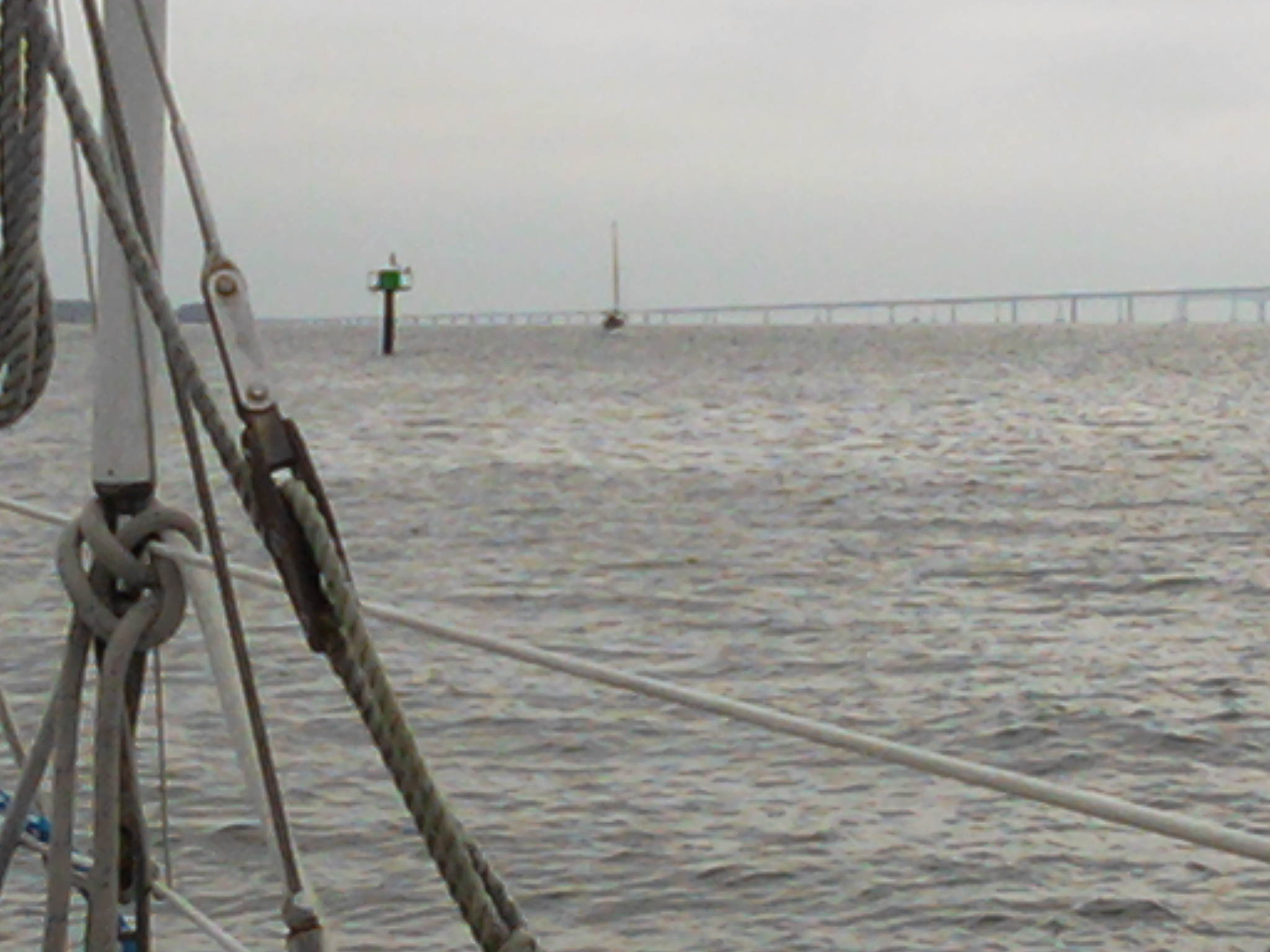
The crew of Plover bids farewell to Steadfast as she motors into the murky morning from Lake Ogleton.
Steadfast headed into the Bay among the dozens of pleasure craft hoping to see the fleet of warships headed south from Baltimore after the OpSail weekend there. With the spectator fleet, warships, police and Coast Guard patrols and barge traffic, there was a lot going on. By midday, though, Steadfast was nearly by herself headed up the north Bay. There was a brief interlude to repair a leak in the fresh water system but otherwise the day was uneventful until, heading into the Sassafras River to anchor for the night, we saw “Bounty“–one of the Tall Ships from OpSail–already there.
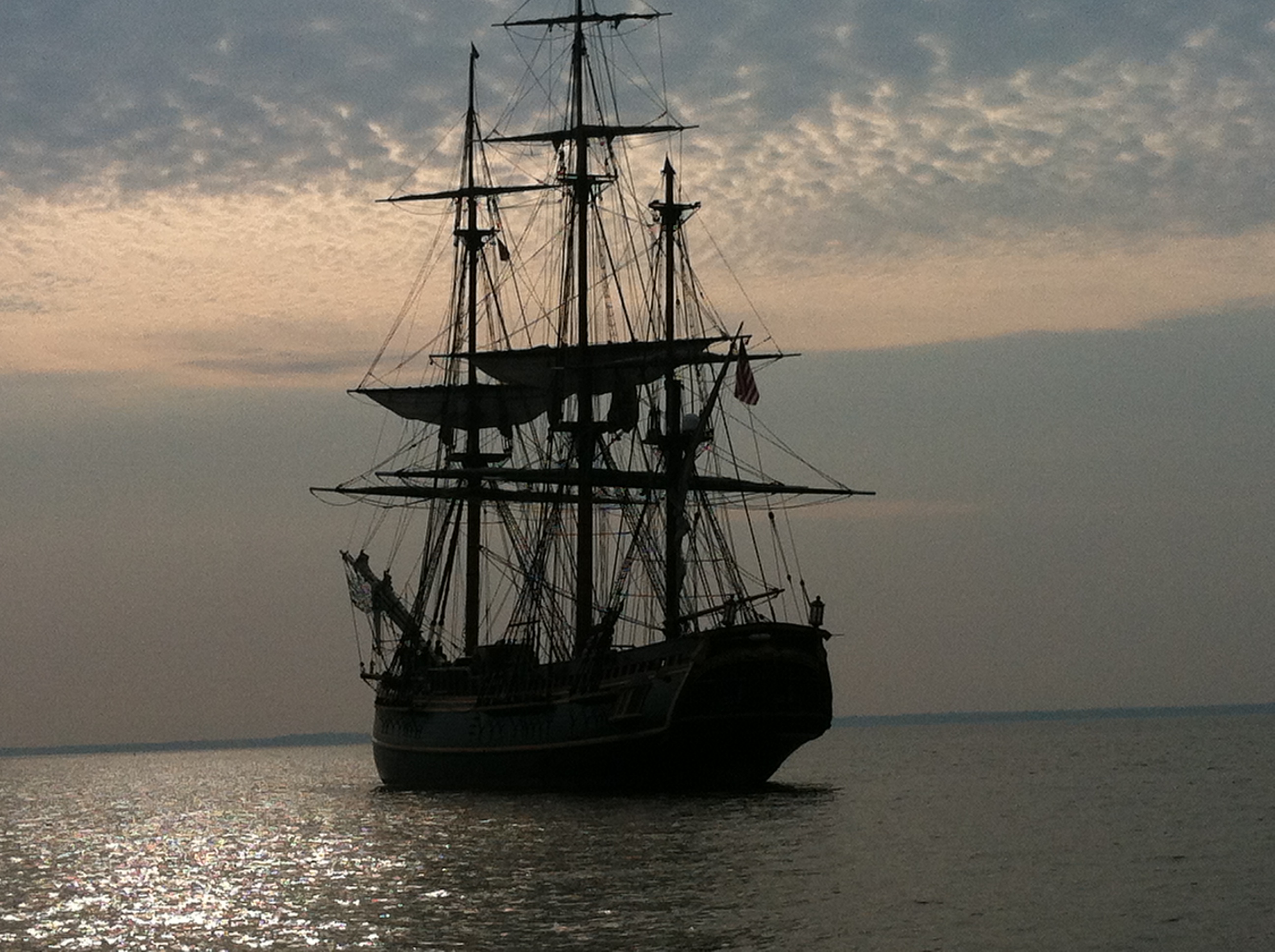
The replica HMS Bounty, lying at anchor in Sassafras River (MD), later was lost at sea in Hurricane Sandy.
She led the way out of the anchorage in the morning and Steadfast followed into the Chesapeake & Delaware Canal and under the series of bridges that span that waterway.

Bounty motors under one of several bridges that span the C&D Canal
The C&D is a rush in a little boat like Steadfast: instead of her usual 5 knots under power, she ripped along at as much as 8.5! Woo-Hoo! The flood tide carried us the full length of the canal and kept pushing us down Delaware Bay until late afternoon Wednesday. The nearest anchorage–one of only a couple on the entire 50NM length of Delaware River / Bay–was at the mouth of the Cohansey River, about 2 miles north of the channel. The only marker for the Cohansey–Green #1–is placed so to blend well with the verdant shoreline. In other words, “Where the heck is that dang marker?!” or words to that effect. So it took a while to get in, get anchored and settled down, as in, safe from the flies. How to describe accurately and objectively “the flies?” Hmmm. Let’s just say they let you know they’re there. The helmsman is advised to edit slightly the sailor’s adage to read “One hand for the boat, one for the fly-swatter!” The Green Heads–big, ugly, slow–are the daylight dread. They can be managed with a skilled and quick hand. But the deck becomes No Man’s Land once the sun goes down and the air becomes filled with small and–said with thanks–non-biting flying-thing of whose presence one not so much feels as gradually becomes aware. They’re just…there. Everywhere. All over. Everything, as in, be careful breathing. Anchor checks at night are brief or, better yet, non-existent. Dragging anchor seems preferable to inhaling flying things. But Thursday was another day, a fairly straightforward and flyless motor down (flies don’t come out on cloudy days, it seems) the rest of Delaware Bay ’til entering New Jersey at the Cape May Canal about 1430 hours. Fishing is the main activity on the waters off the Jersey Coast but Steadfast headed to… Utsch’s Marina – “We love sailboats” says the banner on the double-truck spread in the cruising guide. And by golly, we felt loved. A little lost and alone but loved, nonetheless. Of 350 slips, eight (8) are occupied by vessels equipped to carry sail.
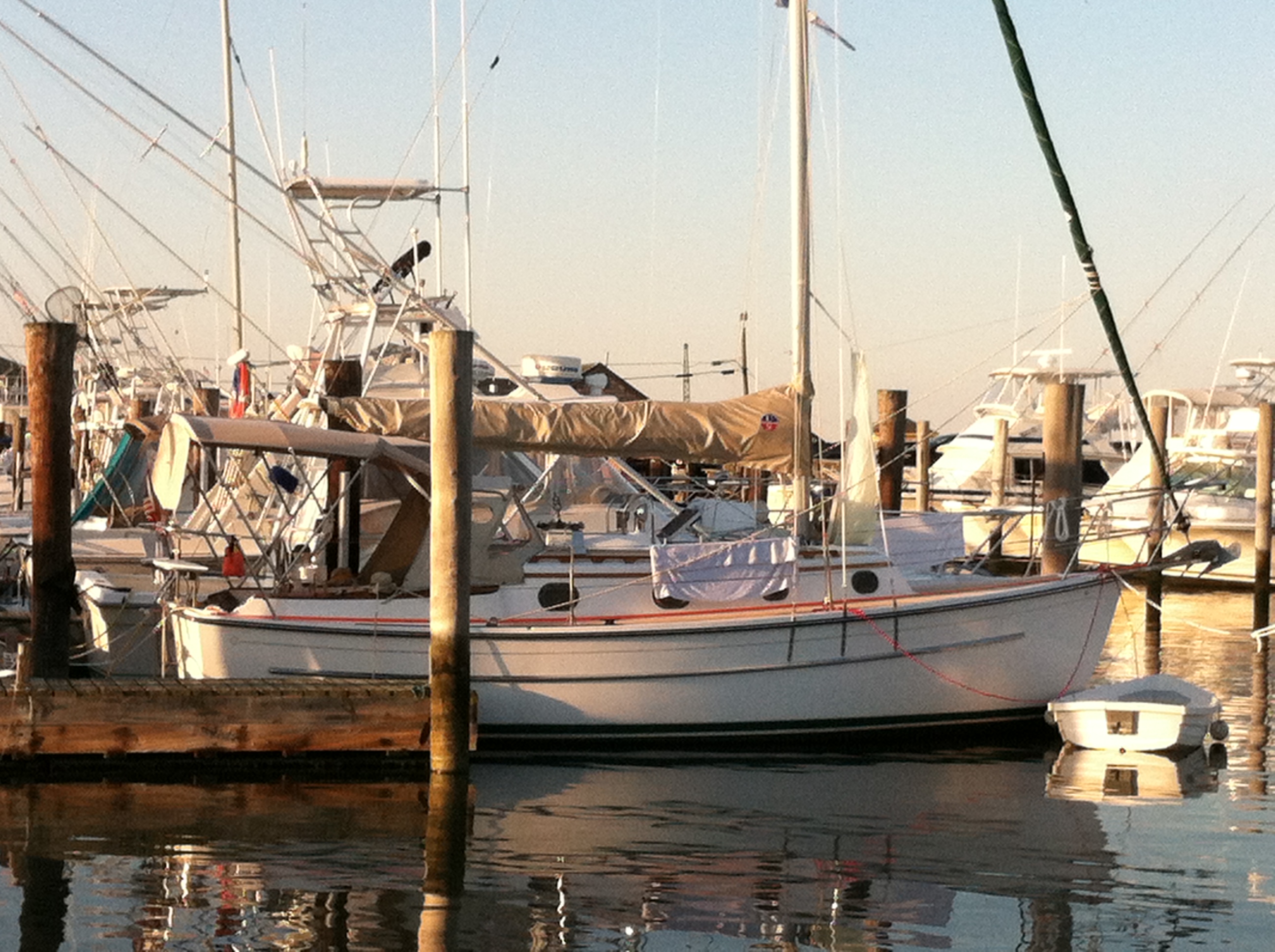
Drying towels in the slip at Charlie Dock, Utsch’s Marina, Cape May. Note the neighboring sport fishermen, a few of the 300+ tied up here.
Nice folks here, though, and we had a good time. Much better Friday night when Bowe came in from NYC. More about that in the next chapter.
Meantime I wait for dinner at The Lobster House. Will let you know whether the food’s any good but if the ol’ cars-in-the-parking-lot measure is accurate, it should be great! Stand by. Out.
22 June
Friday turned out to be a late night, and the forecast wasn’t great for sailing Saturday, so Bowe and I slept in. We re-provisioned, returned his rental car and spent a good bit of time in the engine room addressing another leak in the fresh water plumbing. Not a big deal just time consuming. We’ve already put more than 60 hours on the diesel this trip which is getting close to the normal total for a full year! The girl’s holding up well but things do happen. Sunday turned out to be beautiful and we nosed out into the Atlantic Ocean (!) for the first time, heading 045 degrees toward Atlantic City, again motoring all the way. We did set the Genoa for a couple of hours but never shut off the engine. She made good time, averaged a little over 5 knots for the nearly 40 miles and–once through the slop-and-chop of Absecon Inlet–we turned into Clam Creek about 1530 to tie up at Kammerman’s Marina. This shot gives you an idea what Kammerman’s is like. Cape May has the famous “Painted Ladies,” colorful homes from the Victorian Era. Atlantic City has these “Tired Ladies” (note the brown structures in the background, leaning eastward) along the waterfront across from the garish glare of Harrah’s, the Golden Nugget and others.
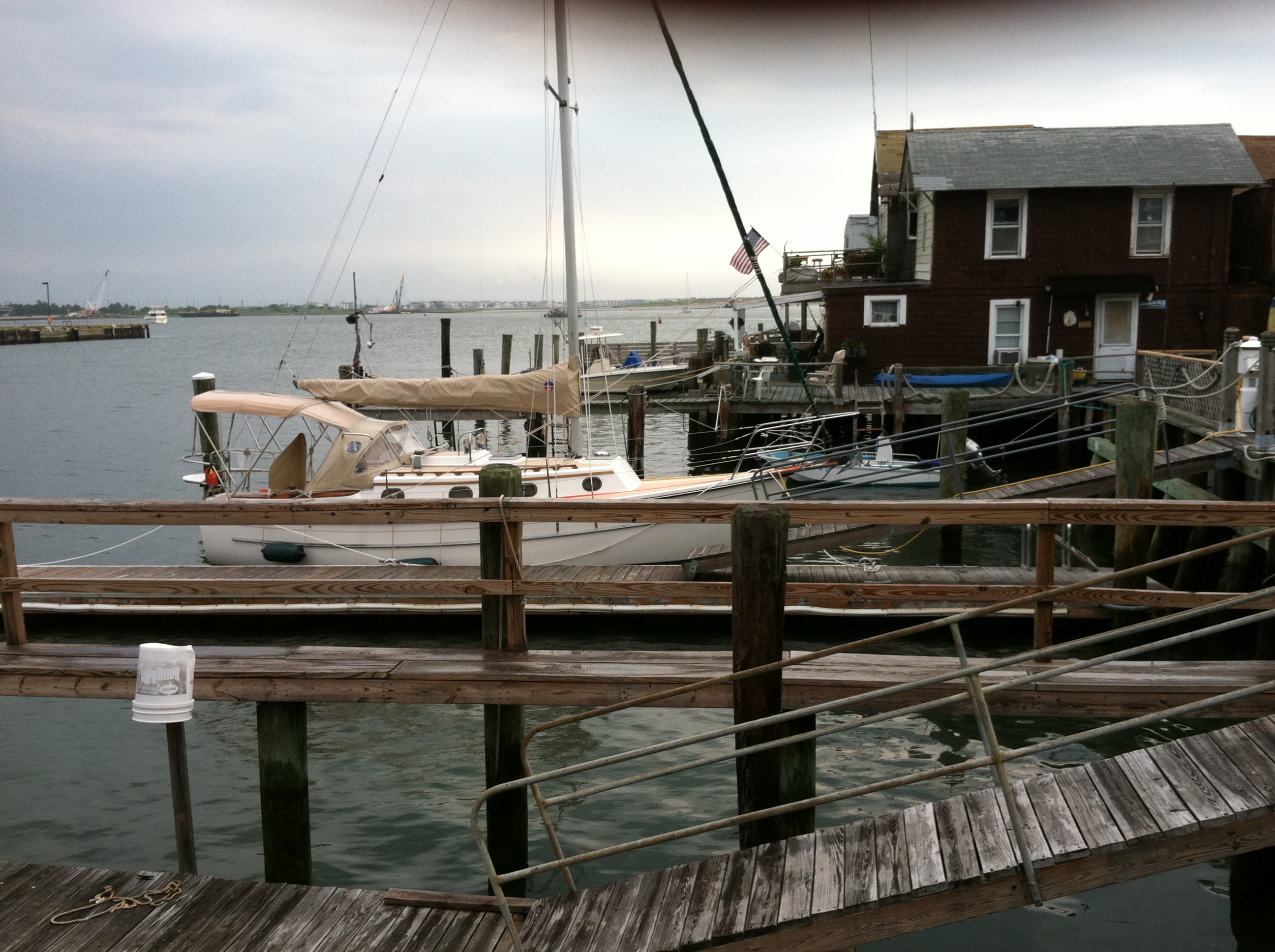
Though not far from the casinos, Kammerman’s has something of a “rustic” feel.
But the Kammerman’s staff and the neighbors all were friendly and helpful and the rate–$2 / foot–is half the rate across the way at the Trump Marina. After Monday’s off-and-on rain and thunderstorms, we headed out this morning…around the bend and into Gardner’s Basin, a much newer, cleaner marina which we learned charges even less than Kammerman’s! So here we sit as the wind blows out of the north at 15 – 20, gusting to 25 or 30. The forecast is for more tomorrow! It’s been a rough couple of days, walking around AC. Fortunately, there’s Gosling’s aboard ’cause it looks like it could be a Dark & Stormy night. Arrrrrrrrrgh!
Steadfast, out.
29 June
The simplest of pleasures are not to be overlooked, as in sipping that morning cup of Joe on the back porch–or in this case, the cockpit–as the shower clears and the sun brightens the haze over Atlantic Highlands, NJ. The setting, with tidy hillside homes overlooking more than a hundred sailboats in the mooring field below, has the feel of many New England harbors.

The handsome waterfront homes of Atlantic Highlands, NJ, keep watch on the harbor full of yachts.
The setting was not fully appreciated–heck, it wasn’t appreciated much at all–when finally making the turn into the harbor at 2005 (8:05 pm) last night. At that point, the sweetest sound that could be was the voice of the harbormaster responding, “Yeah, cap’n, we got a mooring for ya. Come on in.”
Sweet, indeed, since Atlantic Highlands is first come-first served; and at that point, it had been a 16-hour, 86-nautical mile day. Sitting at the pier in Atlantic City the past few days, waiting for the weather to shift, this leg of the trip became more and more daunting to my mind: small boat, ocean swells, no real good place to go in a pinch and…no crew. Sheesh! “What am I thinkin’?”
Turns out, I was just thinkin’ too much. There’s a point where you just gotta do it and in reality, the trip was no big deal. The boat did fine, of course; she always does. It’s amazing the engine just keeps plugging along, all those hours (yes, the westerly winds forecast for the day–which would’ve been perfect–had a lot of north in them, when they blew at all). There were a few other boats out there, so I never felt alone-alone. And…there’s always TowBoat, “standing by one-6.” So, good trip. Good to see the Manhattan skyline when I turned at Sandy Hook.
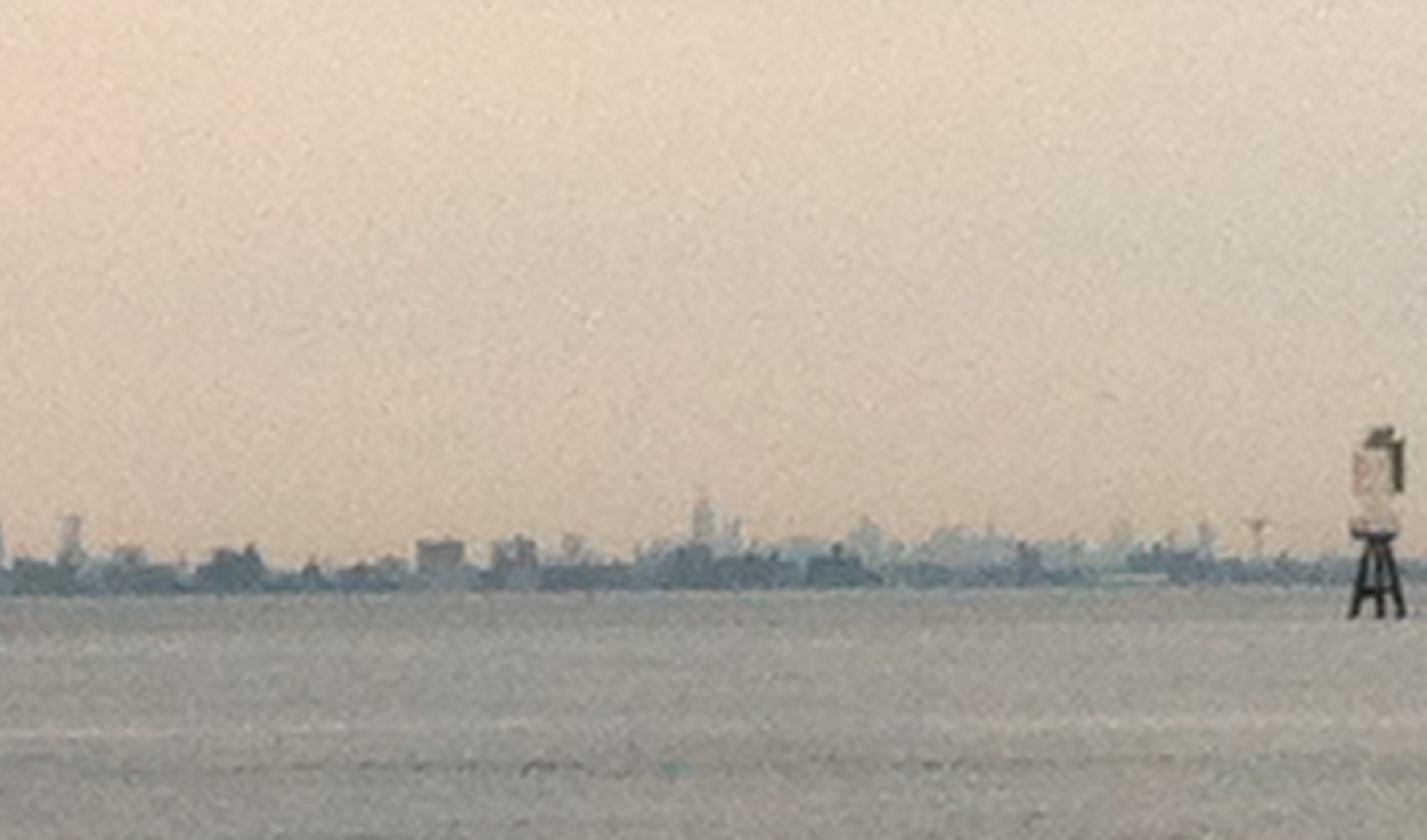
Turning Sandy Hook at dusk, the Manhattan skyline is barely discernible but unmistakeable nonetheless.
And good to be tucked in here for the day. Bowe’s trying to work out logistics to re-join me tomorrow and then we’ll make the run through NYC, up the East River and into Long Island Sound. This is the day the Lord has given us. Be glad in it.
Steadfast, out.
1 July
There’s a faint zephyr across the harbor, the sun descends and the dinghy rides quietly a few feet off the transom. That’s the kind of day it’s been, i.e., low excitement quotient and that, mates, is just fine.
The introvert in me enjoys a quiet Sunday afternoon sailing alone. The daily routine of cruising solo–plotting routes, sail handling, piloting, mooring and meals–adds enough challenge to deliver an entirely different experience, a new puzzle to be solved every morning.
Even the best puzzles need to be set aside once in a while, though, and so it’s always a pleasure to welcome aboard affable crew. Certainly that was the case those days when Bowe was aboard, especially for the trip across New York Harbor and up the East River; and likewise when JB helped with the trip Sunday from City Island around to Stamford, Steadfast’s first real venture into Long Island Sound. For all the warnings and words of wisdom, the run from Atlantic Highlands into Long Island Sound was without incident. There was one close call: getting the crew aboard at low tide can be a trick.
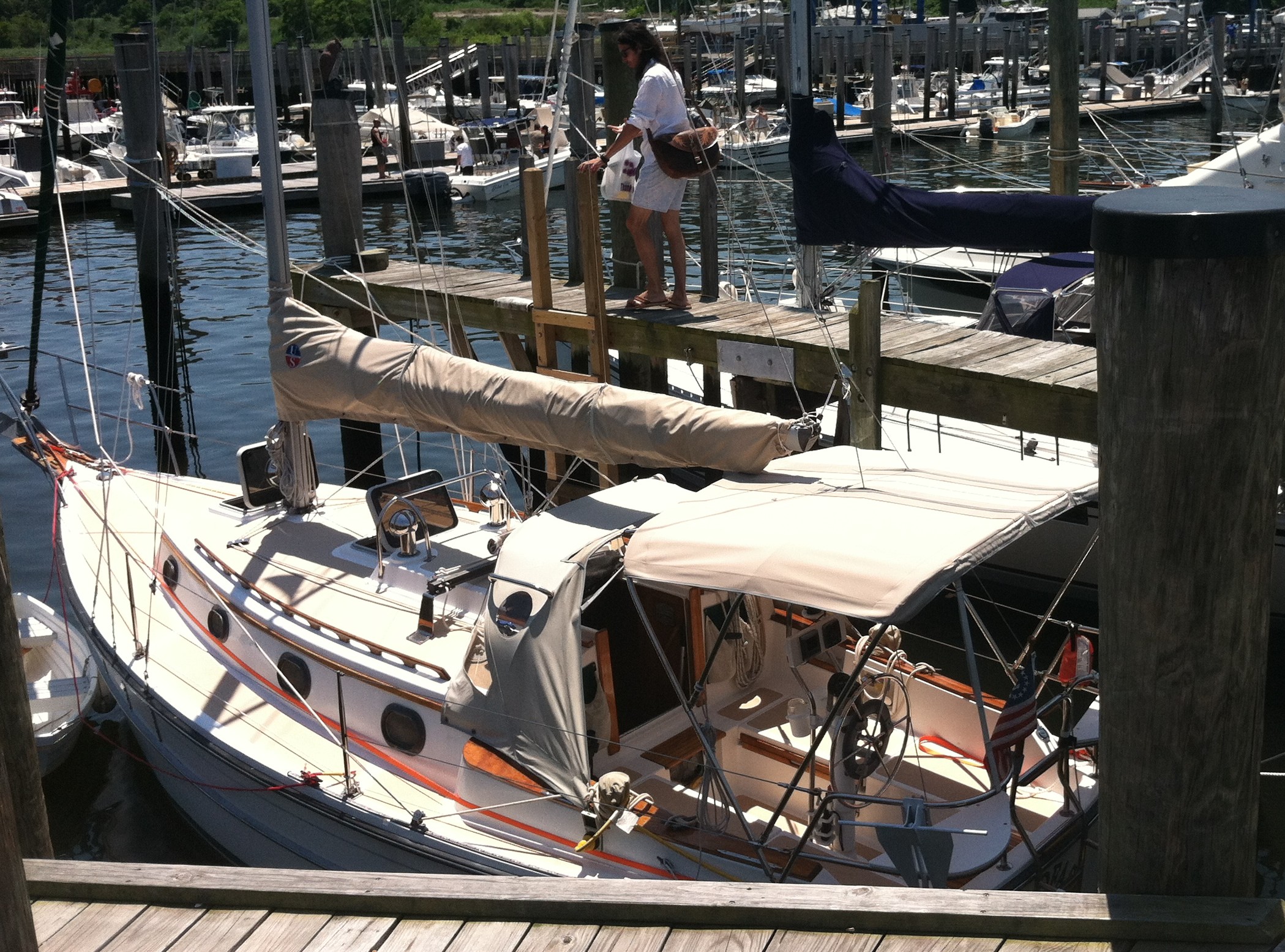
It’s a long first step: the tidal swing at Atlantic Highlands, NJ, can make boarding a challenge.
Once underway, and not knowing what to expect about the East River and Hell Gate, we secured a dock line to the dink as a safety. ( There’d be no retrieving her if the pennant should let go!) Then Steadfast rode the tide and gradually gathered speed, from her normal 5.5 knots to 7 or so past Governor’s Island ’til topping out at plus-11 (!) through Hell Gate. Now that, pardon the pun, is a rush! You’ll understand why we didn’t get a lot of shots of the shoreline: we were just trying to hold on!
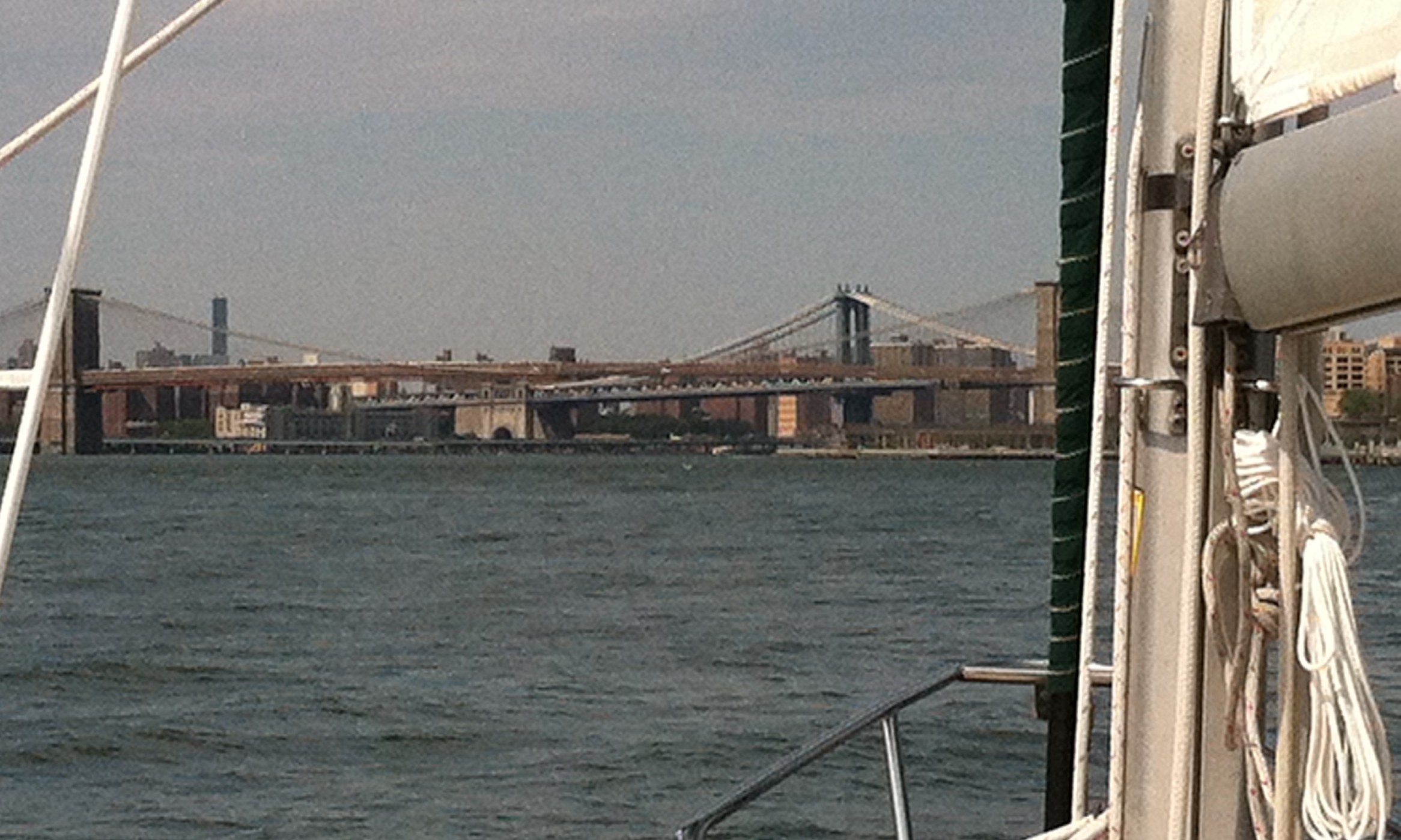
Northbound with the current past Brooklyn and lower Manhattan.
Once past Throg’s Neck, we were into LI Sound. A call to Barron’s Boatyard secured a mooring for the night and, after getting Steadfast all tidy, Bowe headed back to the City and I rode with JB ashore at her home in Darien.
The next morning, a neighbor was nice enough to drive us from JB’s house in Darien to the mooring at Barron’s. Fred the Dockhand gave us the quick ride out to the boat and then, well, not much. The engine wouldn’t start.
But, hey, it’s Sunday. She’s been working hard these couple of weeks. Ms. Westerbeke wants to sleep in. And, indeed, after a few more shakes, she was roused and we were off. There wasn’t a lot of wind but enough, it turned out, to tack up the Sound most of the way to Stamford, and it was good to have the sails up and full and, for those three hours or so, not be dependent on the diesel. Sweet.
She fired when asked to help get us up the channel to Harbor House Marina, just inside the hurricane barrier (which wasn’t needed that night but it was good to know it was ready just in case). Tying up turned out to be a classroom session under the tutelage of Stuart, a bronzed, shirtless sixty-something wharf rat and professor of all that is nautical. At least, in his own mind. Stuart barked orders to all assembled–the dock hand, JB and me–and basically did everything but climb aboard and take the helm! Stuart seems to have compiled a resume. When signing in at the office, the dock hand advised, “Ignore him. He’s just a know-it-all.” And will remain in the annals of cruising tales for some time.
From there, shoved off Monday morning and headed again eastward. When the wind died, and being basically equidistant between two shores, I elected to motor an hour into Huntington Harbor where the channel is guarded by this stately ol’ girl.
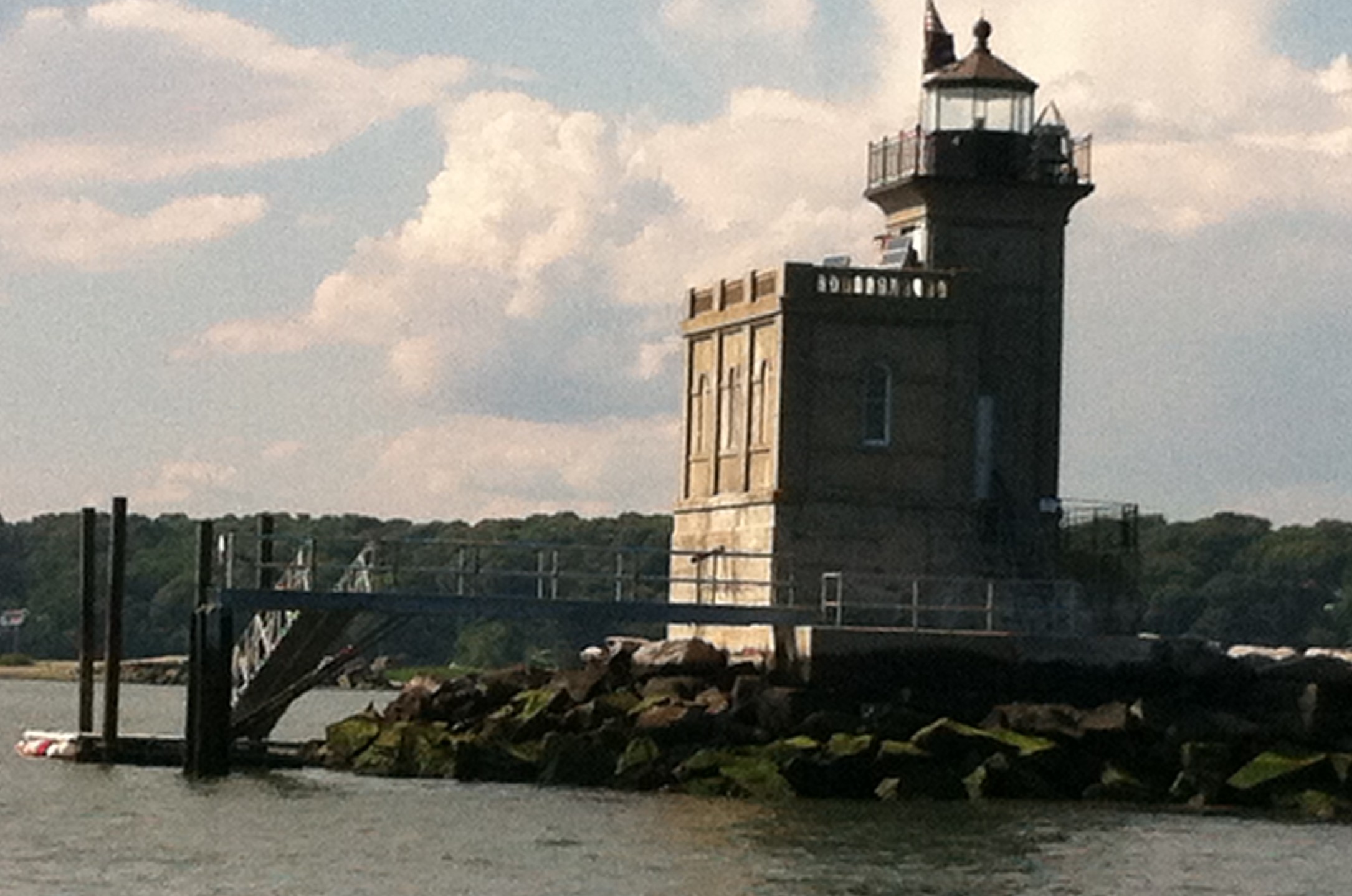
A handsome granite light marks the entrance to Huntington Harbor on Long Island’s north shore.
Topped up the fuel tank and took a mooring at Huntington Yacht Club for the night. This morning was spent rowing ashore, walking to town for breakfast and then stopping at the supermarket. (Man does not live on bread alone but you can’t make a sandwich without it!)
Once back on the boat, time to get underway, except… Remember that little problem with the diesel Sunday? She just flat quit today. A check of the fuel filters showed why: water and sediment in both. Not good. Those were changed out in less than two hours and I was ready to go. Ms. Wes still was not, however.
So a call to Zimmerman Marine in Deltaville–which did such great work on Steadfast over the winter–proved invaluable. Adam got Chad to the phone and Chad first talked me through the steps to bleeding air from the injectors, then stayed on the phone as I went through each step. And–ta-da!–it worked just as he said it would. She fired, ran for an hour and–perhaps more important–when shut-down, re-started like a champ!
So at 1600, cockpit straight again and tools all away, the decision was made to sit here for another night. I’m just sorry there wasn’t crew aboard to take photos of the whole operation.
Steadfast, out.
4 July
Bursting with new confidence in Lady Westerbeke, ready to cast off to yet another romantic and far off landfall, Wednesday offered a wet and windless greeting that suggested something else. The drizzle started about 0600 and continued through coffee, at which time it seemed prudent to go ashore and find some more fuel filters. You know, just in case. The tide was low and, though Steadfast seems well off, the water in the foreground (below) would not dampen your knee.
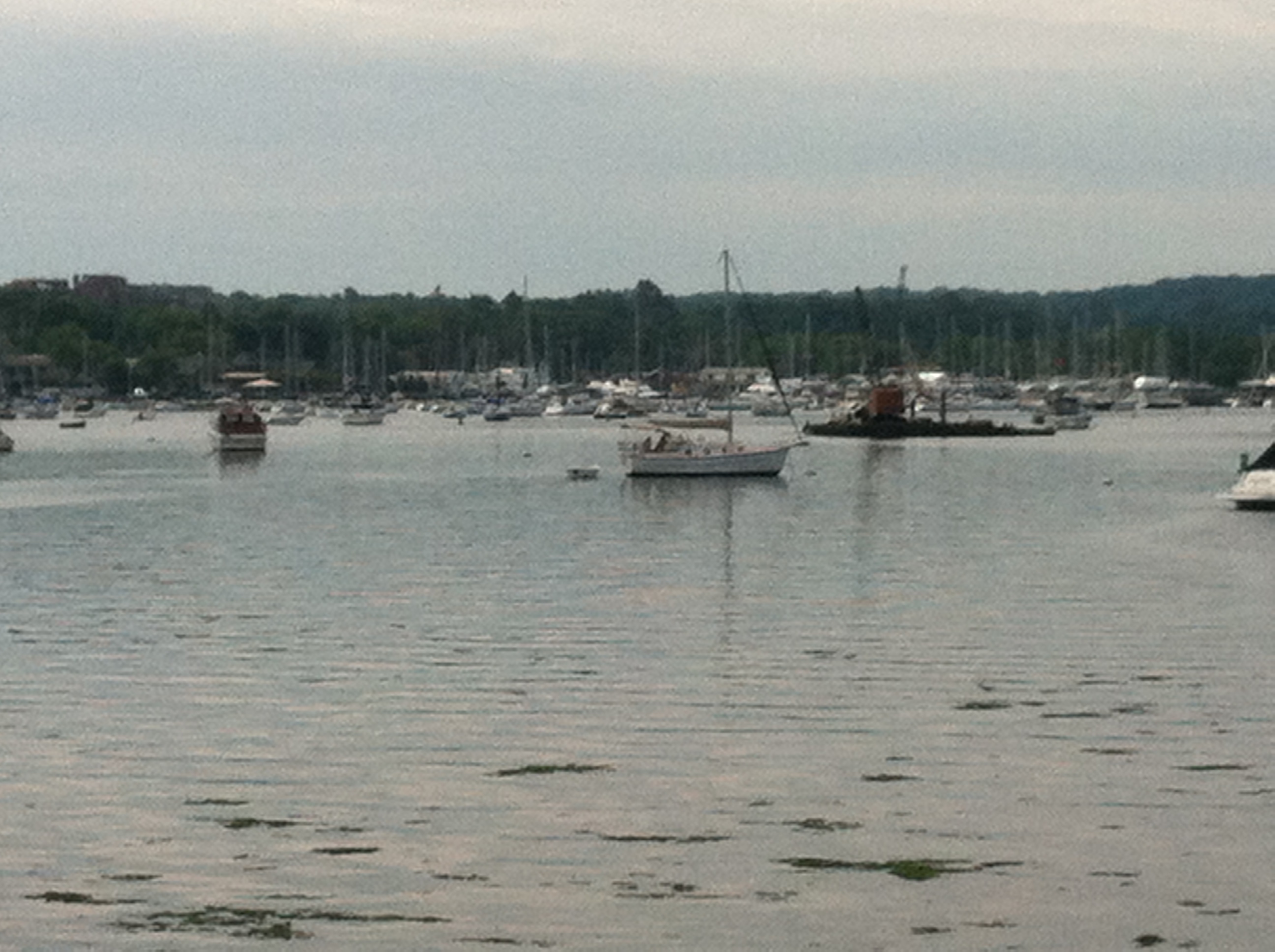
The mooring field off Huntington Yacht Club is a long row from the town dock, in turn a good stretch of the legs from the retail district.
Once back on board, filters in hand (as well as a new ensign to celebrate the holiday), the sky had cleared and the Sound beckoned. Ms. Westerbeke obliged and we did, indeed, cast off at 1138 to become part of the steady flow of vessels in / out of Huntington Harbor, nearly transom-to-bow, as it were.
The hope was to make a harbor back on the Connecticut side. That would be easiest to meet Dylan when he flies in from LA Friday morning. An inquiry to Milford Yacht Club regarding reciprocal privileges–as they say, “Mathews Yacht Club: membership has its privileges”–yielded the hoped for response that dockage was available. Leif Erickson probably sailed in here without a hitch but, I’m tellin’ ya, there are a lot of green 1s and red 2s on Long Island Sound. Were it not for the little 99 dollar Etrex GPS, I’d probably have been in Stratford tonight.
But the Milford jetties were right where they were supposed to be and, at 1655, the club pier looked most accommodating. It’s an interesting lay-out in Milford Harbor. There are the piers, of course, but then two rows of floats run right down the middle of the harbor, below. These “moorings” are anchored to the river bottom and serve a boat on either side. When a bad storm is in the offing, the three Milford boat yards haul them all out.

The “moorings” in Milford Harbor are a series of floating piers down the middle of the channel.
The club launch offered a ride up to town and, after a wonderful dinner of lightly fried whole belly clams, a ride back in time to enjoy a spectacular display of fireworks just behind the trees.
Happy Fourth! Steadfast, out.
5 July
Maybe all the commotion kept Ms. W from getting a good night’s sleep. Maybe she resented having to work on the Fourth. Whatever, she did not want to get going this morning. When the filter change – fuel line bleeding ritual failed, the word “Uncle” was heard (along with others) and the call went out to Milford Boat Works to send a mechanic. He proved a better blood-letter than I and for him she responded (of course, he’s younger than I, also). But by then, the day was all but shot so here we sit again tonight, again surrounded by the echoes of fireworks all around. With luck, Dylan’s train will be on time, he’ll be on it and Ms. Wes will be ready to go tomorrow (she gets to sleep in; if on time, Dylan won’t arrive ’til almost noon). Or you’ll receive another installment of “Zen and the Art of Diesel Mechanics.”
Steadfast, out.
6 July: Into the Mystic
MetroNorth pulled into the Milford Station on time Friday afternoon and–after the red-eye flight from LA–Dylan was awake enough to recognize it as his stop. The MYC launch brought us back to the boat, Ms. W fired and we shoved off shortly after 1300. Winds were–duh–light, meaning another day of motor sailing, but hey, ‘s all good on the water.
Besides, Chris-the-dockmaster at Brewer’s marina in Westbrook assured us, “No problem, we’ll have lots of room for a 27-footer. Just call when you get here.” This despite it being the second Fourth-of-July weekend.
The afternoon was–to quote a renowned golf analyst–“just a beautiful, beautiful, beautiful, BEAUTIFUL day.” Falkner Island provided another iconic New England image as we slid by, the current pushing Steadfast at nearly 8 knots.
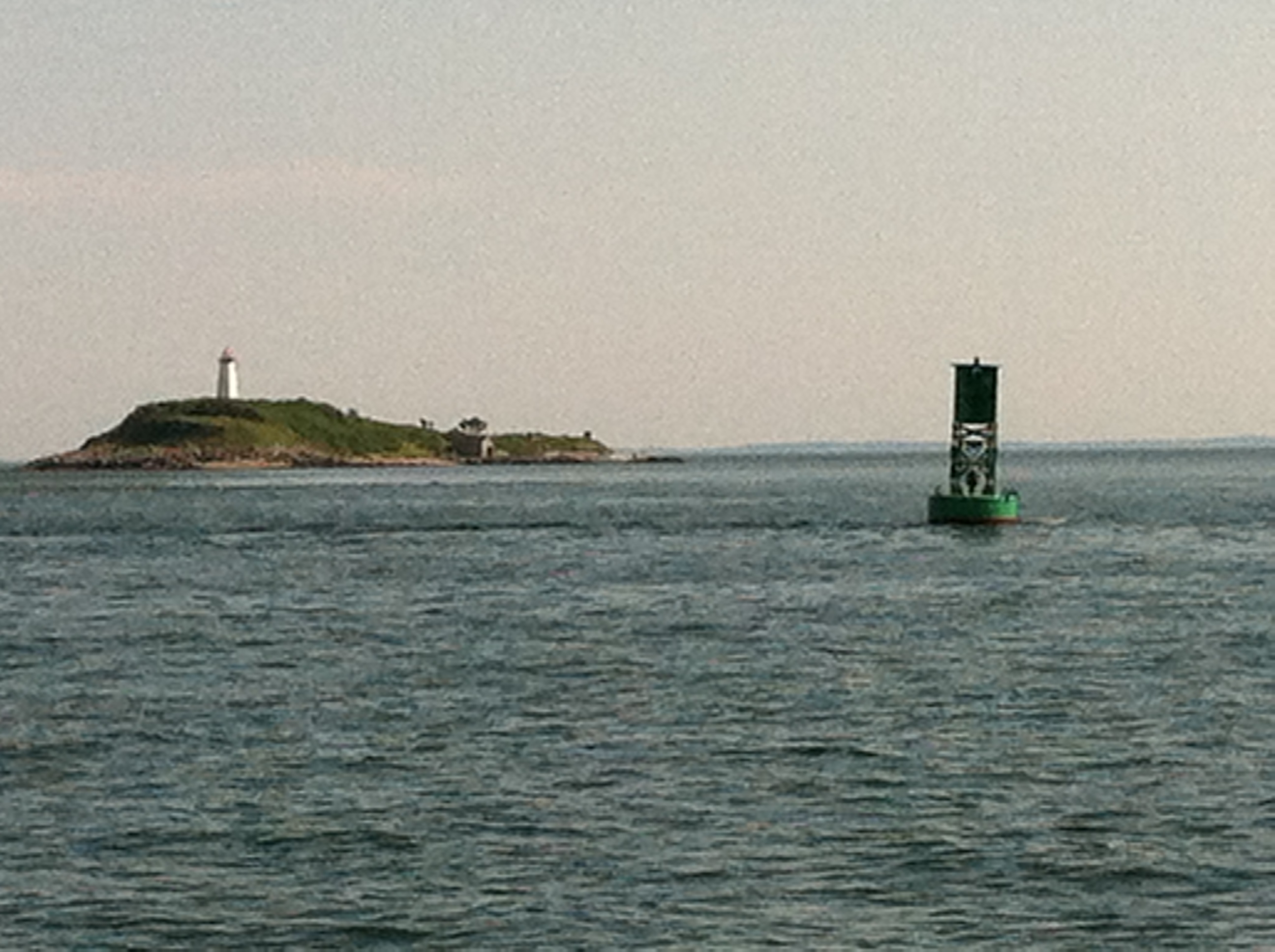
Even on a calm day, the current’s enough to set the buoy to listing off Fisher Island.
Brewer’s, of course, had more business than Chris had expected and slipped Steadfast into the one remaining space of more than 250. There was no electrical hook-up and the pump-out station was conveniently situated outside the cockpit. When asked later whether the aroma was included at no cost, the dockmaster offered to discount the night’s charge. Much appreciated.
Saturday morning, of course, Ms. W gave an opportunity to practice the fuel line bleeding process–I am gaining some measure of facility at this–then fired and we headed east to Mystic, hoping to get in before the expected showers / thunderstorms. Having left 4 hours earlier than the day before, the current now was not favorable, the wind light and–with the frequent wakes of motor yachts–it turned into a real slog through a 2 foot slop most of the way.
It was all worth it, though, to grab a mooring off Haring’s in Noank, at the mouth of the Mystic River. That was a short dinghy ride across the busy channel (an adventure in itself, testing the limits of the Walker Bay 8) to dinner at Ford’s on the pier. As is the case with the neighboring Abbott’s and Costello’s, Ford’s is BYOB. But Universal Package Store (or UPS) is just up the hill so, after provisioning with a couple of six-packs, it was back to Ford’s for lobstah rolls and beyah. Yum!
The diesel fired first try Sunday but with winds again light, we motored up river an hour to the Downtown Marina (which had just lost power to its pier so dockage was half-price!) and a stroll around town.
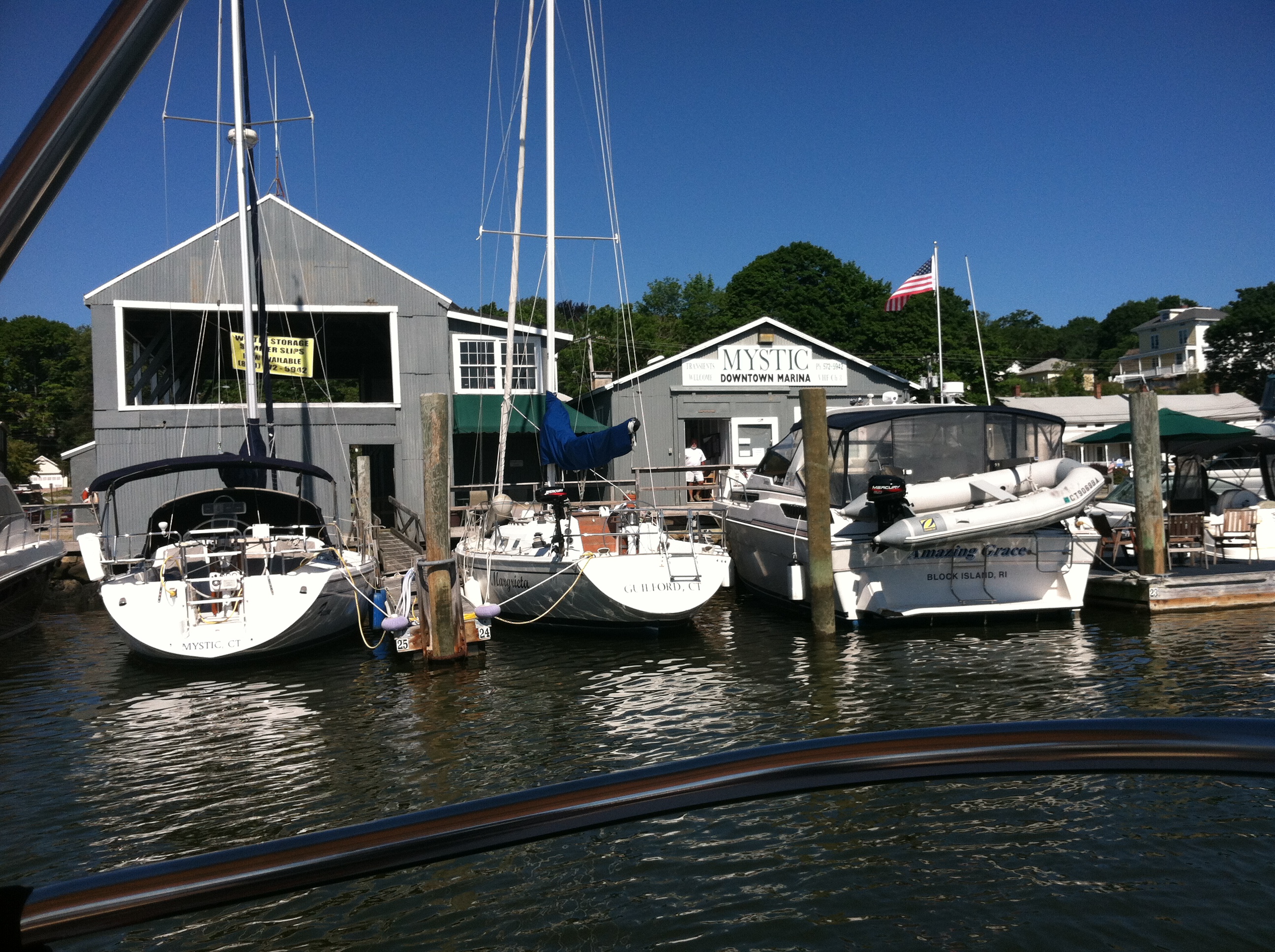
Just a couple of blocks from the US1 bridge, the convenience of Downtown Mystic Marina is worth the long motor up river.
The train station is just a few blocks away and Dylan will catch the 11 o’clock tomorrow to head to RI to spend time with family there. It’s hard to see Dylan go, especially having done no “sailing” at all, but Mystic is a lovely town, one we’ve visited many times before by car, and has been a perfect place to spend time together.
Steadfast, out.
10 July: Block Party
“Sheesh! Waih-YOU comin’ from – long sleeve sheuht and jeans? It’s a beautiful day!”
The New Shoreham harbormaster has a good sense of humor, as many Ro-di-landahs do. Good thing: he’s a busy man, especially this Tuesday afternoon when, for some reason, the town’s mooring field is chock-a-Block full. So he’s hustling about Great Salt Pond escorting each new arrival to a vacant private mooring for the same wonderful $40 fee.
And how did Block Island become the day’s destination, you ask? The temptation is to write about treacherous seas, the challenge of making passage in the deep Atlantic. In truth, it wasn’t hard. Topped off the fresh water tank, scrubbed three week’s worth of scum off the bottom of the dink (easier to tow, maybe?) and, of course, drained the fuel filter. Ms. Wes fired again like a well-behaved lady eager for a day’s work and we cast off from Mystic Downtown Marina at 0925. Without doubt, that was a delightful stop – the managers, Jack & June; the location, close to Main Street; and the ambience, including fresh herb garden.
There was a 10-minute delay for Amtrak to cross the Mystic bridge, then the hour motor downstream to Fisher Island Sound. It seemed a shame to waste such a lovely day–bright sun, clear skies, flat seas and 70-degrees. So once through Watch Hill Passage against a knot-and-a-half current, the decision was made: Newport would be more than 35 miles but the entrance to Block beckoned just 12 to the southeast, and was made at 1419. Getting here from Watch Hill is easier than finding Anegada from Virgin Gorda. On a day like this, Block you can see…all the way!
Not much wind but what the boat made use of, averaging close to 5 knots for the total 24.5 mile trip. Those 5 knots of apparent wind in the shade of the Bimini awning made it quite comfortable with sleeves and jeans, hence the harbormaster’s inquiry as he eased Steadfast up to her mooring for the night.
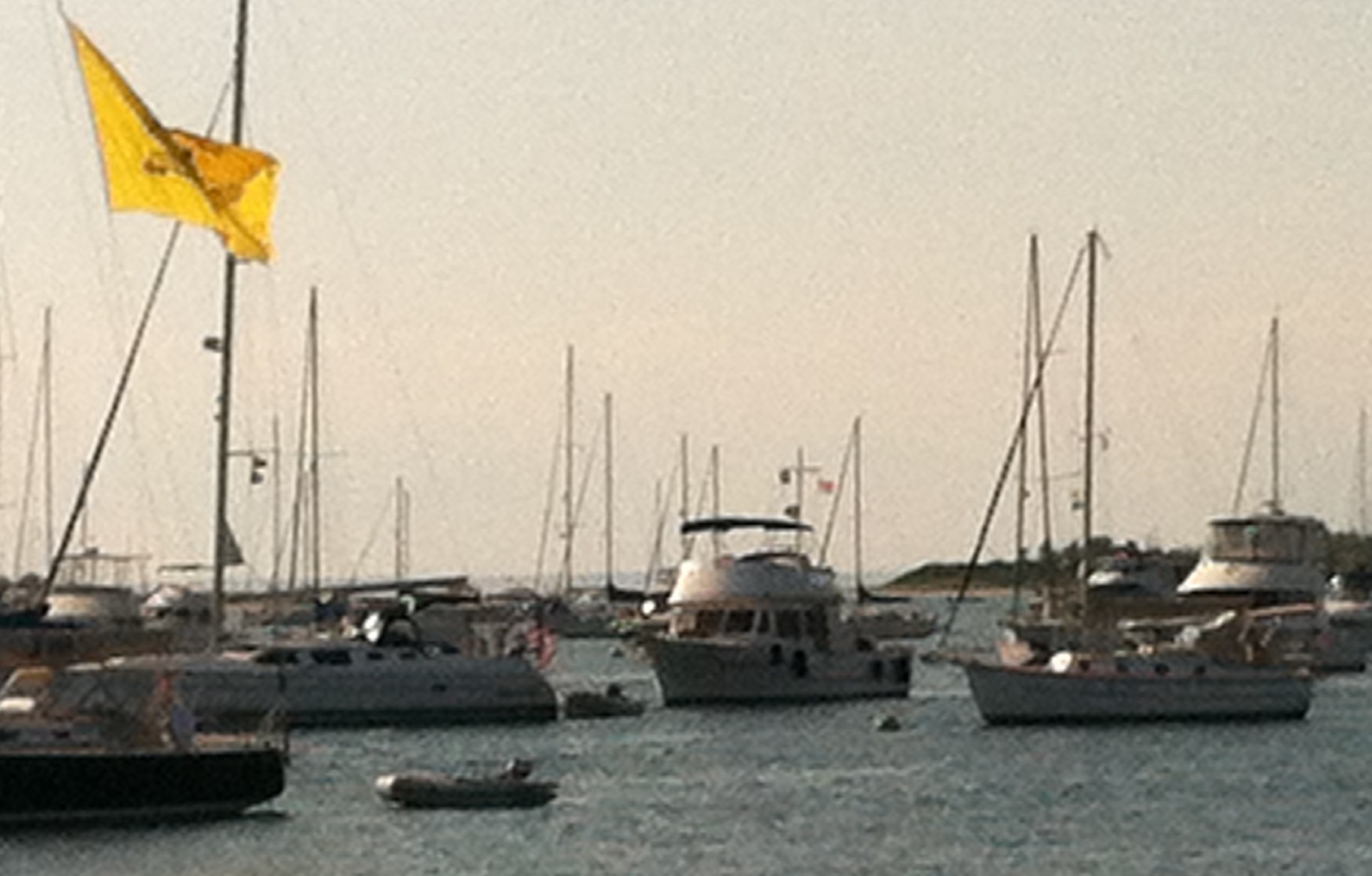
You get to know your neighbors in Great Salt Pond, with boats on all 400-or-so moorings and in the snug anchorage.
Interestingly, there was virtually no traffic coming across to Block, yet it’s packed in here. And they’re still coming in. One can only imagine what it must’ve been like for the Fourth. Good thing the harbormaster has a sense of humor.
Steadfast, out.
12 July: Early Out
They rise early here in Great Salt Pond. Not everyone, mind you, but apparently those who want to be sure of riding on a town mooring. It would be two hours before the anchorage would be roused by the rhythmic cries of “Ahndi-AH-mo. Ahndi-ah-MO!” from Aldo the baker motoring between boats in his red and white skiff.
All seemed still and quiet while the coffee brewed at 0530. Then, the first cup only half gone, a hull was seen to leave a ball in the coveted town mooring field. Then a second a few minutes later. Ah, says the wily skipper, “I’ll snag one of those before the rest of the anchorage even knows they’re open.”
Wrong. Before the mooring line could even be cast off, an inflatable dink zoomed through the mooring field and its pilot grabbed one of those just vacated. A 40-foot sloop swooped in to take the other and the party began. The 90 town moorings, you see, are at a premium. The same forty-bucks for the night BUT you can stay as long as you like. No reservations accepted; all first come, first served.
As a result, the mooring field stays full. But the skipper of a 25-foot Wellcraft sport cabin–Early Out of Noank, CT–was just sitting down to his first cup in the cockpit when Steadfast completed her failed try at a mooring ball. He confirmed they’d be leaving in an hour or so.
“Would you be willing to give us a call? Steadfast.”
An hour later he did, the exchange of the mooring pennant was made and Steadfast was secure. Early Out, indeed. It was then 0715. Others continued to school like sharks ready to strike. Competitive, these yachtsmen. Your intrepid skipper, however, used the succeeding hours first to drain more water from the fuel filter (just a couple of drops) then, since we’d motored through a good bit of seagrass the last few days, check the filter for the engine cooling water intake. Good thing, it would appear. Once the filter was cleared and all once again stowed, it was time to row ashore, walk the mile or two to Old Harbor and lunch at Rebecca’s. Good stuff. There was a stop to reprovision at Block Island Grocery, another on the pier for a bag of ice, then back on board to restock the ice box.
A quintessential New England town, New Shoreham (Block Island) is a photographer’s delight.
Ashore, there’s a photo op in every direction. Block is highly recommended to those who enjoy a cool ocean breeze and a generally laid back atmosphere as stated eloquently on the tee-shirts for sale at Payne’s Marina: “This doesn’t suck.”
Early out? Not when you come to Block. You gotta stay at least little while.
14 July: Honey, I’m home!
For such a busy and popular harbor, the day starts quietly in Newport. The gulls are laughing, of course. Watermen chat over coffee on the commercial wharf, waiting to head out. But after a night of sampling the entertainments on Thames Street, it appears the yachtsmen here start their day slowly. A striking contrast to the raucous scene on arrival in mid-afternoon. After motoring among kids in the sailing camp’s dinghy fleet, dodging the high speed ferry to the Vineyard and giving way to several large motor yachts, this was the harbor view that opened on rounding Fort Adams.
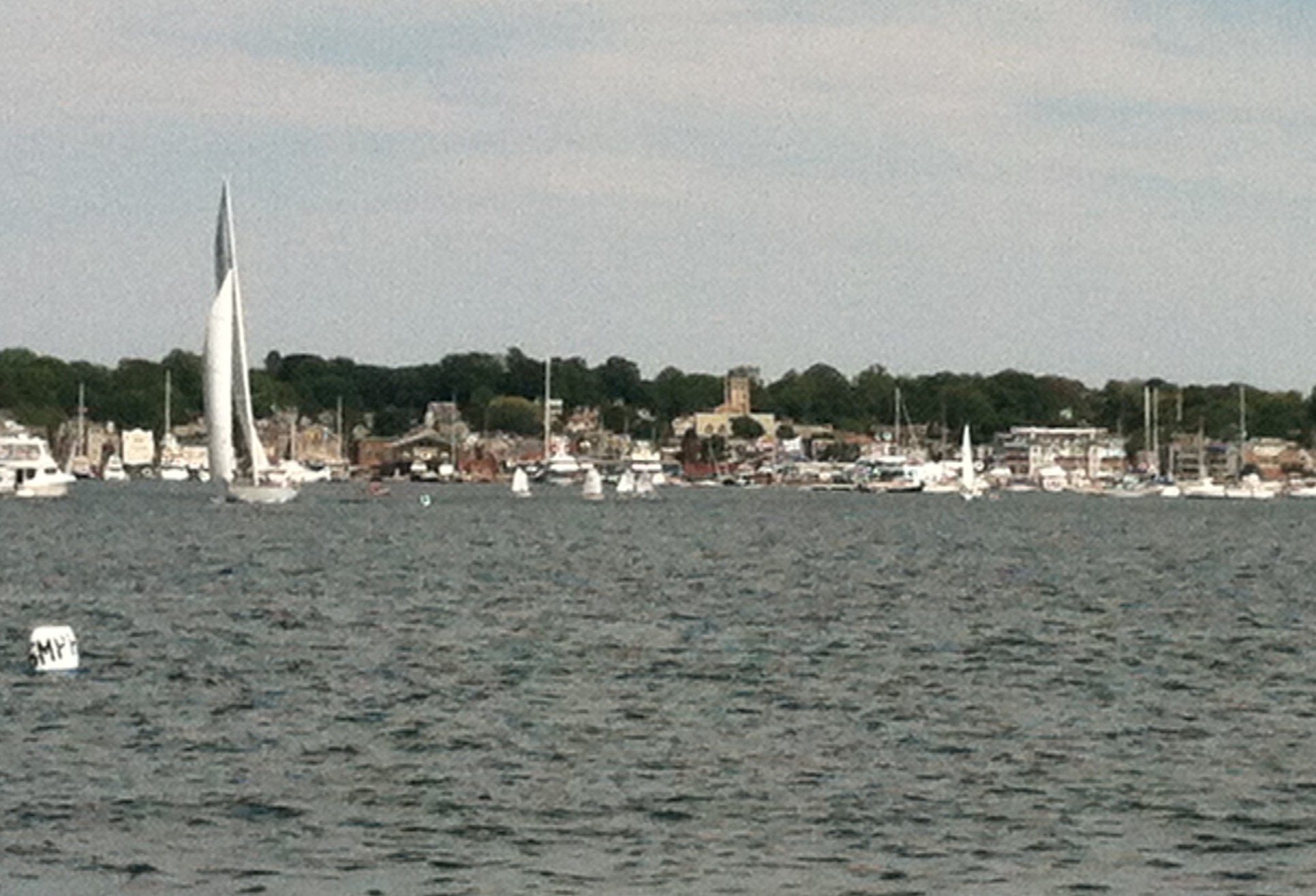
Kids at sailing camp, tourists on a classic 12-meter, lobstermen with the day’s catch, all of Newport seems underway.
Annapolis, eat your heart out! THIS is the sailing capital of the US.
From a 10-foot hydrofoil with Kevlar sails to classic 12-meter America’s Cup veterans and 100-foot schooners loaded with tourists, all manner of craft make way through the harbor…under sail!
For Steadfast, the crossing from Block was uneventful–the preferred status, by the way–but not nearly as relaxed as the trip over. In fact, once out of Great Salt Pond at 1028, it was not relaxed at all. The Pond was still, the sun hot, so there was no expectation of sailing. Despite the light so’easterly, the ocean swells outside quickly built to 4-feet and a parade of passing motor yachts left it confused in their wakes. There was no stepping away from the wheel. The helm demanded two hands at all times, so no photos out there.
But about noon, the beam seas began to moderate enough to suggest unfurling the genoa. That worked so well that three miles south of Point Judith, the main went up, too, and–are you sitting down?–Ms. Wes took a break. We sailed. In the deep Atlantic, and Steadfast settled into an easy motion on a broad reach making 4-to-5 knots. That was carried almost to Brenton Reef–the southernmost point of Newport (Aquidneck) Island–where there just wasn’t enough wind to make the more northerly run into the harbor. Rounding Castle Hill light gave a good view of several stunning estates including Hammersmith Farm, where young Jackie spent summers learning to be a horsewoman.
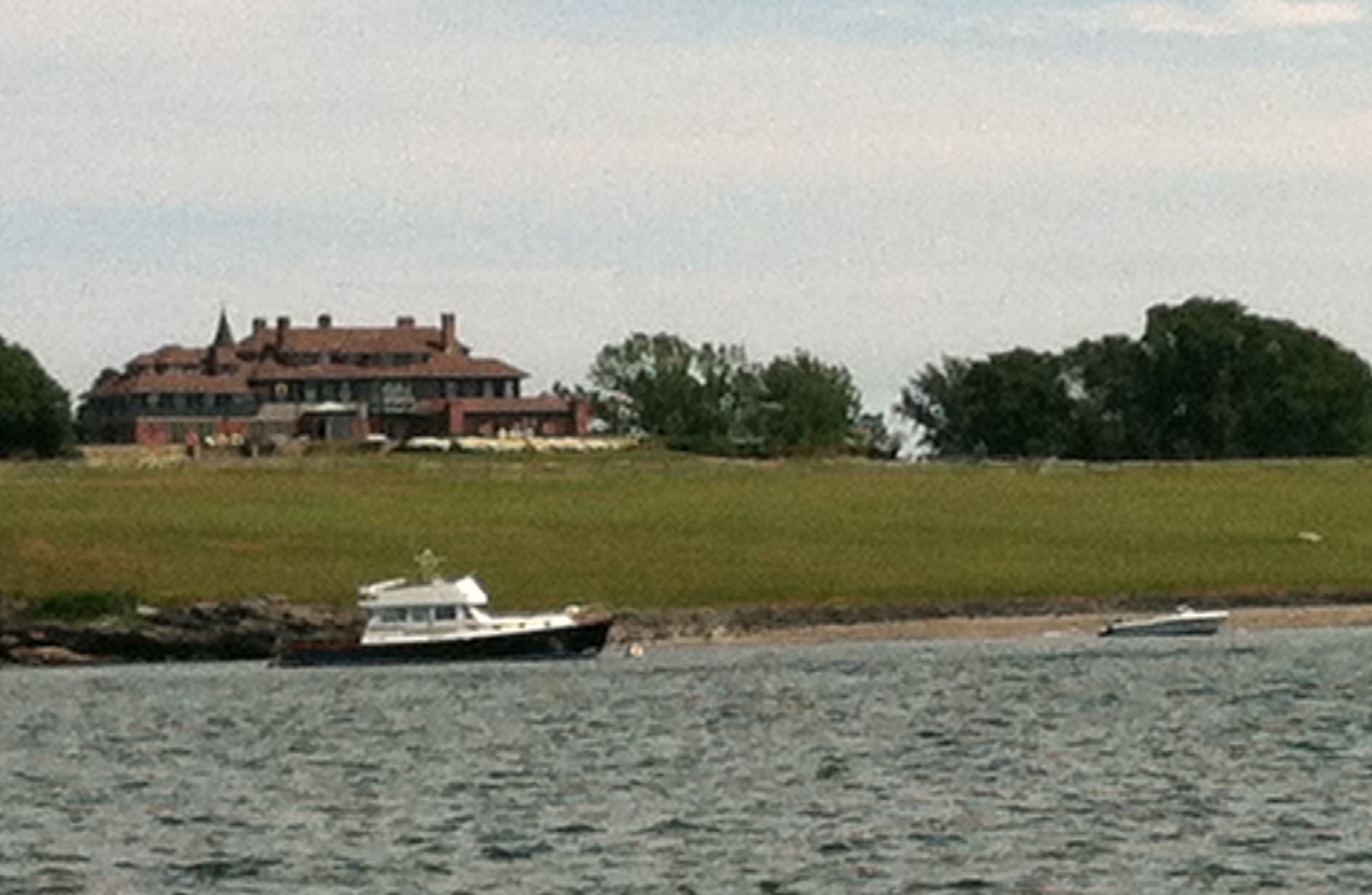
The famous Hammersmith Farm is one of the many stunning properties on the Newport shore.
Making Block Island felt good. It is part of my native state, after all, and there are childhood memories of trips over on the ferry with Dad. But boats in harbor and cars on the roads are mainly from New York or Connecticut. Everywhere you go, Rhode Islanders seem in the minority.
Certainly tourism abounds in Newport but there’s no mistaking, this is Ro-die-lan. One need not explain the Red Sox cap nor preference for Sam Adams. And having spent a good bit of the college years with friends in Newport, it was special to be at the helm today coming into the harbor.
“Honey, I’m home!”
13 July: Little Bitty
Venturing into the Atlantic swells, coming across Block Island Sound, 27-feet seems a small hull, indeed. Steadfast does not gain in stature in Newport Harbor, passing the vintage sailing yacht with uniformed crew of six or the mega-motor yachts the size of the shoreside hotel. As Larry the Launch Skipper says, “Ya gotta have at least a 60-footer ta stan-dout in Noopawt.”
Steadfast did stand-out in one way, however, that being her ability to secure the last mooring available Thursday evening because, yes, she is only 27 feet and could squeeze in among a handful of daysailers on the harbor’s north end.
Friday the Thirteenth began with breakfast at Benjamin’s, one of the few remaining local hangouts among the chi-chi shops and myriad tee-shirt vendors on Thames Street.
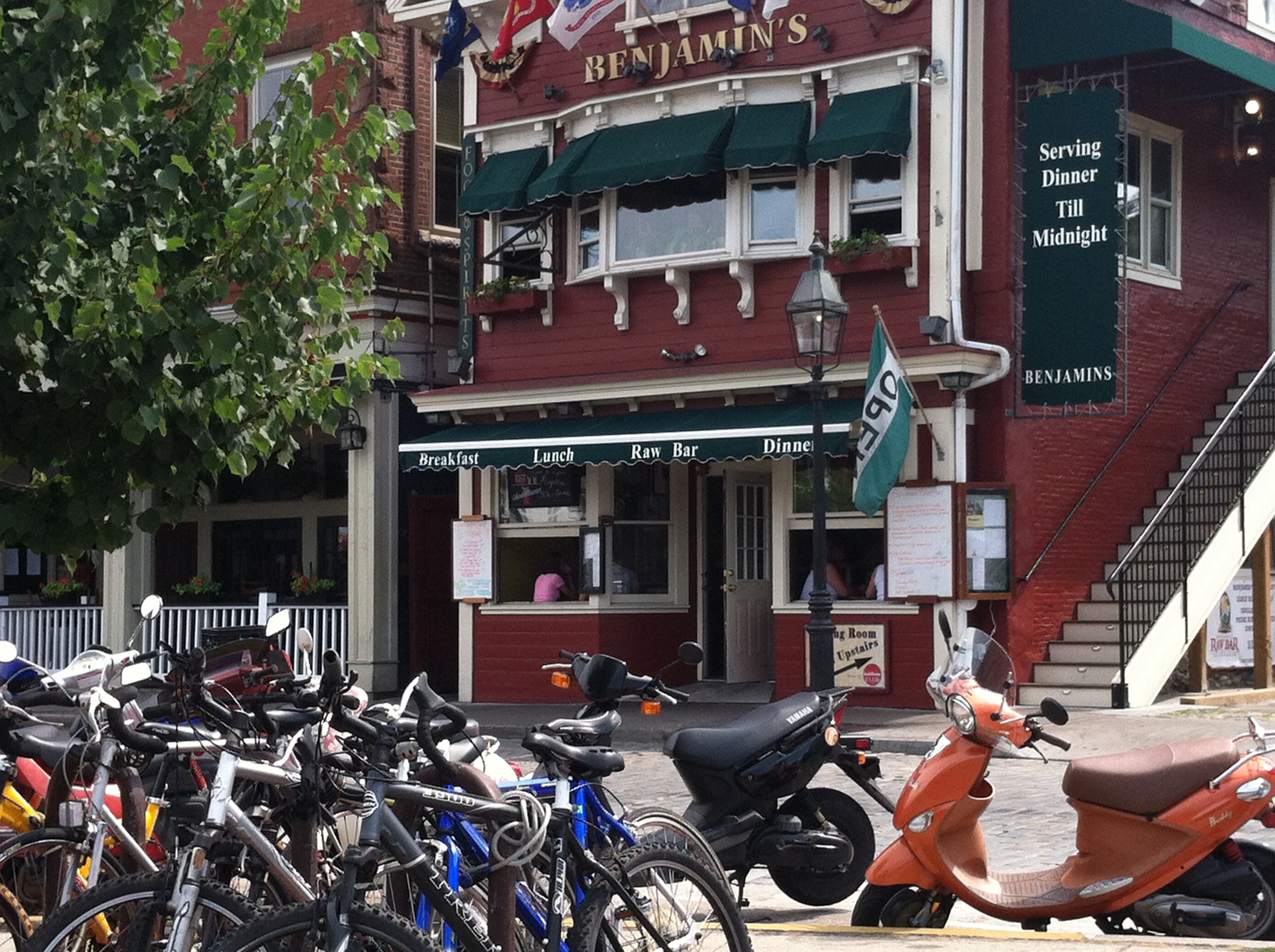
The raw bar is open for breakfast at the Thames Street landmark Benjamin’s.
It then morphed into a layover day. The deciding factor was not superstition, mind you, but a further lack of tolerance for the state of the cabin. After four weeks underway, there was some sprucing up to be done: minor repairs to hatches and rails, and, polishing the bronze ports (but I don’t do windows). Amazing how much better she looks. There are eight of those guys to maintain, if one is so inclined. There’d be more, of course, on a 40-footer.
It’s further proof of the wisdom of the well-known philosopher of song, Alan Jackson: “It’s alright to be little bitty…”
Steadfast, out.
14 July: Wind!
There’s a reason Newport is a center for sailing. This part of the world is well-known for the so’westerlies that typically blow 10-15 knots, all day, all summer long. But Saturday’s forecast was not quite as encouraging–light winds early, not building ’til late in the day–and an early spritz gave way to a thick but bright overcast.
No matter. Two days is about the limit in any one harbor so the mooring was cast off at 0945, the island’s southern point, Brenton Reef, cleared an hour later and somewhere off in the haze on a heading of 115 was the entrance to Buzzards Bay.
The main was up but mostly as a steadying sail against the three-foot seas on the beam. With this sky and from two miles off, photos of the coast would not show much. So you won’t see any shots from the morning. By noon, the light southerly freshened enough to coax out the genoa which helped pull her along at 6 knots with Ms. Wes turning just 2000 RPM. From there, the log is sketchy at best. Just know that NOAA was prescient, the wind continued to build, Ms. Wes took a break and by 1230 we were sailing a broad reach making a steady 5 knots. Not bad.
Turning north into Buzzards Bay meant the wind was dead astern, not the easiest point of sail to handle, especially with the following seas. It became moot, though, when the skipper of a tug towing a half-full fuel barge announced his intention to use the Buzzards Bay channel, too. Discretion in this case meant Steadfast altered course ’til the tug passed and Steadfast once again could head north.
Some thought had been given to maintaining the earlier heading straight out to Martha’s Vineyard. The decision to head, instead, into the Bay proved more prudent as the wind kept building. By the time the call for a mooring was made to New Bedford Yacht Club, it was a steady 15-18 and gusting in the 20s. The anxious moments that followed, hoping a mooring would be available, were wasted. There reportedly are more than 800 moorings in Apponagansett Bay. And access to the moorings means using a tender of some kind, some kinds quite colorful and traditional.
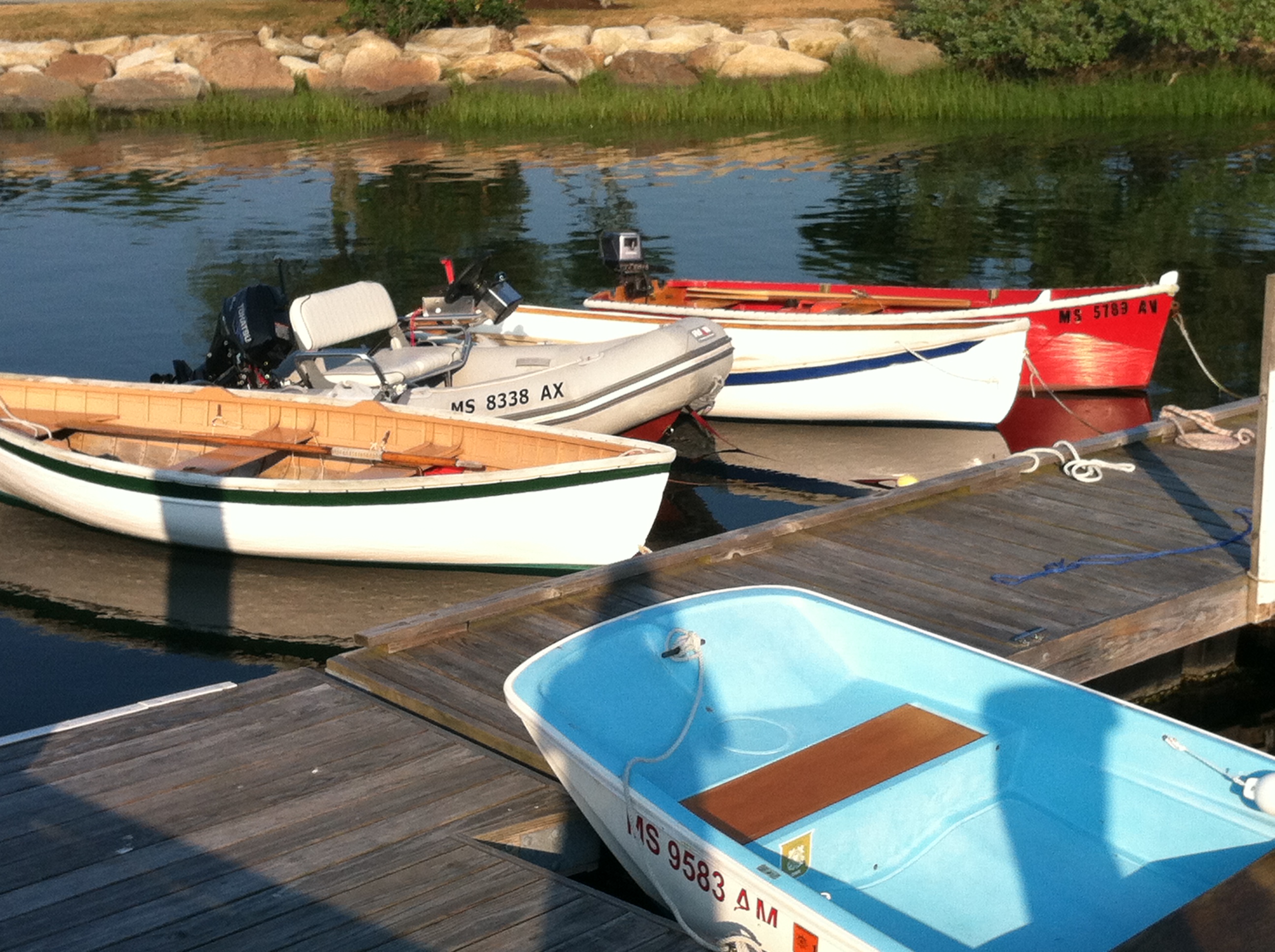
Dinghies describe a colorful palette at New Bedford Yacht Club in Padanarum, AKA South Dartmouth, MA.
A late start to the morning, an hour’s stroll around Padanarum, home to the well-known Marshall catboat, and skies threatening thunder storms all conspired to keep Steadfast on the mooring for another night. But this being the second day, she’ll want to be underway again tomorrow, seeking those so’westerlies again.
Steadfast, out.
16 July: At the Onset
Chris and Bill brought Plover, their 41-foot Dickerson ketch, north from Delaware on the offshore route and, after sailing straight through–including the storms Sunday night–sent an email that they’d turned into Buzzards Bay before dawn Monday, headed for Onset, MA. It seemed reasonable in contrast to bring Steadfast the 30-or-so miles east from Padnarum to meet them. In the process of so doing, today’s profound thought occurred, i.e., tools work far better when used for the purpose for which they were intended. Example: a straight blade screw driver works quite well as an ice pick but not nearly as well as it does turning slotted bolts.
Likewise, many auxiliary powered sailboats motor quite well but never as well as they handle under sail. Monday provided further proof of the latter. A light nor’westerly followed Steadfast out of Padnarum at 0730, mainsail set to try–not altogether successfully–to keep her on an even keel with the two-foot seas running off her starboard quarter. Once turned toward Onset and headed east, though, the genny was unfurled, Ms. Wes took a much-deserved break and we sailed. Honest. Here’s proof.
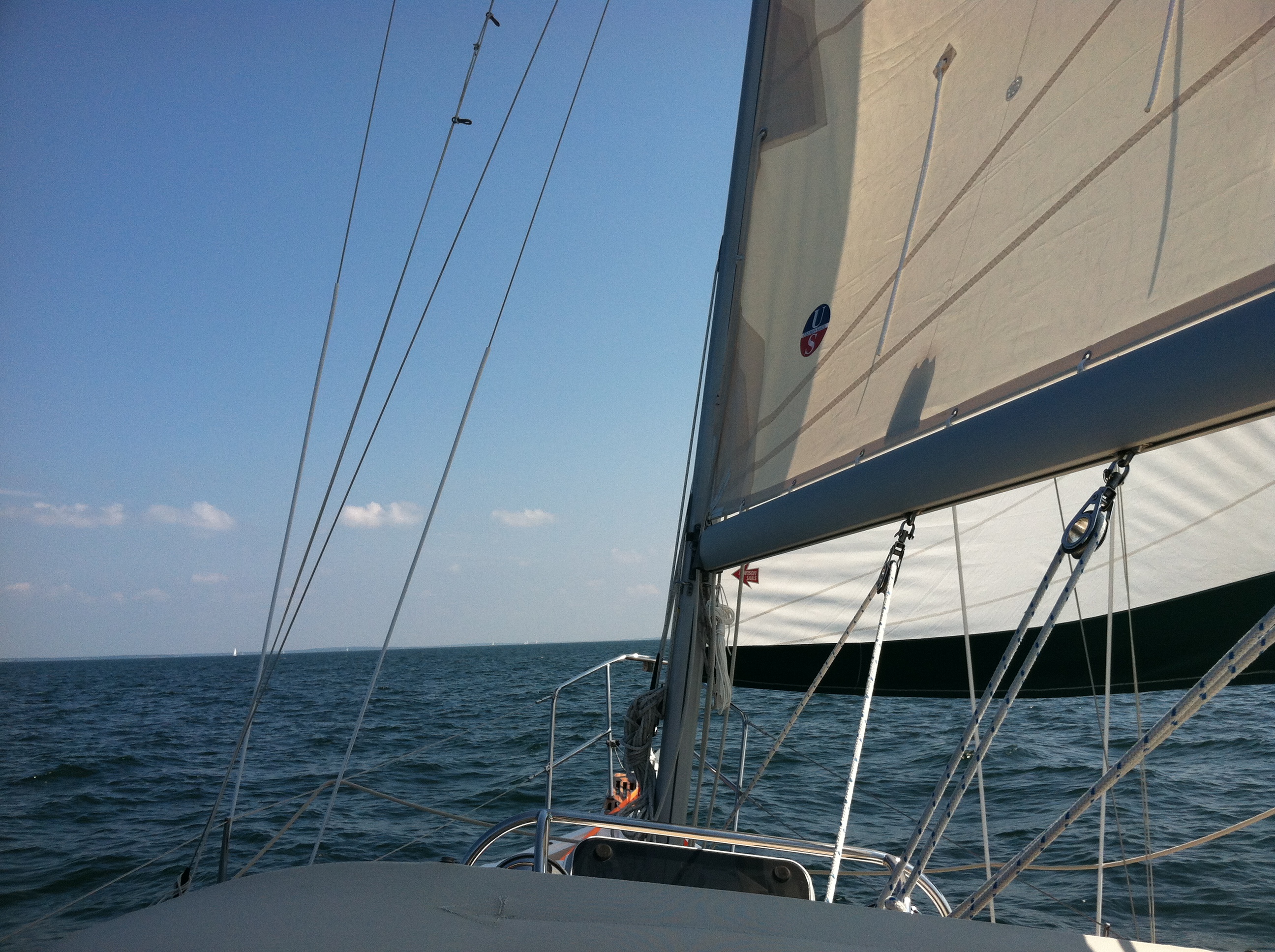
In what proved an unusual experience, wind filled her sails and Steadfast beat up Buzzard’s Bay.
It took a few minutes–not much of this has been done on this trip, after all–but we both settled into our respective roles and Steadfast began to behave in the manner to which she was born. Ten knots of wind had her heeled 12 degrees and doing a smart five knots. Not as quick as under power, mind you, but much more comfortable. She likes to sail, by golly!
Onset lies just off the channel leading into the Cape Cod Canal, a handy place to stop and wait for a favorable tide. Currents through the canal run about four knots so it’s best to have it running with you, ebb west or flood east. And its quite a lovely little village, just a good 15-minute stretch of the legs from the mooring field. There’s beach all around the harbor, more akin to the Cape than the rocky shores west of here, with handsome Victorian-era homes standing proudly among the more prevalent and modest weekend retreats.
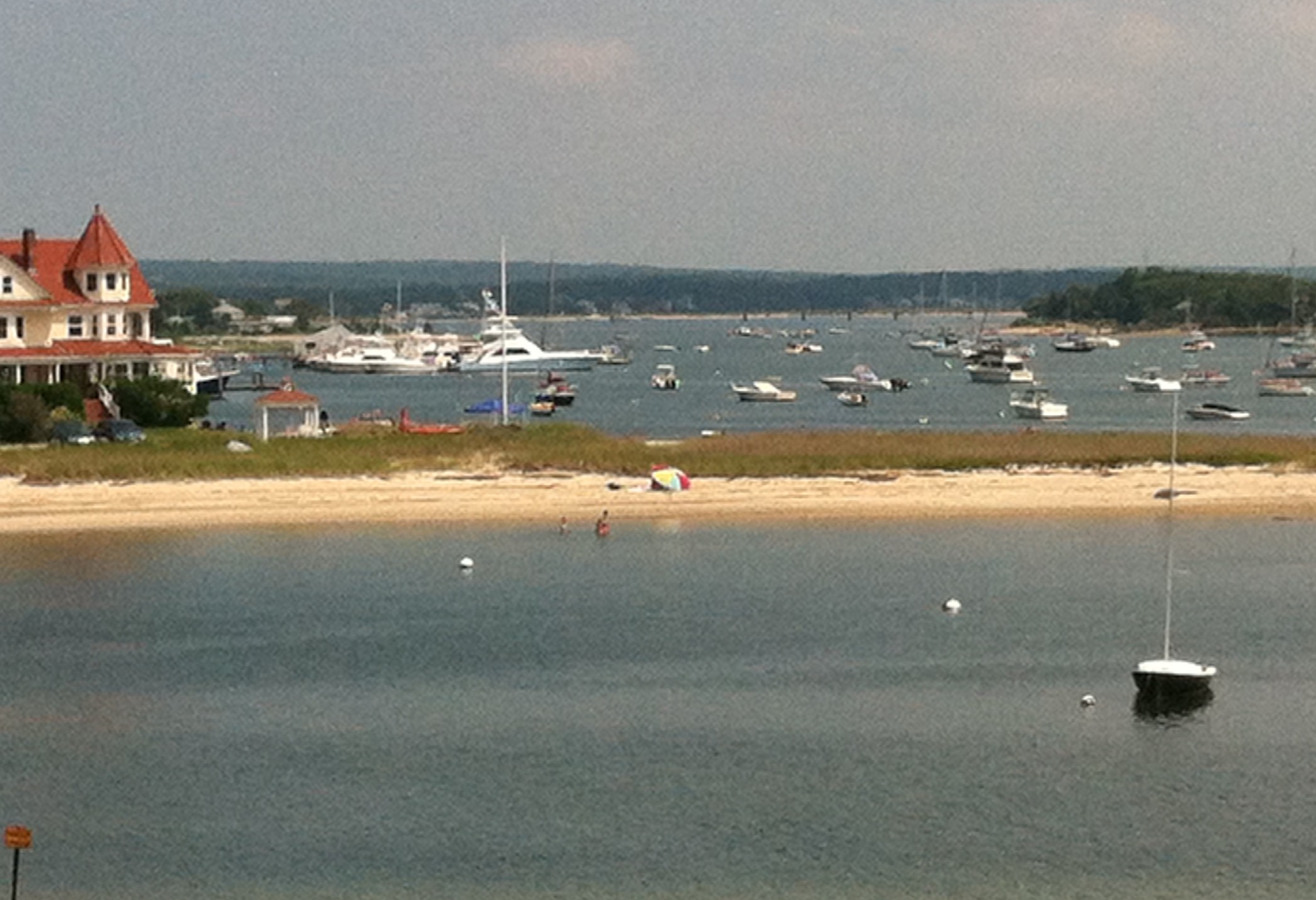
A long sandy bar separates the Cape Cod Canal from the harbor at Onset, sheltered from virtually all directions
It was good to visit again with Chris and Bill–our wakes last crossed in Annapolis–and, indeed, we dined together tonight, charting the planned transit of the canal tomorrow afternoon to coincide with the favorable tide as we head into Cape Cod Bay.
Steadfast, out.
18 July: Good Time for a Sandwich
“That’s a really beautiful boat. What kind is she?”
Ah, does the skipper live who doesn’t love to hear that? But that’s not what endeared Tom to me this evening. No, Tom was…well. I get ahead of myself.
Plover took on fuel early this morning as planned. The rest of the day was spent waiting for the much-discussed “favorable tide” to carry us through the Cape Cod Canal. The max is something over 4-knots so, in a boat that makes five or six at best, you want to have the current with you. Fifteen hundred was the designated hour, about thirty minutes before slack tide. Eldridge Tide & Pilot Book–the seaman’s Bible up here; don’t leave home without it–said that’s when to go so that’s when we went. This despite the forecast that carried a severe thunderstorm watch. But, hey, you know what that’s like. Maybe yes, maybe no. In fact, NOAA described it as a 50% chance.
The canal is just a 9-mile ditch, basically, a hundred feet across with 30-plus feet of water and rip-rap stacked on both banks. Worst case, were a storm to hit and visibility shrink, just follow the east bank ’til you get to an opening, turn right and you’re into Sandwich Town Marina (not unlike Cape Charles Town Marina, by the way; nothin’ fancy, lot of work boats, and a Coast Guard station right there). It’s the only place to tie up within 20 miles. Given the late start and the forecast, I’d called this morning to make a reservation. (Plover’s crew, intrepid as always, never wavered from its stated intent to make Provincetown tonight.)
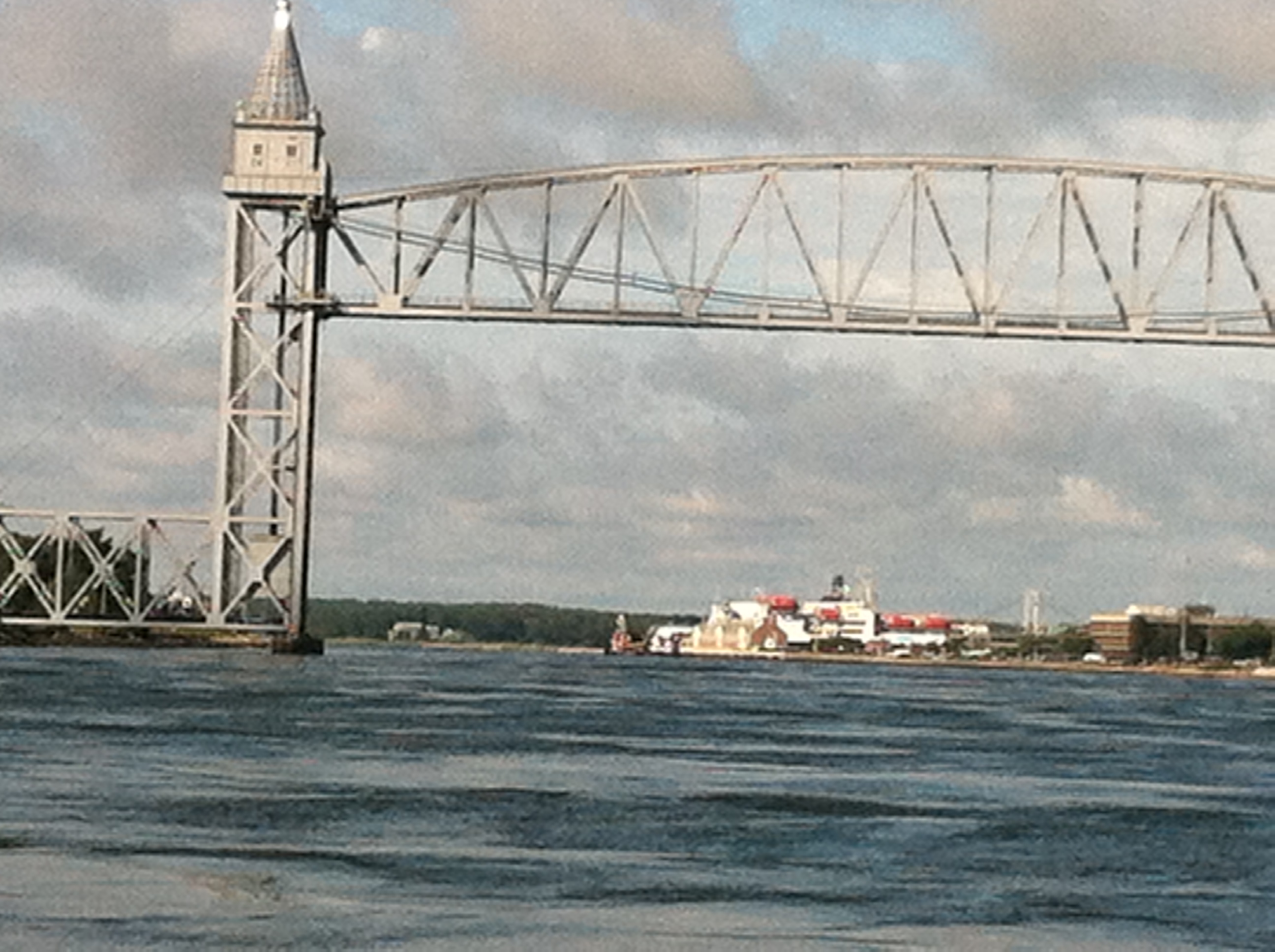
The railroad bridge that spans the Cape Cod Canal is just west of the campus of Massachusetts Maritime Academy.
Not long after passing under the railroad bridge that greets eastbound traffic first, the temperature started to fall out of the 90s and the sky to the west darkened. As the speed-over-ground picked up–5, 5-and-a-half, 6, eventually 7-plus knots–there was reason to hope Steadfast could be tied up before the storm hit. Not confidence, mind you, but hope.
It was just starting to spritz when the Sandwich Marina appeared to starboard and the turn was made. The dockmaster stood on the fuel dock and motioned to an open slip.
“Do you want me to come around to help or do you have it?” he shouted over the then rising howl of the wind. It appeared there’d be no need as Steadfast slid gently between the pilings and slowed to a stop. Sort of.
Right then, the wind shifted a bit more to the north and a gust swung her sideways across two (fortunately empty) slips. And that’s when Tom left the snug cabin of his 35-foot fishing boat to grab, first, the bow rail and, when offered, a stern line. A bit of a fire drill as it turned out but Tom was most gracious as he stood in the spritz and offered his previously mentioned assessment of the boat. “Well, she sure is pretty,” he added.
We chatted further as docklines were secured and the dinghy made fast. And just then, BOOM! an impressive jagged bolt discharged about a quarter mile to the west and the heavens opened. Others bolts of lightning followed, all around, and briefly the boat bent to the gusting wind, heeled at 10 degrees in the slip.
The storm was done in a few minutes, of course. With any luck, it may have missed Plover altogether. We wait to hear. But for the moment, Tom is my new best friend and this is by far the best Sandwich I’ve made in a long time!
Steadfast, out.
19 July: Providence
A pair of sockless, ‘Sider-shod feet are seen through the port over the galley stove.
“Hey, Bill? My brotha Jawj and I ah gonna go get some breakfast. Wanna come?”
The voice is Tom’s. You remember Tom, right? He of the impeccable pre-storm timing? Breakfast out wasn’t in the morning’s plan but, sure, what the heck. And into Jawj’s (that’s George’s) cah we go.
“I’m givin’ ya the nickel toowah,” says George as he drives through the village. “That’s the steeple that Christopha Wren designed.”
Tom’s home is Falmouth, on the other side of the Cape but George lives here in Sandwich. Lovely village, Sandwich, and one which would’ve remained unseen were it not for George. Or maybe Tom. Tom, you see, discloses that “I’m not even shewa why I came in heeyah last night. I thawt I was goin’ home to Falmuth but, for some reason, just came in heeyah, I don’t know why.”
The tour ends at The Marshland Diner where the bench out front is full of hungry would-be patrons. “Don’t wawry,” says George assuringly. “It won’t take lawng.”
He knows, of course. Three seats soon open at the counter and breakfast arrives shortly thereafter: the Poppy Bagel McNagle – toasted bagel with a cheesy omelet on one half, the other smothered in mushrooms, onions and diced tomatoes. No need for lunch today.
When learning of the need to re-provision, “I don’t mind takin’ ya thayah. Tha Stop-n-Shop isn’t fah.” And it goes on. “I can pick ya up, too. I insist. Glad to do it.”
After giving a boost to the local economy, stowing provisions and saying goodbye to Tom–he decides to head home–Steadfast re-fuels and ventures into the remaining few hundred yards of the Cape Cod Canal at 1300, then turns north toward Plymouth for what has all the signs of an uneventful 20 miles.
Then – no warning – Ms. Wes starts breathing hard. She doesn’t feel well, it’s clear. Steve Blake, in Newport the other night, told a story about snagging such a big wad of sea grass one time that the prop jammed. Steve’s remedy – revving in reverse – was tried but to no avail. That story, though, prompted a thought: could there be more grass in the water intake strainer? After shutting down, the quick inspection showed, yes, indeed – a wad that’d choke an elephant! Once cleared, Ms. Wes was happy again and back making 5 knots-plus.
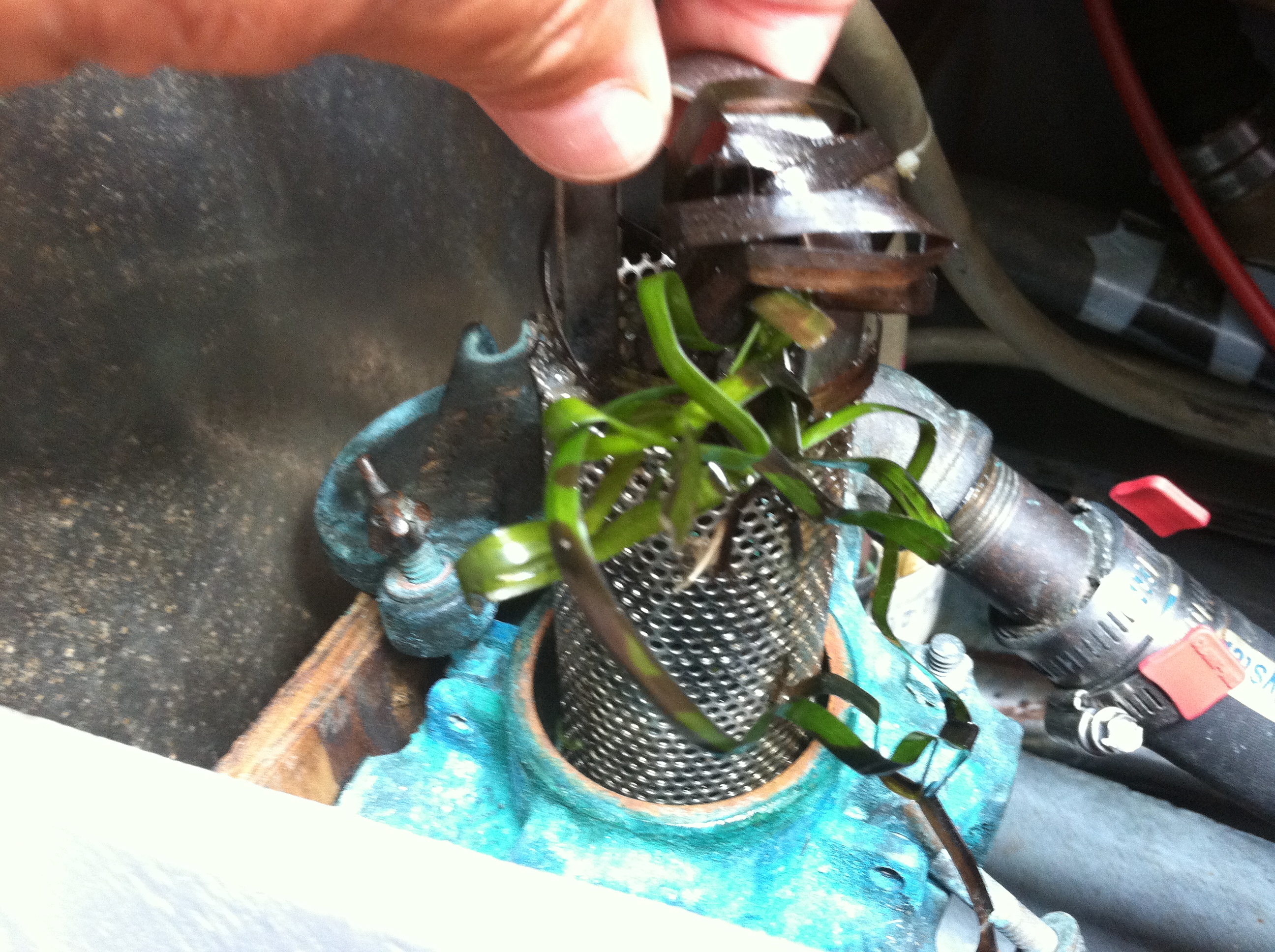
Clumps of seaweed to rival Medusa’s tresses became an on-going problem, clearing the Perko a morning routine.
Then, right at the turn into the 5-mile-long Plymouth channel, it happened again. This time, there was no clearing the problem so the genoa was deployed on a dead run into the first leg of the approach. The Harbormaster responded to an FYI call–no engine, under sail, just want you to know–by sending a boat to check. He continued to check in from time to time the rest of the way and, two hours later, the Plymouth Yacht Club launch came along side.
“The Hobbah Mastah told me to give you a tow into yaw mawring,” reported Gary, the launch driver, and the day was done.
Could be coincidence, Steve Blake telling his vignette about the seagrass a few nights ago. Could be serendipity, Tom being on the pier last night just in time to help Steadfast tie up before the storm hit. But remember, he’s not even sure why he was at Sandwich Marina.
The reason to me seems clear: providence. Providence in Newport, Plymouth and Sandwich that made for a truly memorable day.
A darn good breakfast sandwich, too.
Steadfast, out.
20 July: The In-Laws
So it’s gettin’ close to ten pee-em and theah we ahh – me, Dave O’Brien and Joe Castiglione – just the three of us, commiseratin’ the way the Sawx can’t BUY a hit tonight when it counts and now, last o’ the ninth, looks like anotha loss. And Dave Oh’s voice, always resuhved, intones…
“…and the pitch, Ross swings. Lifts a high fly ball towards the wall, and…and it’s headed back, it’s GONE! A three-run homer! The Sox win! Ross with a walk-off home run and…”
And what a way to wind up the first night on Boston’s South Shore, or as Joe and the locals say, Shaw.
Anyway, that was last night. There was an early call this morning from the mooring ball. A lack of wind let the boat ride up on the plastic ball and it was caressing — well, banging on, is more like it — the hull at 0500, right by the skipper’s bunk. But that’s okay. There was scientific research to be done, as in, why isn’t the water pump pumping cooling water to the engine? Huh? Why?
After checking the usual suspects – intake strainer, impeller, heat exchanger – one does what one always does in such situations, i.e., call Bill Burry. Fortunately, Bill’s still within cell range, just over in P’town, and suggests — I am not making this up — disconnecting the intake hose and blowing on it to “make bubbles under the boat.” Whatever, hose clamps were released, the trumpeting worked and on a re-start, Ms. Wes maintained her cool for a full hour, no problem. Looks like we’re good to go tomorrow.
But first, there’s the requisite visit to the in-laws. So, clean-up, go ashore and–as luck would have it–as I walk down the street, Gov. Bradford is standing right there!
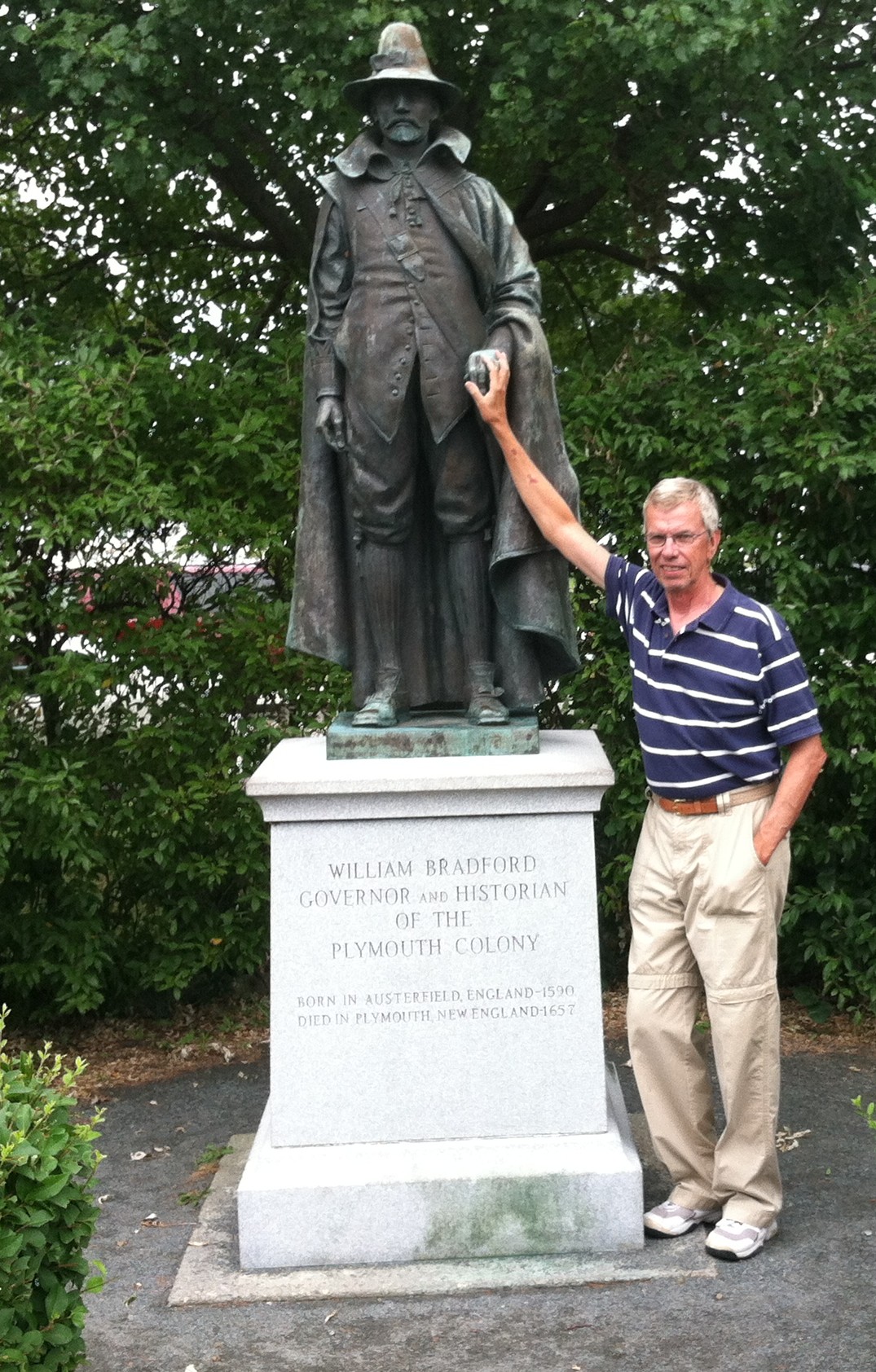
Checking in with the colony’s first governor who, as you can see, is not as tall as he looks in the movies.
Besides being the man who pretty much held the Plimouth Colony together in the early years, the Gov and Kate have some kind of distant relationship so paying respects was a requisite of the trip. A leisurely stroll along the Plymouth waterfront disclosed much the same scene as in Newport: boats moored on one side, while on the other are seen tourists in shorts and flip flops shopping for tee-shirts. Except here there’s a replica of the Mayflower.
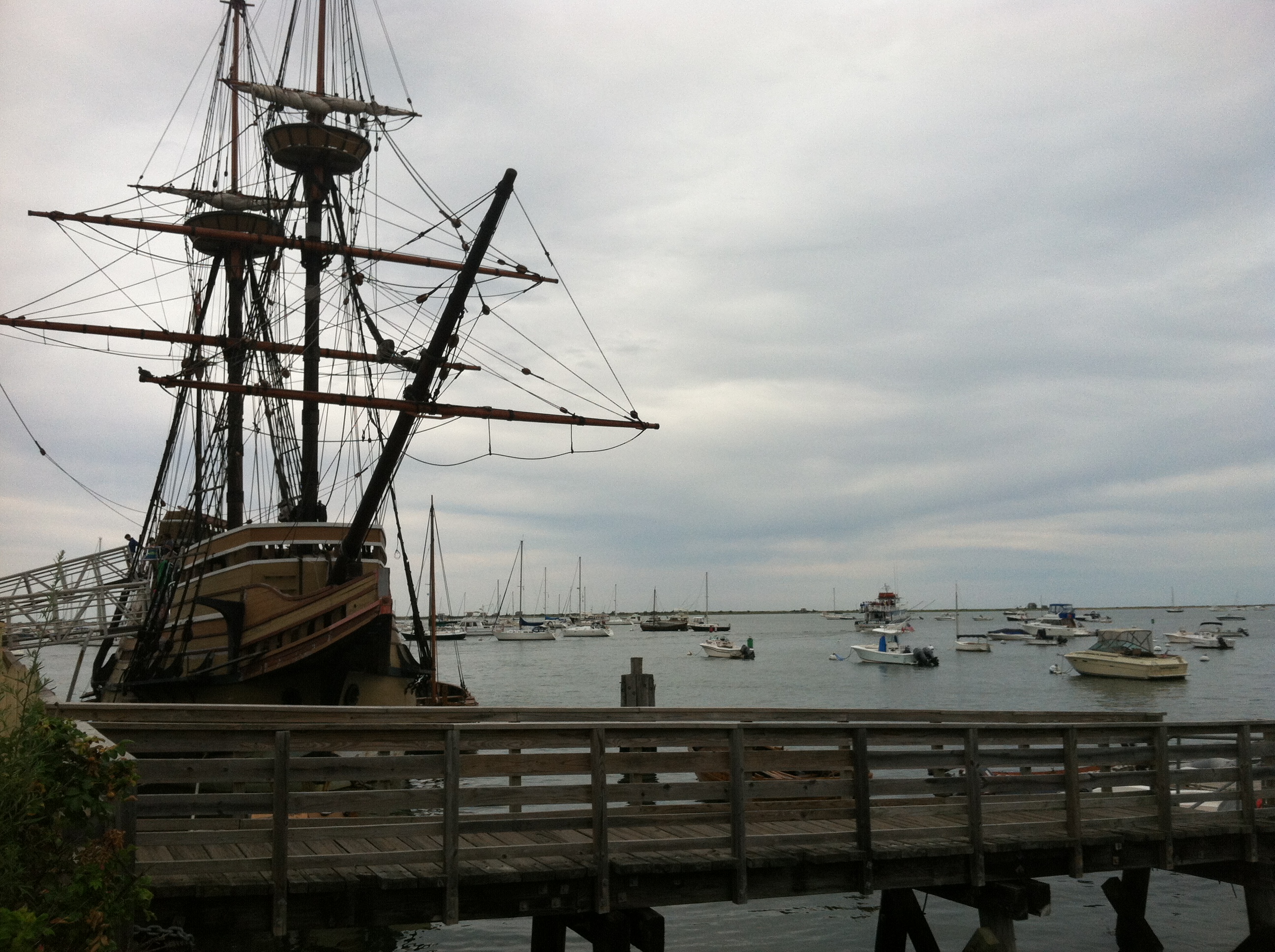
The Mayflower replica is on a pier just west of the Plymouth Yacht Club whose moorings lay beyond.
And there’s Plymouth Yacht Club where, so far, the staff couldn’t be nicer. It’s a set-up ashore much like the more familiar Hampton club, with pub-style dining upstairs, dressier on the first level. Quite nice facilities, all around.
And a strong signal from WEEI, “the voice of the Red Sox” again tonight.
Steadfast, out. Go Sawx!
21 July: Make Room
“Scituate Boat Club, Scituate Boat Club,” the woman’s voice betraying the fatigue of a long day on the water. “This is Dolphin’s Wake standing by at number eight.” No response from the Boat Club. At 2030, the sun nearly down, the crew of Dolphin’s Wake wants more than anything to hear that the club still has one mooring unspoken-for and that it’s a mooring in more than six-feet of water, DW’s draft.
Scituate is a popular harbor, it appears, and so crews keep steering their boats here even at this late hour. But even with 800 moorings bobbing on its sheltered waters, there isn’t always one for every boat that enters. And because it’s jammed with mooring balls, there is no place to anchor! But with a light easterly the forecast, Scituate also would be a relatively easy run up Massachusetts Bay from Plymouth so that was the destination of the day.
First, though, there was the matter of the six-mile Plymouth Channel just to get to the bay. There were just the few clumps of fluffy clouds hanging here and there along the horizon of an otherwise sun-drenched azure sky. Free of the mooring line at 0940, then bucking the flood tide’s one-knot current, Ms. Wes kept her cool and chugged along smartly. Seas were two-to-three on the beam as the heading shifted to 000 and, with all sail set, Steadfast pushed north on a beat, then a reach, at about 4 knots.
It being Saturday, there were many sails underway. The lobstermen don’t get the day off, though, and were working pots that seemed always to be, yes, dead ahead. (How do they know you’ll be coming?) By 1440, the wind had begun to lay down and with Scituate just four-miles off, Ms. Wes went back to work and pushed Steadfast past the breakwater and into harbor at 1525.

An impressive breakwater lines the entrance to Scituate Harbor.
At that hour, “No problem, cap” was the yacht club’s quick response to the many inquiries for moorings. “Follow me. I’m in the launch.” Then tidy the boat, on deck and below; head ashore for a stroll along the waterfront, then back on board for dinner, during which the plaintive call was heard once more.
“Boat Club? Dolphin’s Wake. Standing-by at red eight for a mooring?” The mooring master finally responds. “Comin’ out to meet ya in a minute and take ya to yaw moorin’.”
Her simple answer, “Excellent,” which could also describe the entire day.
Steadfast, out.
22 July: Cape Ann
The approach to Boston’s Logan Airport has many planes flying over Massachusetts Bay. It’s a good bet that at least someone on each of those up there today leaned toward the window and remarked on the boats sailing below. There weren’t many, though, for some reason.
Sunday dawned clear and cool, 58-degrees in Scituate, MA, with a light westerly funneling down the harbor. A post-breakfast check of the fuel filter was clear, too. For the second day in a row, no water bubbles. A few fronds of grass were cleared from the strainer and Steadfast slipped her mooring lines at 0936, making 5 knots at 2200 rpm as Ms. Wes did her thing.
An hour later, she took a break, all sail was set for what then was a light so’easterly and, the day being so glorious, a heading of 025 was set to carry to Gloucester, MA (anyone for Cape Pond Ice?). A bit more ambitious than Marblehead but it was still early and at 4 knots-plus, what the heck! By 1230, Mass Bay was half behind her, her speed building with the wind and seas. From mere ripples earlier, the occasional white caps now appeared off the starboard quarter and speed over the bottom–now 212 feet below–was pushing 5.
Amazingly, there was little traffic: one lobsterman was passed and eight or nine sets of sail were seen around the distant horizon. That’s it!
Running before the so’easterly at 6 1/2 kts. made for a challenging ride across Mass Bay.
Twenty-minutes later, her speed was holding better than five and by 1330, the genny was reefed and yet she was surfing down the back side of 5-foot rollers at better than 6.5 knots! At 1400, it was time to furl the genny altogether and the last five miles to Gloucester were made under main alone.
“The approach to Gloucester is littered with lobster pots,” says the cruising guide, and it ain’t kiddin’. A particular challenge today, what with them playing hide-and-seek behind breaking waves and the quartering seas doing their best to twist Steadfast off her heading.
The outer harbor was made at 1450 and, once inside the relative protection of the breakwater, Ms. Wes sprang into action , the main was doused and a mooring grabbed at Eastern Point Yacht Club, a stunningly beautiful lay-out with a panoramic view of the ocean, bay and harbor.
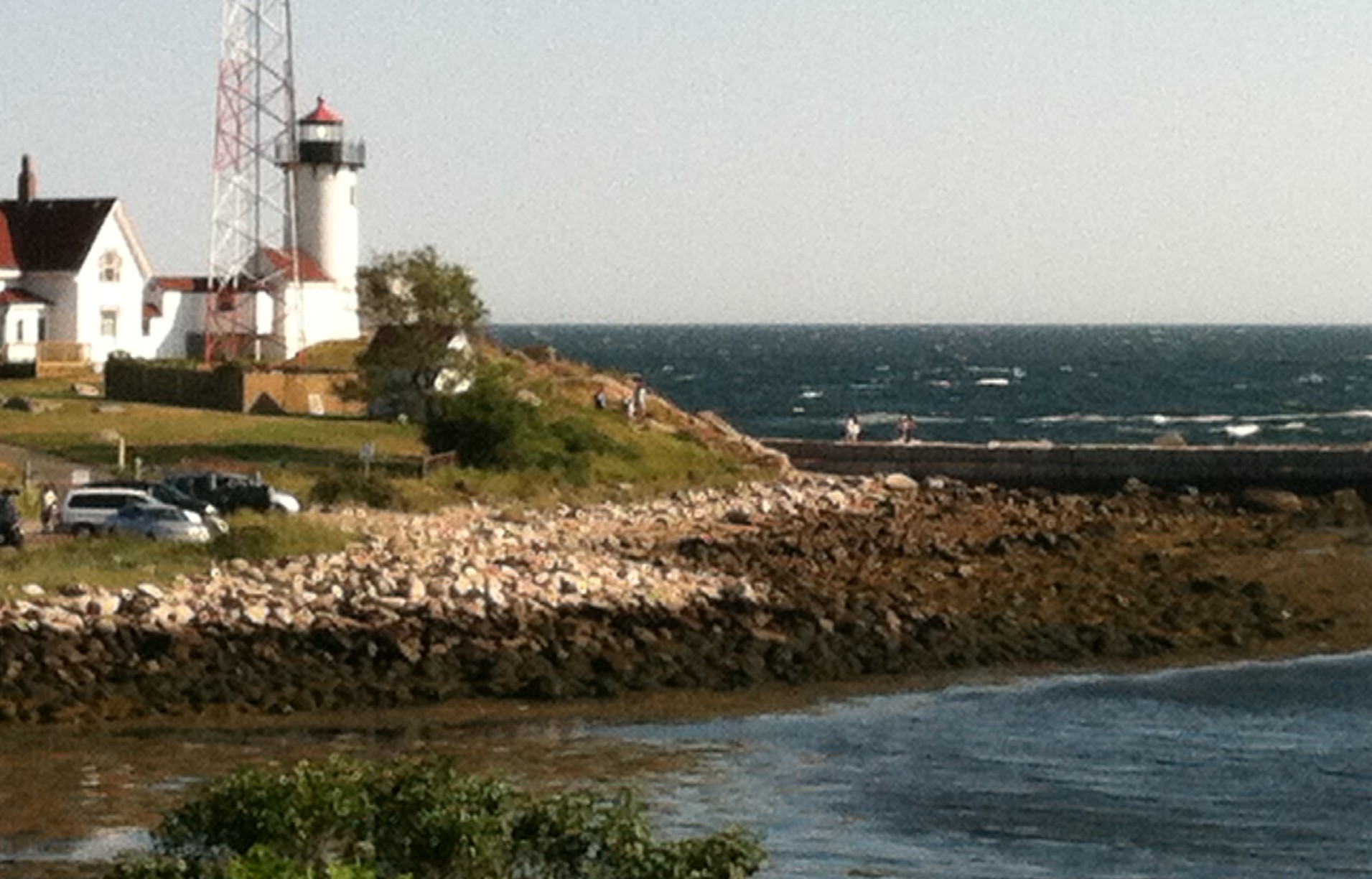
Eastern Point Light with the sea beyond as seen from the yacht club on a breezy afternoon.
NOAA promises the 20-knot winds will lay down overnight and maybe the harbor won’t be so lumpy. Right now, it’s a lot like being anchored in front of the Cooper Island Beach Club when the northerly swells are running, i.e., lumpy enough one needs to lie athwart ships in the bunk to keep from rolling around tonight.
But this is what New England’s supposed to be like in the summer. This is the kind of wind for which Steadfast has been yearning since the middle of June and this day, she showed her stuff.
From that plane into Logan, travelers saw only a handful of boats under sail and, by golly, Steadfast was one of ‘em! Arrrrrrrrrrgh!
Steadfast, out.
23 July: Fried Clams, Anyone?
There’s a steady industrial-sort of hum emanating from the block-long gray shoe-box-of-a-building across the north channel of Gloucester’s inner harbor. But this city’s industry is, as it always has been, fish. So it should come as no surprise that the company generating that steady drone is Gorton’s Seafood, each package proudly displaying the image of the Gloucester Fisherman’s Monument.
Tourism’s important here, too, a big boost coming when Hollywood arrived a few years ago to film “The Perfect Storm.” You now can board a mock up of the Andrea Gail, the boat that took George Clooney and crew to their doom. It’s moored in the parking lot next to the real Cape Pond Ice Company, “the coolest guys around,” made famous in the book and movie, too.
But Gloucester, MA, has always been and very much remains a working fisherman’s town. This is not Newport or Annapolis. Boats here work. Fun boats, yachts, are welcomed but they are in the minority.
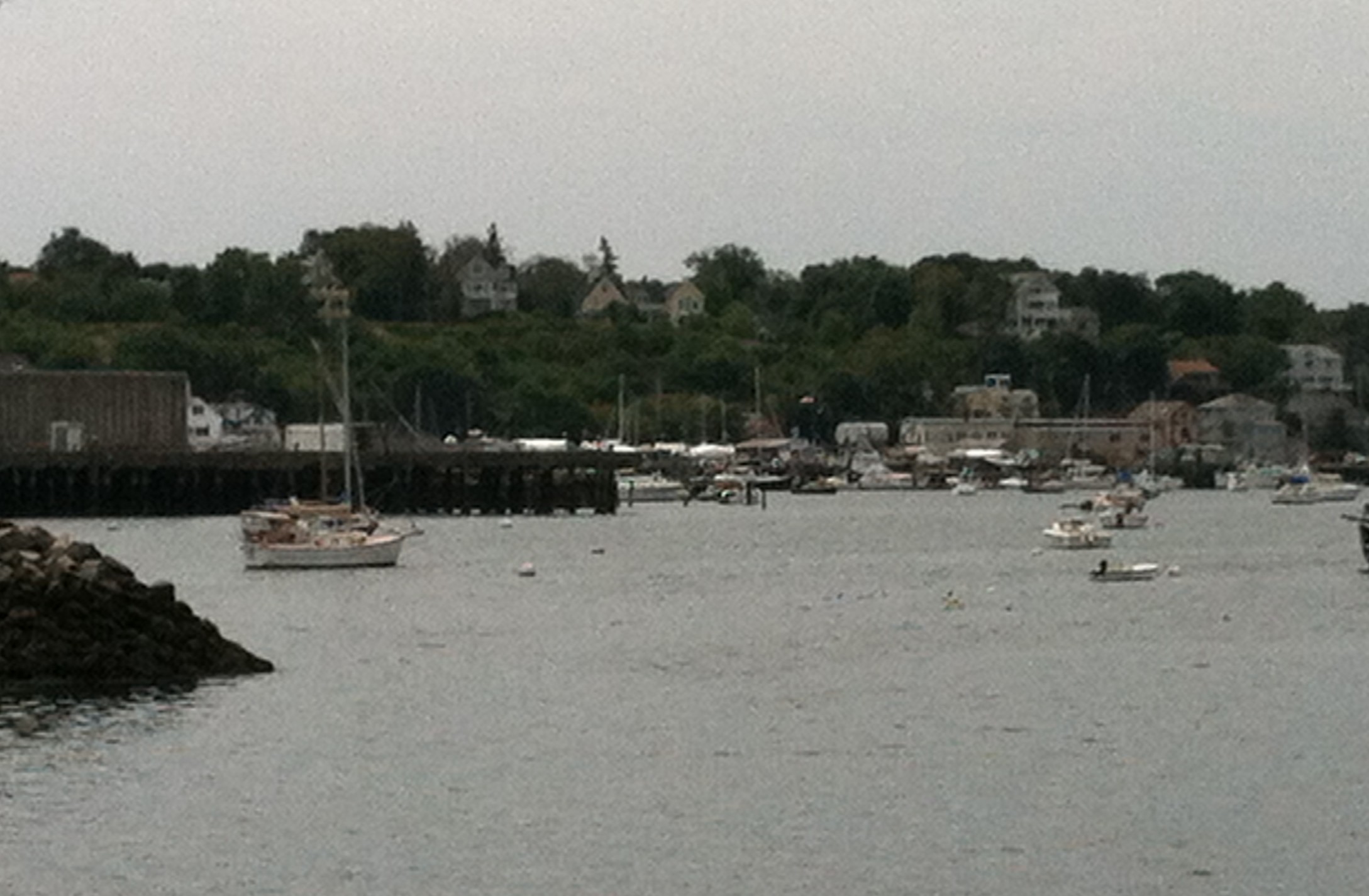
Yachts take up the mooring field but work boats predominate along the piers that line Gloucester Harbor.
Steadfast laid-over in Gloucester for a couple of reasons today. One, the forecast was less than favorable although the day turned out to be lovely: mostly sunny, 78 degrees (and 78% humidity) and a fairly steady so’westerly that cooled the harbor. The big reason for staying, though, was the wind last night that blew two-foot seas around the breakwater at Dog Bar and rocked the mooring field ’til dawn. Rolling first to port, then back to starboard, does not make for a good night’s sleep.
Odds are much more in our favor tonight, tucked in as we are in the northern most reaches of the inner harbor. There’s still a breeze. The boat still swings. But it’s nothing like out there by the breakwater. And, there’s something somehow restful knowing fried clams are being frozen and packed for all of America just a few hundred yards away.
Bon appetite!
Steadfast, out.
25 July: The Sixteen-Hundred Club
The cockpit has a good view of the homes that line Mt. Pleasant Street, Atlantic Avenue and the dining room at Ellen’s Harborview Restaurant, about 50-feet away. The reverse is true, too, so there is a sense of being in a fishbowl. But mainly to enjoy the harbor view for ourselves, cocktails this evening move to the foredeck.
Almost immediately, a sturdy voice bellows across the water. “Cah-mon ovah-riff you wahn. Join us!”
Ocean Reporter is a black-hulled steel vessel of some 40-feet or so, one whose fit and finish defy description. It’s clear she’s a working vessel of some sort but, our perch on the foredeck, her mission is not easily discerned. What better way to find out than to join those assembled on her aft deck. There are many workboats in the tiny harbor at aptly-named Rockport, Massachusetts. The Atlantic waves wash over the granite boulders that line the shores of Cape Ann. Rock jetties flank the narrow entrance to the harbor whose rock banks lay bare at low tide. This is the panorama that greeted Steadfast (that’s her in the background) on her arrival Wednesday evening.
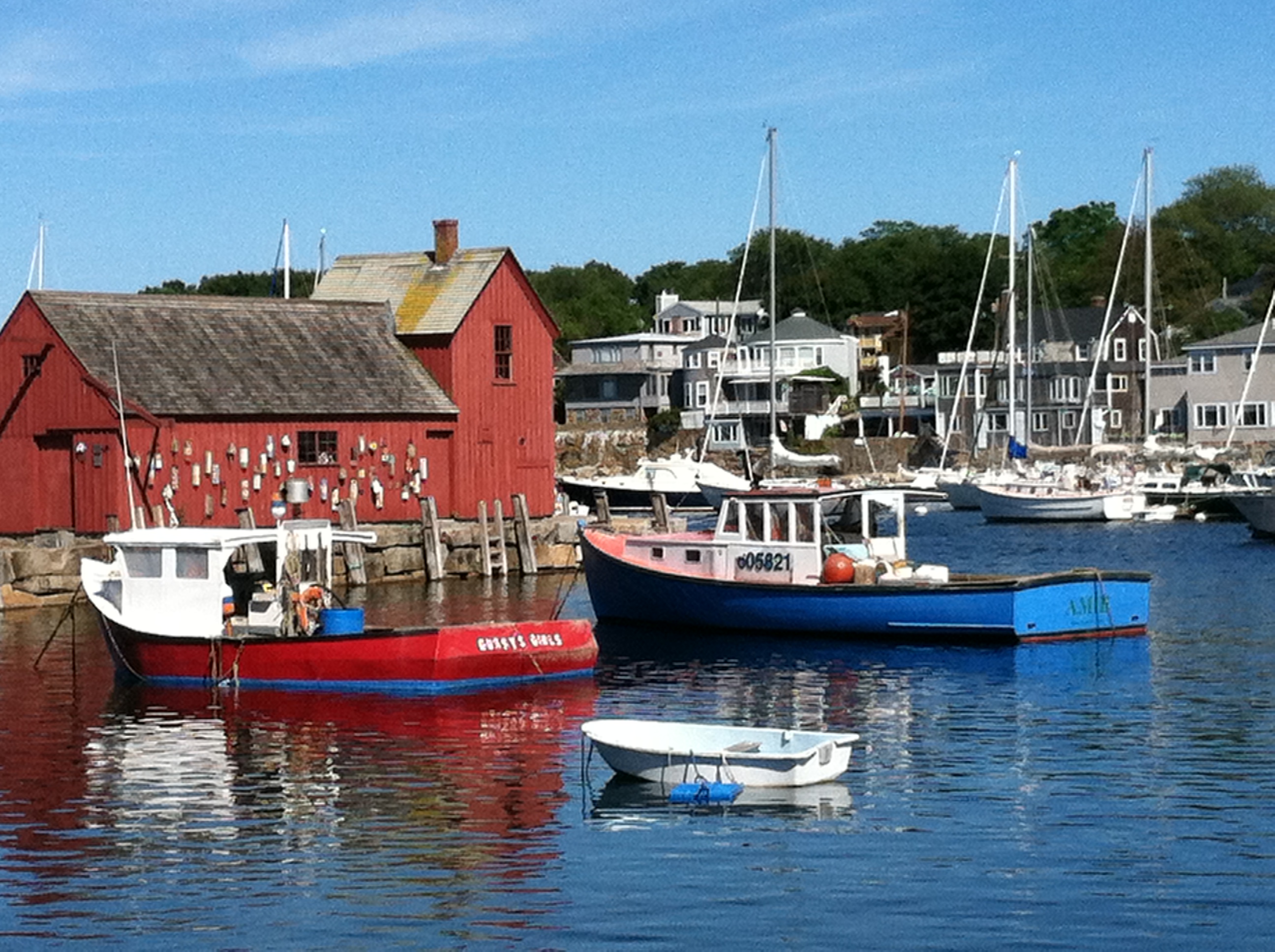
Vessels of all sizes and shapes surround the much-photographed Motif #1 in Rockport (MA) Harbor.
The wisdom of the decision to lay-over another day in Gloucester was affirmed when Tuesday turned out to be all that NOAA predicted with an afternoon storm punctuated by high winds, heavy rain, thunder and lightning.
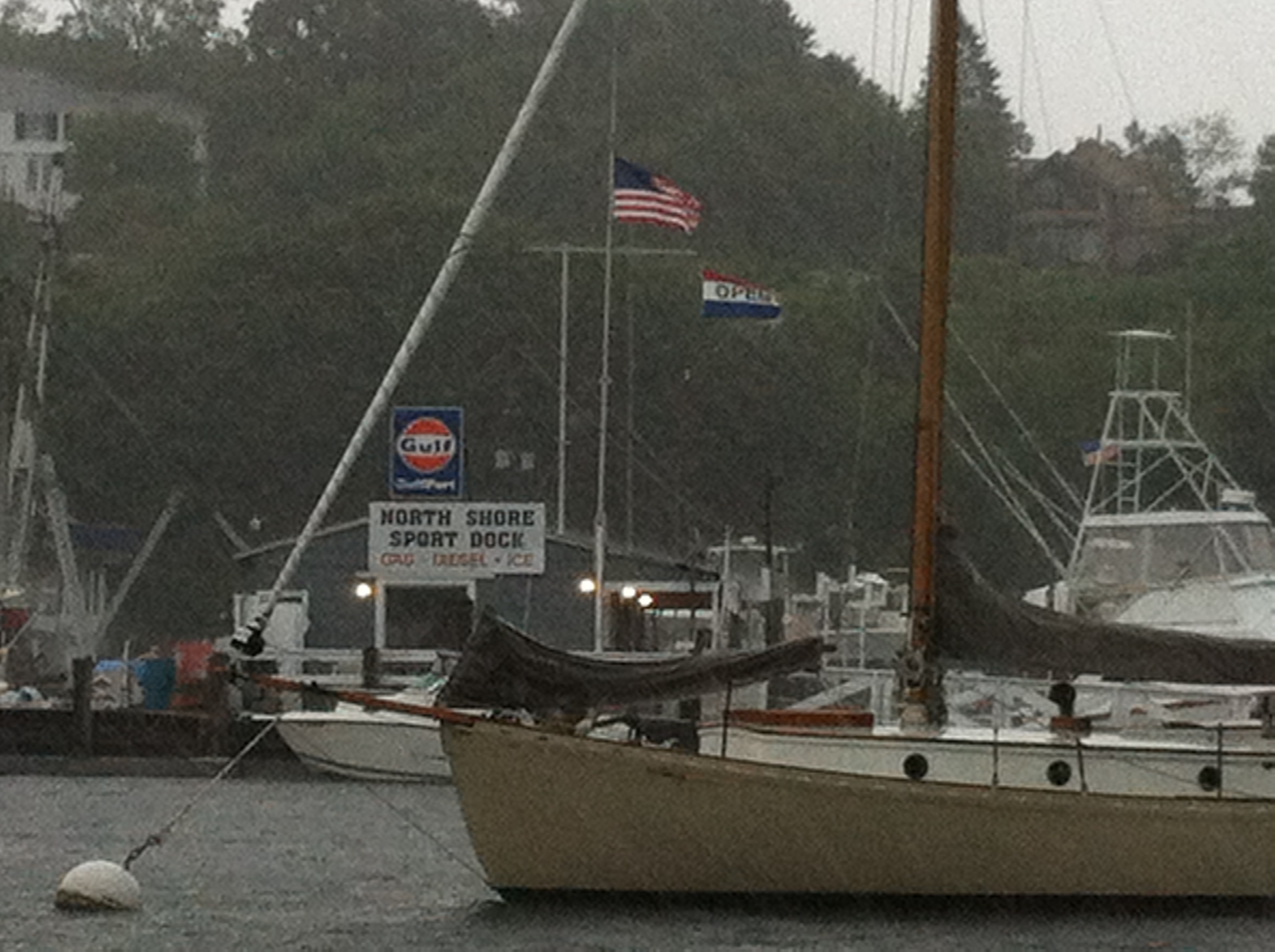
A brief but boisterous thunderstorm rocked Gloucester Harbor in mid-afternoon.
NOAA also foresaw gusty winds Wednesday but the morning sun made Rockport worth a try so mooring lines were slipped at 1027 and Gloucester harbor was cleared 20-minutes later. The nor’westerly wasn’t nearly the 10-15 knots of the forecast but, for awhile at least, enough to warrant wearing sail, close-hauled toward Thatcher Island. Once round Thatcher, the remainder of the 12-miles into Rockport Harbor was under power.
Reprovisioning took the greatest part of Thursday (Rockport’s one grocery closed last year so it’s not easy). Friday morning was for laundry. Then Kate arrived on the midday train from Boston. So by cocktail hour, it already had been a big day!
Then, the invitation to board Ocean Reporter. Wow! We like this place.
After climbing up from the dinghy, we were made welcome by Capt. Bill Lee and introduced to Dave, Bob and Jim. Roy and Jane couldn’t stay but Midge and Alan came aboard before too long, after which Bob and Wanda joined the crew, too. Oh, and Steve was there, with Karen expected shortly. A most congenial group. These and others, we assume, form Capt. Lee’s “Sixteen-thirty Club,” which convenes many–if not most–evenings on the Reporter’s ample aft deck and adjourns promptly at 1800 hours.
Her big diesels wake each morning at 0530 as Bill goes off to set moorings, repair docks, splice rope, retrieve disabled boats and, it seems, whatever else the waterfront of Rockport wants or requires. He’s a popular guy, which becomes all the more apparent when he serves Saturday as chauffeur and tour guide for two sailors from Virginia. You may know them.
“Notta problem. Glad ta do it. Now ta-mahra, don’t fah-git–coffee an’ pace-tree zat the yot club, oh-nine-hun’red. See ya theyah!”
Rockport’s a special harbor for many reasons. The rocky shore. Snug harbor. Quaint waterfront town. But mainly for the people who live here.
Steadfast, out.
30 July: Ocean Isles
There are eight or nine “Isles of Shoals,” a cluster of small islands straddling the Maine – New Hampshire state line. That is, if there is such a thing as a state line six miles out in the Atlantic. Regardless, most are claimed by Maine but the preferred anchorage is Gosport Harbor on the north side of Star Island, considered part of New Hampshire.
Having heard many recommendations on the order of “you’ve got to stop at Isles of Shoals,” and with a favorable if weak southerly in the forecast, Steadfast slipped her moorings at 1000 Monday morning and headed almost due north out of Rockport Harbor. With a bit of a boost from the following two-to-three-foot seas, and picking our way among the lobster pots that litter the approach between White and Star Islands, it was just after 1400 when Kate snagged the mooring line (free! courtesy of Portsmouth Yacht Club) and Steadfast was set for the night. A pleasant motor sail averaging five knots.
The relatively early arrival allowed time to row ashore for a walk around the retreat center compound that has evolved over the years at the site of the former Oceanic Hotel. The small chapel, the many single-story stone residences, monuments to founders of the early community and the weathered stones in the cemetery all harken to the island’s hundreds of years as a settlement.
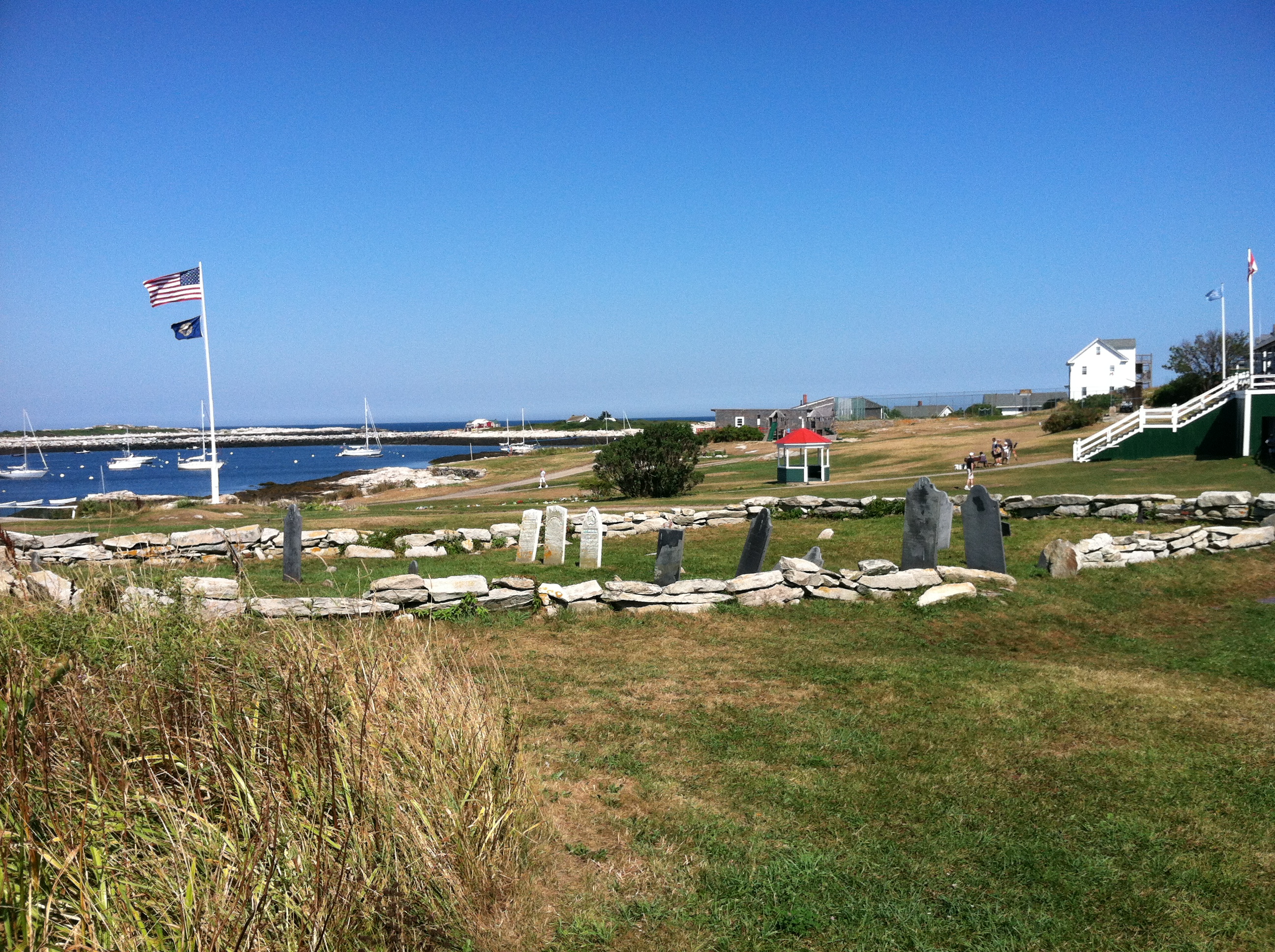
The wind always blows, it seems, across Star Island among the Isles of Shoals.
Views are stunning in every direction, with waves breaking on enormous slabs of granite that huddle shoulder-to-shoulder in defiance to the inexorable assault of the Atlantic.
But Blue Hill beckons so, anxious to make landfall in Maine, we started early Tuesday and set off on the 48 nautical miles to Portland. Again, a light southerly belied the three-to-four foot swells off the starboard quarter that made hour-on, hour-off shifts at the helm the routine for the day. An hour standing at the wheel, steering ‘tween lobster pots and the ever present (it seems) floating sea weed, and a person was ready to sit a spell!
Maintaining the heading became a bit easier in the afternoon as the thin charcoal chalk stripe that was Cape Elizabeth became more defined. Steadfast made decent time, averaging five-and-a-half knots, and she rounded the Cape about 1530, passed Portland Head light, then turned at Spring Point Light to enter the harbor at South Portland.
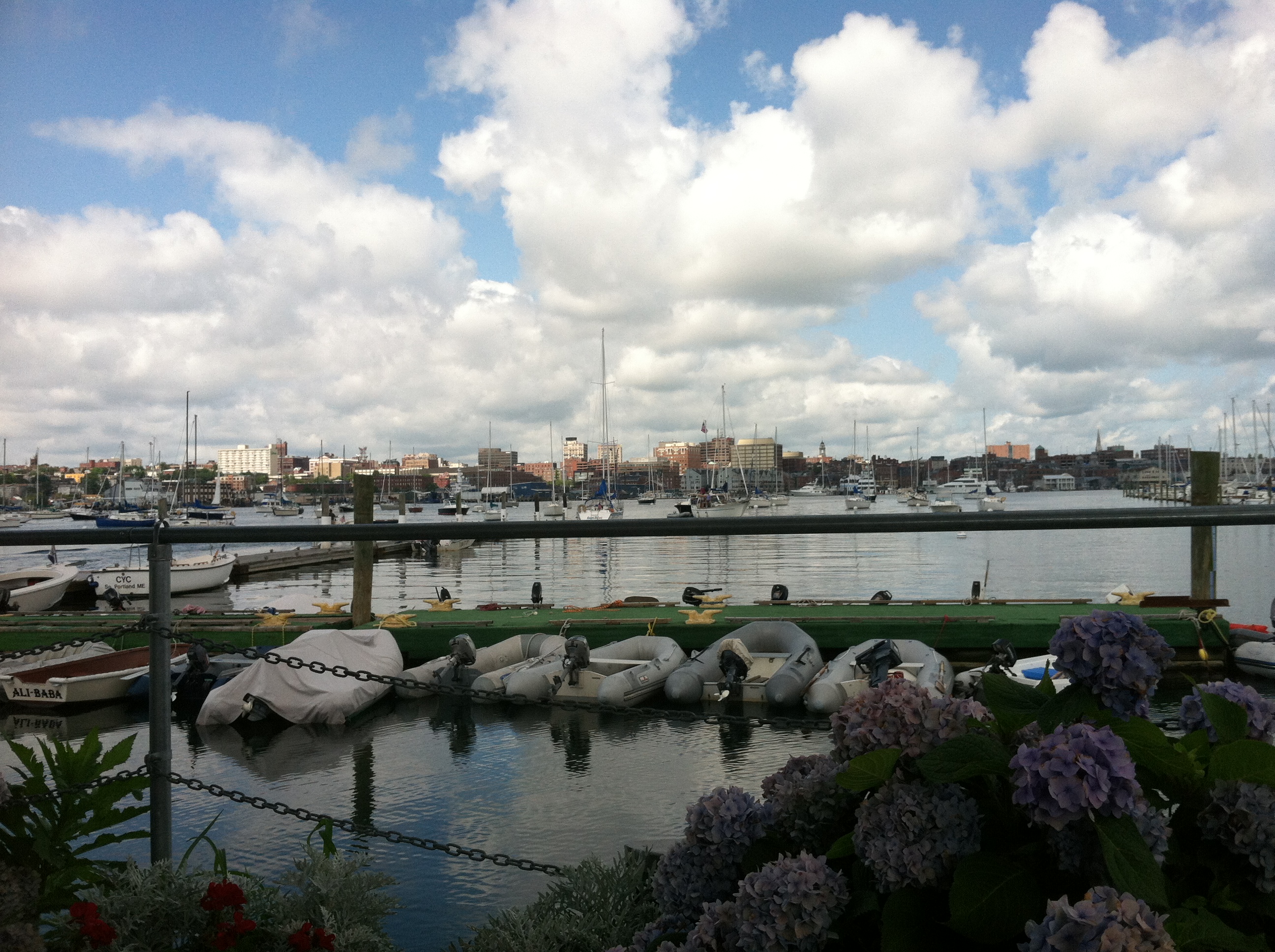
The yacht club has an impressive view of downtown Portland, ME, just a short launch ride away.
From the mooring at Centerboard Yacht Club, Portland reveals her impressive waterfront and the skyline beyond. We’re headed there by launch this afternoon to explore and, just maybe, see what’s on sale at Hamilton Marine.
Steadfast, out.
2 August
There was not a lot of movement on the waters of Portland Harbor this morning. At least, movement that was visible. Most of the moorings at Centerboard Yacht Club could be seen, and sometimes the clubhouse, too. But the Old Port side of the harbor hid behind a grey velvet curtain and the only vessels we saw head out had radar guiding their way. Along with lobsters and the rocky coast, fog is one of the defining characteristics of the Down East experience.
There’d been so little this trip to date that its possibility was not part of the float plan. That changed this morning and the cruise to Boothbay Harbor was delayed in favor of a walk to Hannaford’s Supermarket.
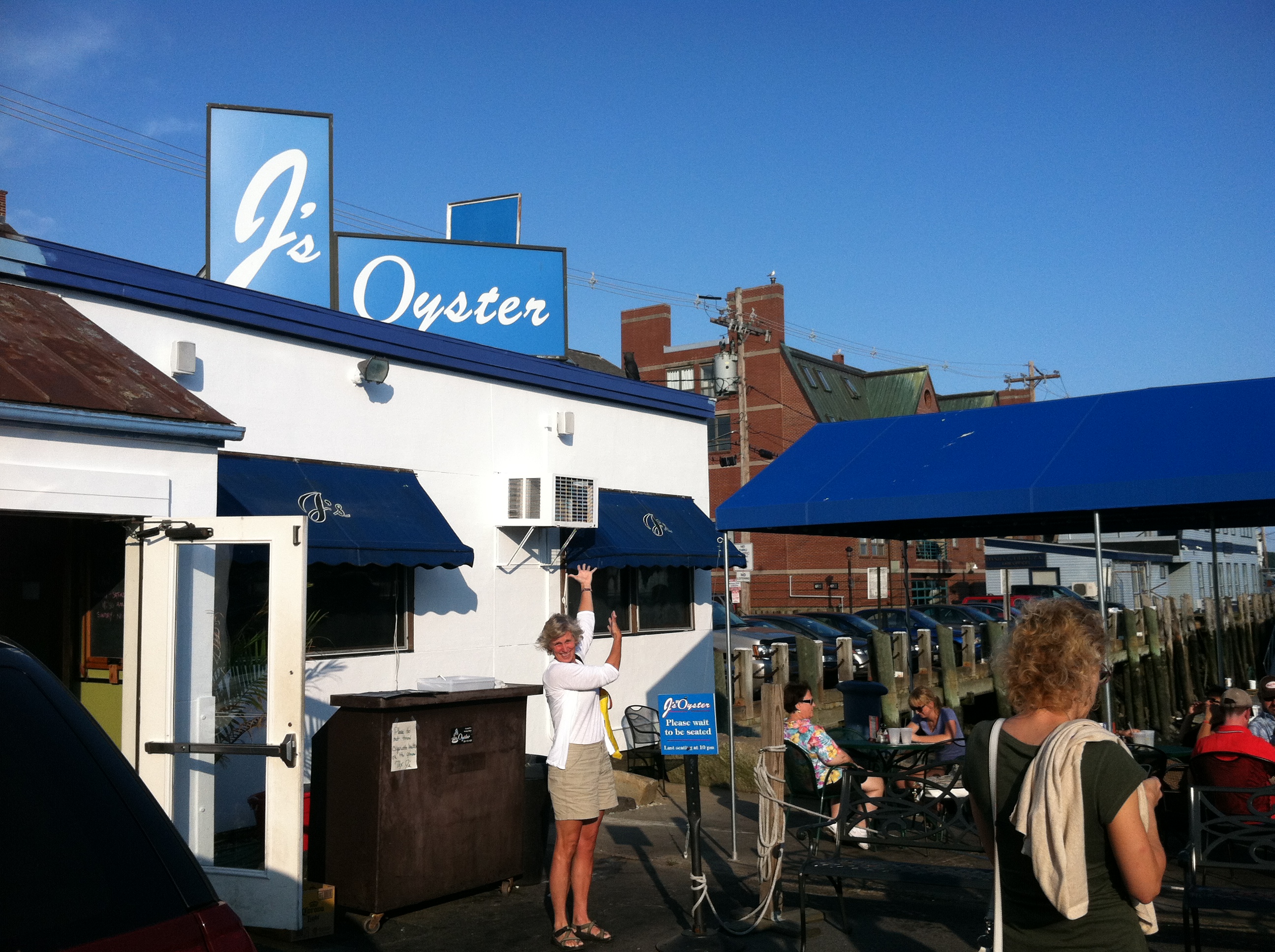
“Oysters” are its middle name but we came for the fresh steamers and weren’t disappointed! On either visit. A great view of the harbor, too.
A return trip to J’s Oyster House on the Old Port side–we were there last evening–is in the offing tonight and, we hope, enough wind for the sail tomorrow across Casco Bay.
Steadfast, out.
03 August
To the north, where the village rolls up the hill, sirens–at least three of them–scream through the wind. The lights flicker off, then on in the restaurants, shops and hotels along the waterfront, then die. Far off to the west, beyond the stately homes that stand among the pines, the slate gray sky is split by the brilliance of a jagged electrical charge that ignites the harbor. NOAA’s “slight chance of a thunderstorm” has rolled across Casco Bay.
In particular, the chance became reality for the hundered or so work boats and yachts moored in Boothbay Harbor, ME. Steadfast is one of ’em, by God, and her crew is glad of it!
This was the first time boat and crew probed the gloom of a Maine fog, slipping the moorings at 0957 beneath a bright sky, with the promise of 10-12 knot winds from the south, but a blanket of fog kept secret all that lay a mile beyond the bow. Oh, and the “slight chance of a thunderstorm.”
The departure for Portland was interrupted, though, when Ms. Wes began to smoke and gasp in a most unladylike fashion. Her hollow cough was the first clue that something was amiss and most likely in the sea water intake line that helps her keep her cool. A cove just beyond Spring Point beckoned with the secure mooring that fit the immediate need: a sheltered spot, away from the tug, tanker and fishing traffic, from which to clear the sea grass that continues to plague our dear Ms. Wes.
First aid applied, she surged back to life at full strength, pushing off into the fog and swells of windless Casco Bay on a heading of 082 degrees, bound for Boothbay Harbor. Not long after, a pair of porpoise crossed her bows as if to say, “don’t worry about a thing, it’s gonna be great!” Then after passing south of Halfway Rock, about 1300, a single sea lion swam slowly across the path of Steadfast. The crew again kept diligent watch for lobster pots and the streams of sea weed that seemed always to threaten to choke Ms. Wes once again.
By 1500, Cape Small was abeam and the decision made–despite the “slight chance of a thunderstorm,” Steadfast would pass Sebago and push on toward Boothbay Harbor, another couple of hours beyond, at least. The fog ahead seemed to thicken, just as Steadfast left the open waters of the Atlantic and came closest to the rocky shore. But after rounding the outcrop called The Cuckholds, the fog lifted, the sun warmed the cockpit and–guess what?–two porpoise leapt across Steadfast’s bow.
Waddya think? Same two as up by Portland Head? Naw, couldn’t be, no way.
At 2020, the wind’s laid down, rain moved on and laughter now can be heard aboard “Lucky Seven,” the 90-foot motor yacht at the pier. The lights are on in the restaurants, shops and hotels of Boothbay Harbor. And Steadfast rocks quietly to the easy rhythm of the tide.
Steadfast, out.
05 August: Long Term Tenants
It’s early. Either the sun has yet to rise or it’s raining. The steady “splat” on the hatch overhead suggests the latter. Rising from the bunk, peering through the droplets that cling to the outside of the port, the fleet that had filled Tenants Harbor the night before has disappeared.
Fog. Not your average, run-of-the-mill what-you-think-of-as-fog-in-Virginia stuff. This is Maine fog which, contrary to forecasts and sailors’ hopes, is about to consume this Sunday on the west side of Penobscot Bay. True to the forecast, there is wind this morning, a ten-to-15 so’westerly perfect for a sail north to Buck’s Harbor, the intended next stop for Steadfast. But instead of blowing the fog away to the east, this wind seems only to blow more fog into the harbor.
The morning hours pass and the only part of the day that becomes clear is that will not sail today. Those whose boats and homes are here on Tenants remain undeterred. Fog is a fact of life on the Maine coast, after all, and life goes on. So a red kayak slips quietly past the bow.

The annual Long Cove Regatta is not your typical one-design race but attracts vessels of many sizes, types and paddles.
A cheerful “Good morning!” receives a like response. A yellow companion boat reveals itself from behind the workboat moored off to starboard. Then a handsome old wood catboat carries a laughing crew spanning three generations. Six paddlers propel dark green canoes, then another catboat, an eight-foot dinghy and, moments later, a 13-foot Boston Whaler skiff scoots noisily past.
“It’s the Long Cove Regatta,” shouts the gentleman at the helm of the Whaler. “Come on along! Whatever boat you have, doesn’t matter.” 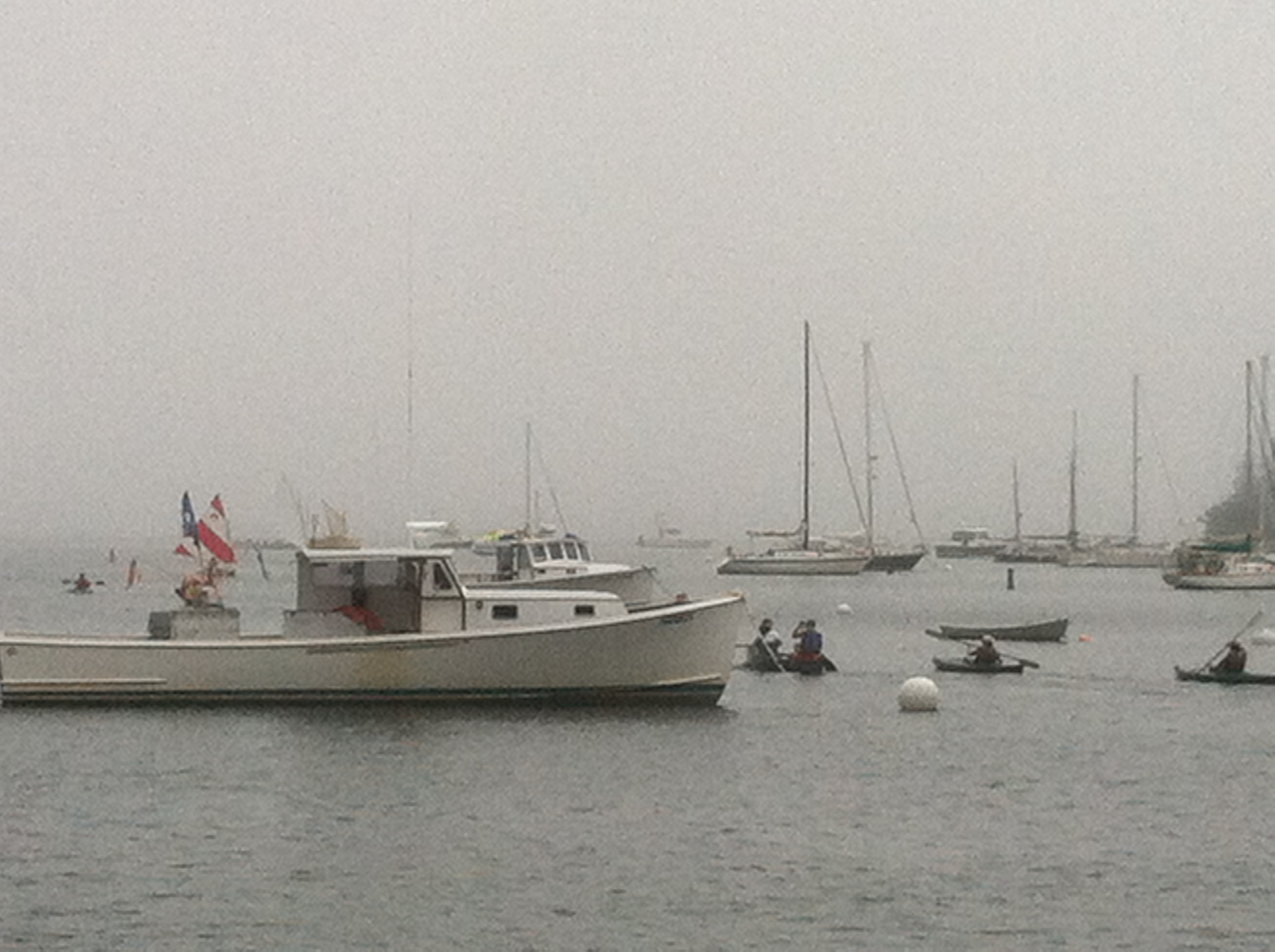
A cannon charge explodes off the far bank, somewhere in the fog, to signal the regatta’s “official” start. And as quickly as they appeared, the mongrel fleet disappears again, and moments later the fog swallows even the laughter.
Hours later, a dark hulled thirty-something-foot sloop emerges from the gloom that still shrouds the harbor entrance; an Island Packet 38 does likewise later. Half a dozen other yachts seek shelter here as the afternoon–and the fog–roll on, each boat displaying a common installation in its rigging: a radar dome.
On the Maine coast in fog, radar’s like American Express – “don’t leave home without it!” Lacking either, Steadfast swings securely in Tenants Harbor. The next harbor waits ’til another day, when lobster floats and rocky shores are clear to the eye of her crew.
Steadfast, out.
8 August: Back Underway
A three-second slur-r-r-sh, then pflitt, pflitt, pflitt. A brief pause and the sequence repeats. And again and on. It’s the rhythmic sound of the skiff sliding along behind as Steadfast sails gloriously up Penobscot Bay. She’s making five-knots or more on a broad reach, the 10 knots out of the so’west pushing her along at first on a broad reach, then a dead run, sails “drawing full and by,” as they say.
This had been NOAA’s promise when, after being graced with the hospitality of Mary and Jim at East Anchorage for a couple of days, the fog lifted on the drive to Tenants Harbor and the mooring pennant slipped off at 1027. Dodging lobster pots and clumps of seaweed, the turn was made to 050-degrees to run up Muscle Ridge Channel.
There were boats out there, lots of ‘em, workboats and yachts for the first time. Ash Island went by to port at noon, the lovely harbor at Owls Head at 1241 and not long after, the so’westerly breeze picked up and the heading shifted to 060′ to run up the east side of Isleboro Island. It was a glorious four-hour sail, first on a broad reach then a dead run, “wing-and-wing” with main over the port rail, genoa to starboard, making a steady five-knots.
Rounding Green Ledge, the heights of Western, Pond and Hog Islands were enough to block most of the wind, but Ms. Wes woke from her nap and finished the rest of this leg into Buck’s Harbor, yet another lovely little anchorage with handsome homes standing watch from the steep rocky banks that ring the shore.
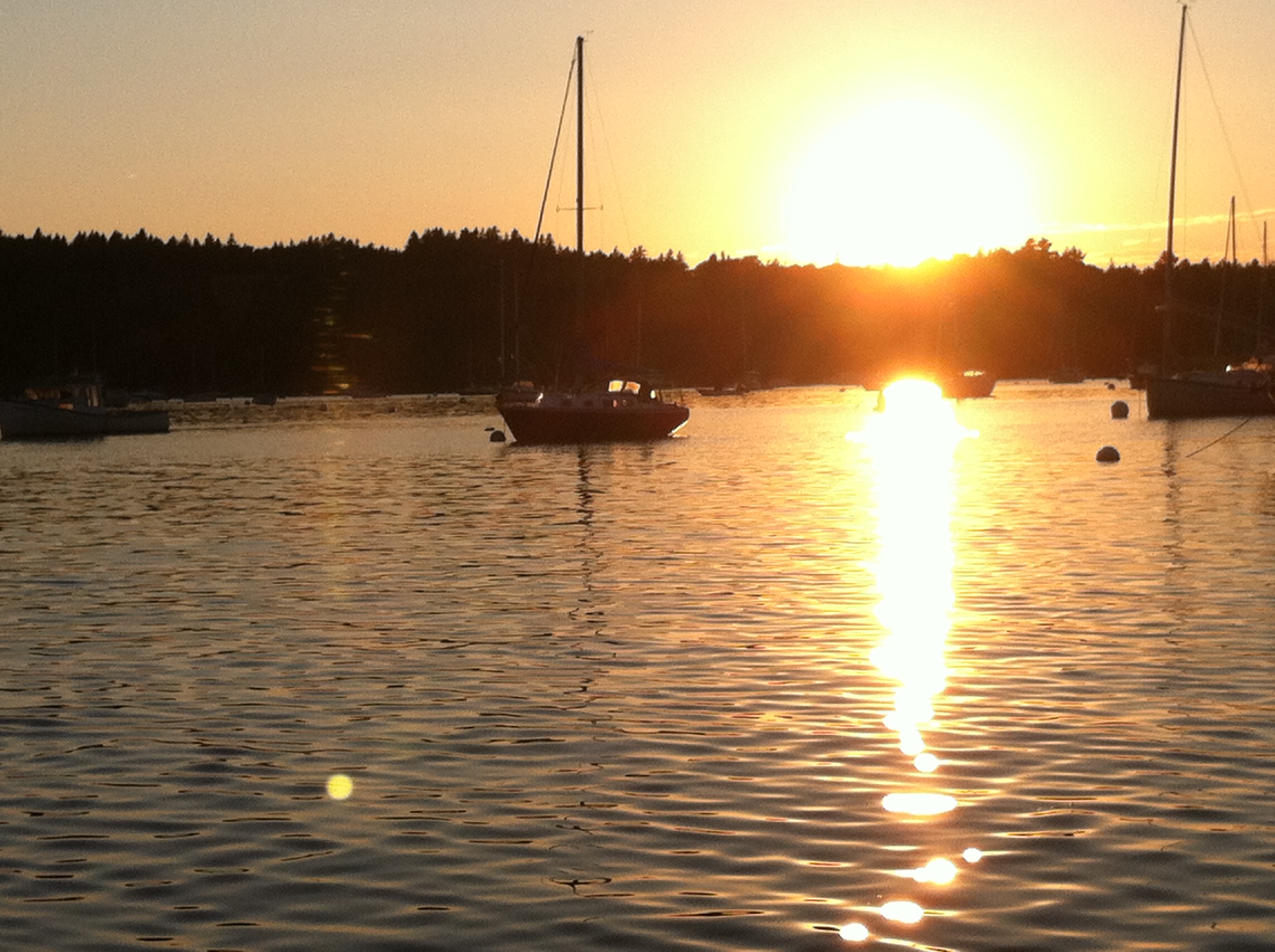
A quiet Buck’s Harbor is bathed in the brilliant last light of the day.
With these 30-plus miles under her keel, Steadfast now is just a day’s sail from Blue Hill, her ultimate goal. Buck’s Harbor staged a dramatic sunset as if to celebrate.
Steadfast, out.
9 August: Friends
Picture this – a fairly narrow 12-mile long passage between the mainland and a string of islands to the south, running roughly southeast to northwest, or vice-versa. That being the case, with the prevailing so’westerly winds, a sailing vessel transiting this passage would be on a “reach” in either direction. Hence, it is suspected, this passage became Eggemoggin Reach.
The east-bound sailor takes Eggemoggin from Penobscot Bay to Blue Hill Bay. The Reach presents iconic images of the Maine coast, with towering pines lining the shores of its rocky harbors, while the steady breeze fills the sails of classic yachts of all types and sizes. That is, when there is wind and no fog!
On this Thursday morning, Buck’s Harbor awoke under a damp blanket of fog. But after a row ashore to Buck’s Harbor Market for coffee and muffins, bright sun filtered through the pines, boosting confidence that visibility on the Reach would not be a problem. In fact, boats passing a mile off could then be seen clearly from the harbor.
So with showers in the forecast and a light southerly barely stirring the harbor, the crew conferred and the decision was made: Blue Hill beckoned. Steadfast bravely motored off her mooring at 1050 and headed out into Eggemoggin Reach. A quarter-mile-long suspension bridge spans Eggemoggin Reach at Bayard Point, a couple of miles east of the turn out of Bucks Harbor. It’s a handsome bridge, or so we are told. All that could be seen of it from the deck of Steadfast was the north tower!
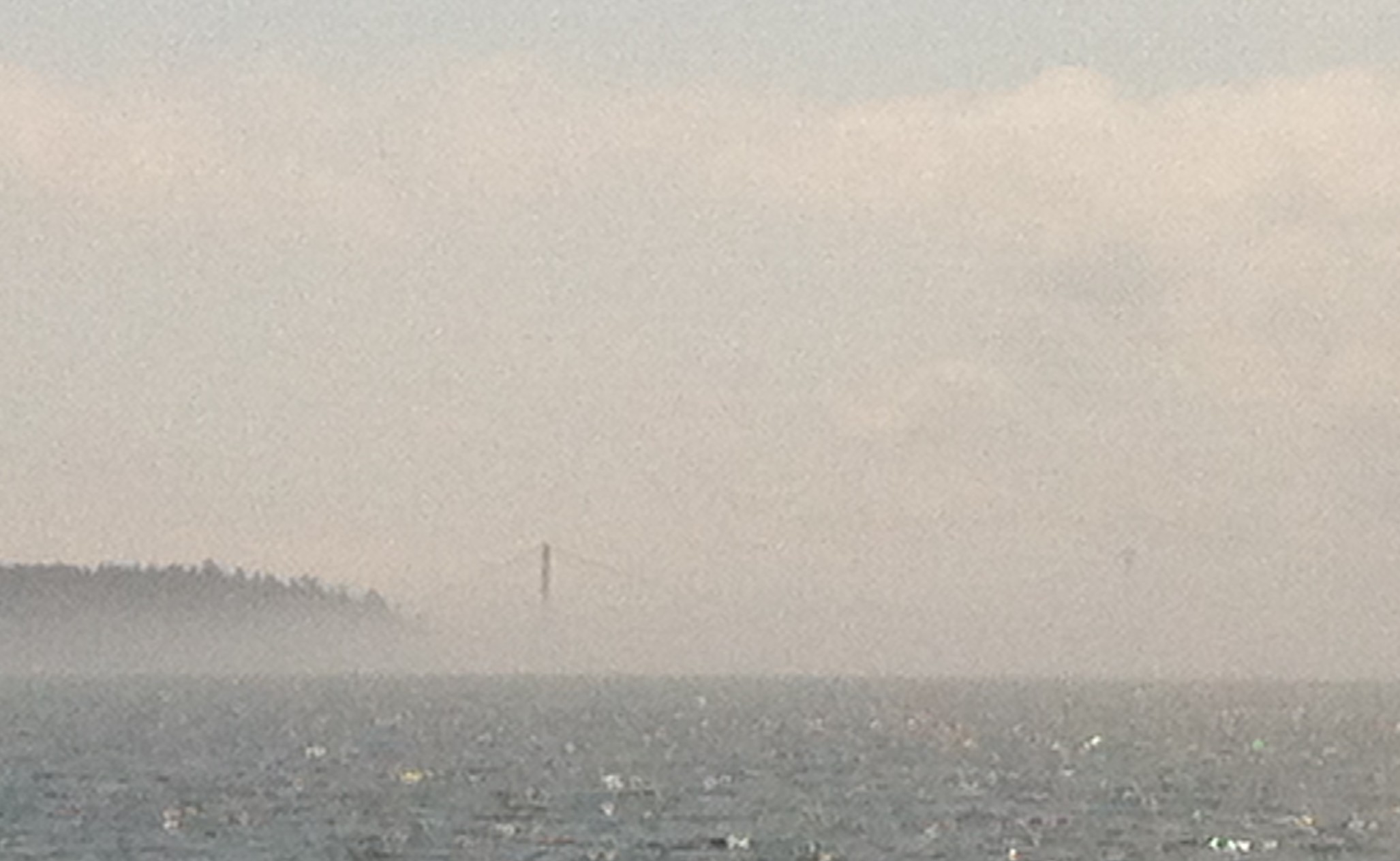
Somewhere in that soup, a suspension bridge spans Eggemoggin Reach just east of Buck’s Harbor and that’s where we’re headed.
But, hey, that’s from a mile away. That mile “hole” in the fog will move with the boat as she goes along. Right?
Well, not exactly. As the fog closed in, Ms. Wes slowed to just 2 knots and Kate moved to the bow to stand watch for lobster pots and, worst case, other boats. Some west-bound boats did emerge slowly from the gray but few. There were no “close calls,” they and Steadfast cautiously moving from one landmark, one buoy to the next. Fog lifted, shorelines emerged, then after teasing for fifteen minutes or so, disappeared, playing hide-and-seek down the length of Eggemoggin Reach. The turn nor’east into Pond Island Passage was made at 1342, then–after picking her way between pots, weeds and rocks–Steadfast turned into Blue Hill Bay on a heading of 350′.
But the fog wasn’t done! Visibility shrunk to just a few dozen feet in any direction, just enough so Kate on the bow could warn of pots when those popped up. And there are quite a few at the southern end of the Bay! All this time, Ms. Wes kept turning her faithful 2,200 times a minute. The main was raised on the Reach, less for the wind and more to make Steadfast more easily seen by others. But now the main began to draw, the fog lifted and–for the final five miles to Sculpin Point–Ms. Wes rested and Steadfast glided quietly up Blue Hill Bay, wing-and-wing, a stately conclusion to her grand Down East cruise.

Steadfast lies to her easternmost mooring, Blue Hill Harbor, ME, before beginning her journey home.
At 1648, she was riding pertly on the mooring ball marked “Crawford” at Kollegewidgwok (yes, that’s how it’s spelled) Yacht Club. Mary rode the club launch out to greet us and, by golly, we’d made it! How crazy is that?
One other detail worth noting: Mary’s welcome, while gracious, was not the first we received on our arrival. Blue Hill’s resident seal, Matilda, had broken the surface with her nose, then swam playfully to greet Steadfast as she entered the harbor. Ah, but it’s great to have friends!
Steadfast out.
15 August
Those who’ve been anywhere in Maine know it is a world unto itself. The coast is a little different. The towns are a little different. Mainers are a little different, too, “Ay-ya-a-a-ah.” For natives of the Maine coast, life has required they be resolute, resourceful, hard-working and…early to rise. The summer sun is up at 0430 and the lobster fishermen crank those big Detroit diesels with first light.
Of this remarkable world, Blue Hill may as well be the capital–a just-the-right-size village on a snug hurricane-hole-type harbor–and for the Kings, anyway, East Anchorage is the White House. East Anchorage is Mary and Jim Crawford’s summer home wherein evolved, a year ago, the crazy idea to sail Steadfast to Maine.
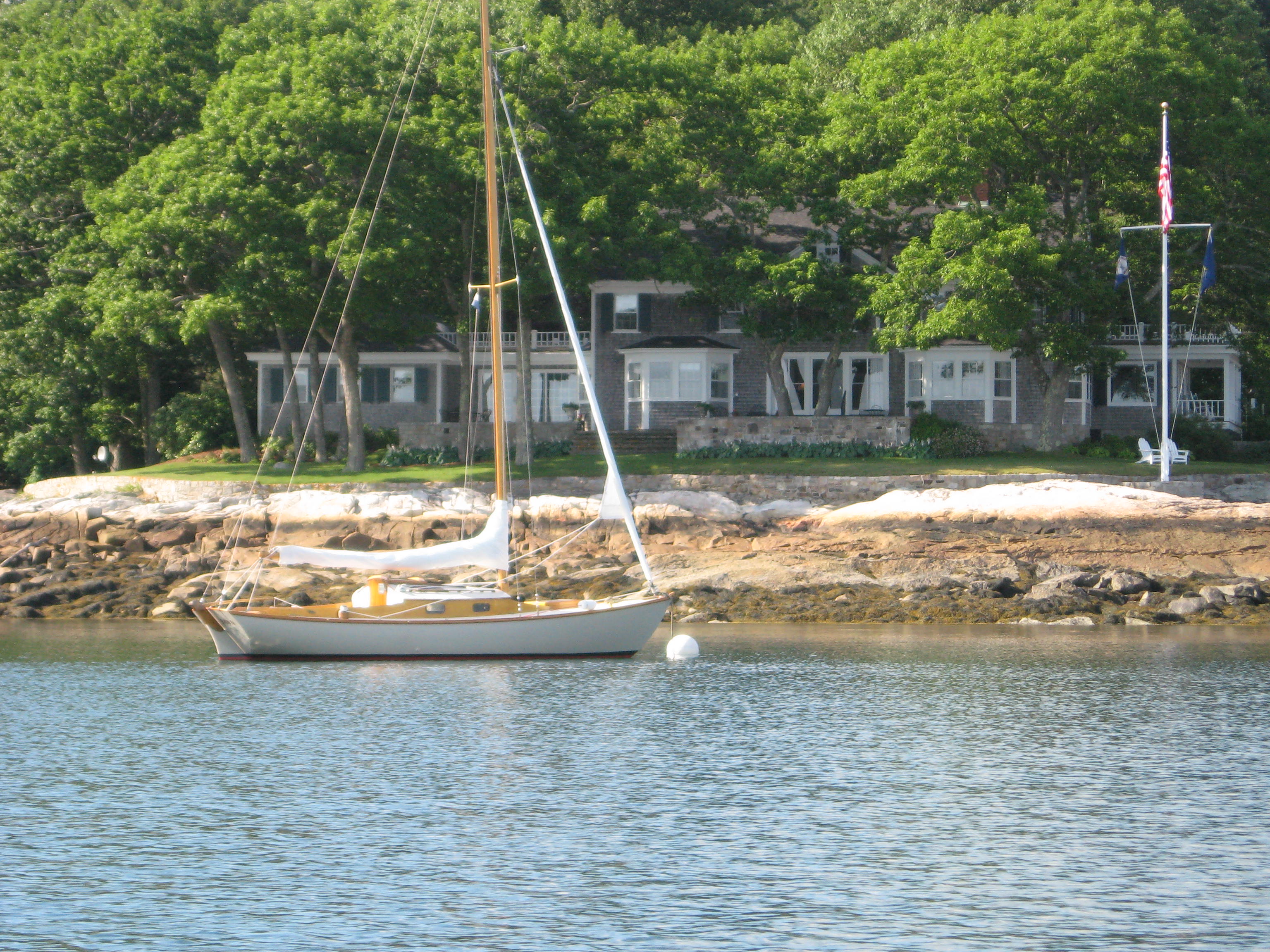
Molly Bawn rests quietly off the pier at East Anchorage, the Crawford’s beautiful Blue Hill home.
The visit included a hike to the peak of 900-foot Blue Hill with panoramic views across the bay to Mount Desert Island and beyond; lots of fresh Maine blueberries; daysail on Jim’s classic wooden sloop “Molly Bawn”; ice cream at the Fish Net drive-in; lunch on the patio watching the Atlantics racing; and, well, you get the idea. Among all the unique and wonderful experiences and places, picking the most outstanding is difficult if not impossible. But Perry’s Pound is a strong candidate!
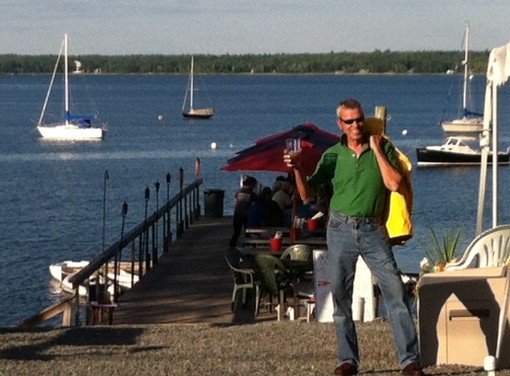
Fresh lobstahs, cold beyah AND a gaw-juss view: they do dinnah right Down East!
The pier is on a cove east of East Blue Hill that harbors a handful of pleasure and work boats, offering a stunning view across to Newbury Neck (I think). The lobstahs are in tanks under the tent. Customers are at well-worn picnic tables under the bright umbrellas. The waitress is from Georgia. The food from heaven. Buckets of steamers to start, then the lobstahs, cawn-on-tha-cob, etc. And it’s BYO so you know the wine is delicious!
Wonderful, unique, unforgettable. Choose an adjective. Or just say, in so many ways, “Blessed.”
More later.
Steadfast out.
August 16
Oh, Kathryn. The walk from East Anchorage, down the drive to the left then up the Ho Chi Minh Trail, seemed like a good idea at the time. It was mid-afternoon and the others were getting ready to board Molly Bawn for a sail, the wind just filling-in and all. And the partnership of a steady breeze and bright sun would make the perfect time to let our little Steadfast breathe. The poor girl’d been choking for days, what with the fog Saturday morn, then the dreary drizzle Sunday. So it’d be good to open her up, all around. Let her get a good breath of air. Good.
And, the thought was, it’d be good for her skipper, too. Get busy, do something productive instead of moping about, feeling lost. Which basically is how he felt, despite the breeze and sun.
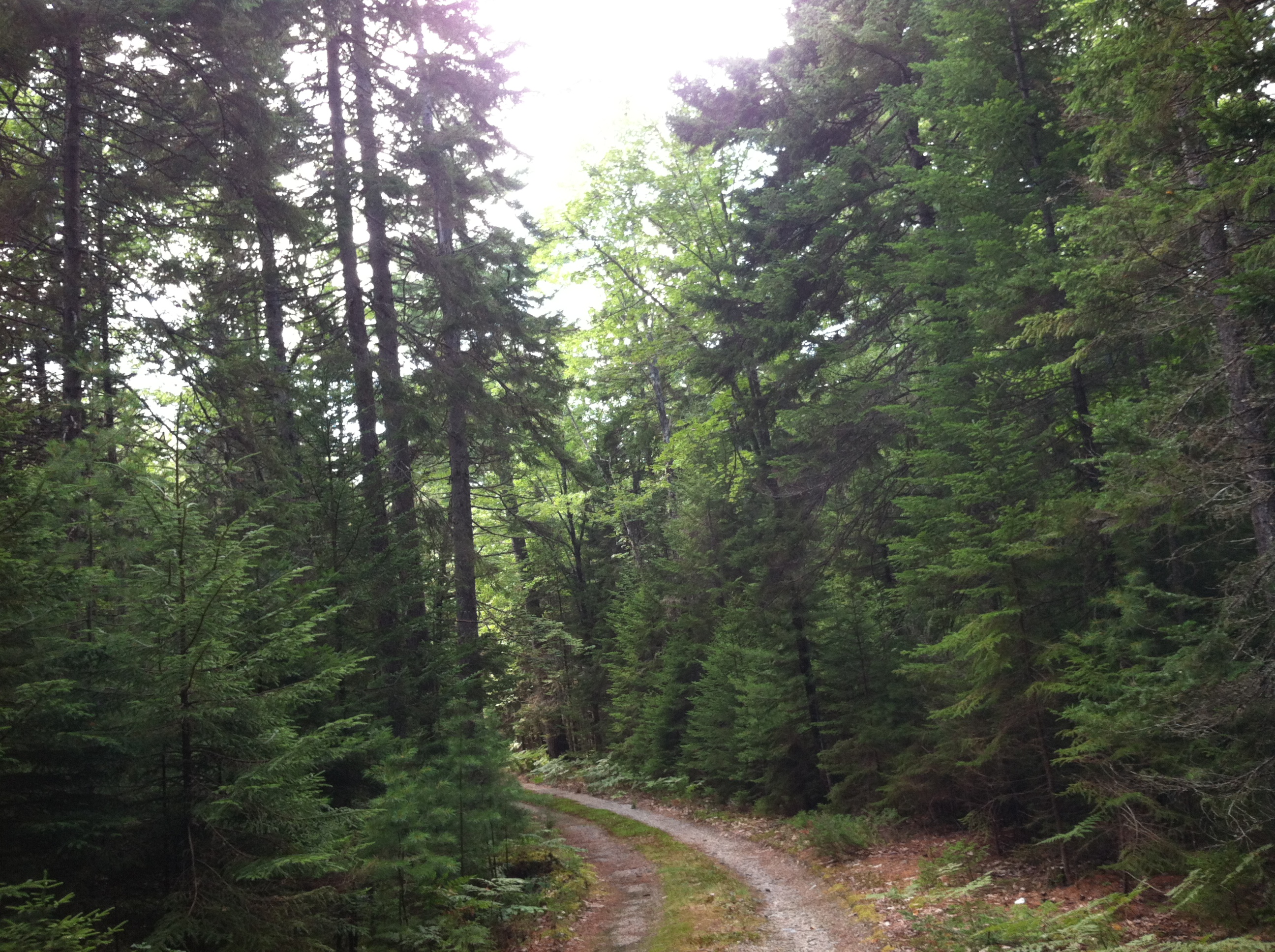
Pines stretch toward the sky on the slopes leading down to Blue Hill Bay.
But after the turn up the ‘Trail,’ here’s what he saw. Slender pines reaching–no, struggling to reach, yearning to reach–the heavens. The forest floor below them dank, dark, the sun favoring these trees or those with its light and warmth.
This isn’t the happy image that was hoped for. But it suits.
Yes, I miss you. I can’t think of these past two weeks without breaking into a grin. Oh, what an adventure we had, just you and I. Oh, what fun fog can be. Oh, how hard it can be to say good-bye.
Oh, Kathryn. I love you.
Good night.
14 August
Much has been written, infinitely more thought and felt, about the daily but often difficult task of saying goodbye. After cruising Downeast from Rockport, MA, then sharing all that Blue Hill had to offer, Kate needed to get back to Richmond. There had been, as you’ve read, 17 days of unforgettable moments aboard Steadfast. It was a long, lonely drive back to Blue Hill from Boston where Kate caught her flight to River City.
There were goodbyes to be said in Blue Hill, too, again not easily done after such a relaxed and remarkable visit. First, though, Steadfast needed to be made ready for the cruise back to Virginia. Re-provisioning, of course, and laundry. Re-filling the water tank. More than that, after all her hours of dutiful service, Ms. Wes deserved to have that old black sludge flushed from her sump and enjoy a fresh couple of quarts of 30 weight and all new filters. And with all those miles under her keel, Steadfast had developed quite an impressive aquaculture along her waterline.
So Steadfast slipped her mooring at Kollegewidgwok Yacht Club at 1052, bound for Center Harbor and the well-respected Brooklin Boat Yard. Matilda the Seal swam out to bid farewell as Blue Hill was left in the wake. It was sunny, 78 degrees and the bay a slick calm, Steadfast heading almost due south to Pond Island Passage, then up into Eggemoggin Reach. By the time she turned into the Reach, a southerly wind had built to a helpful 10 knots and, with sails set, Ms. Wes got a break and Steadfast joined the many others sailing in both directions. The clear standout was one of the famous Maine Windjammers heading Downeast under full sail.

Eggemoggin Reach is a popular passage for the Windjammers that ply Maine’s waters each summer.

Some of the same seaweed that so often clogged the engine water intake hitched a ride along the way Down East.
Once in Center Harbor, Steadfast lay on the pier at Brooklin Boat Yard which handled the work in a matter of hours the next morning. A steady and occasionally heavy rain held her on the pier an extra day, as if Maine didn”t way to say goodbye to her.
But she did. The next morning, clouds lifted, sun appeared and the cruise back to Hallieford began.
More later but for now, Steadfast, out.
23 August: Big Gulp
Ten feet off the stern, there’s the sudden sound of splashing. Concentric circles ripple the slick surface of Center Harbor this early morn, siting the location but not the cause. Then the black head of a cormorant emerges, clutching crosswise in its beak a slender foot-long elver. The bird shakes his head violently, then plunges the elver below the surface. The sequence repeats several times before the cormorant decides breakfast is ready, stretches his neck upward as far as it’ll go and swallow the elver whole in one big gulp. The bird swims quietly away, gulping occasionally as he goes.
Breakfast on Steadfast is simpler: coffee, cereal, milk and fruit. After the rains of the day and night before, the skiff needs bailing (don’t want to tow all those extra pounds), the cockpit needs to be toweled off to dry in the sun that now brightens the harbor. Eight knots blow out of the nor’west, straight down Eggemoggin Reach. There’s haze in the distance but no fog. A good morning, in other words, to start the next leg on the journey home.
Steadfast clears the pier at 0826 and once out on the Reach, turns to a heading of 305-degrees, making 5+ knots as Ms. Wes churns at 2200 rpm. An hour later, off Bucks Harbor, there are more boats but less wind; in fact, none. Nearing 1100, she turned to port at Green Ledge to head down Penobscot Bay as a pair of porpoise frolicked off the beam. The wind arose, gently out of the south, enough to encourage the sails to unfurl and Steadfast began to tack down the bay close-hauled at 3.5 – 4 knots. As has been the case for much of the Maine visit, the afternoon breeze began to build and by 1350, its 18-knots was churning up a Chesapeake-style 4-foot chop that made spotting lobster buoys increasingly difficult. There was a feeling much like a cormorant who’d tried to swallow more than he could consume in comfort.
So sails were furled, Ms. Wes called into action and Steadfast motored the final 8 miles into the broad harbor that fronts the quaint town of Rockland.
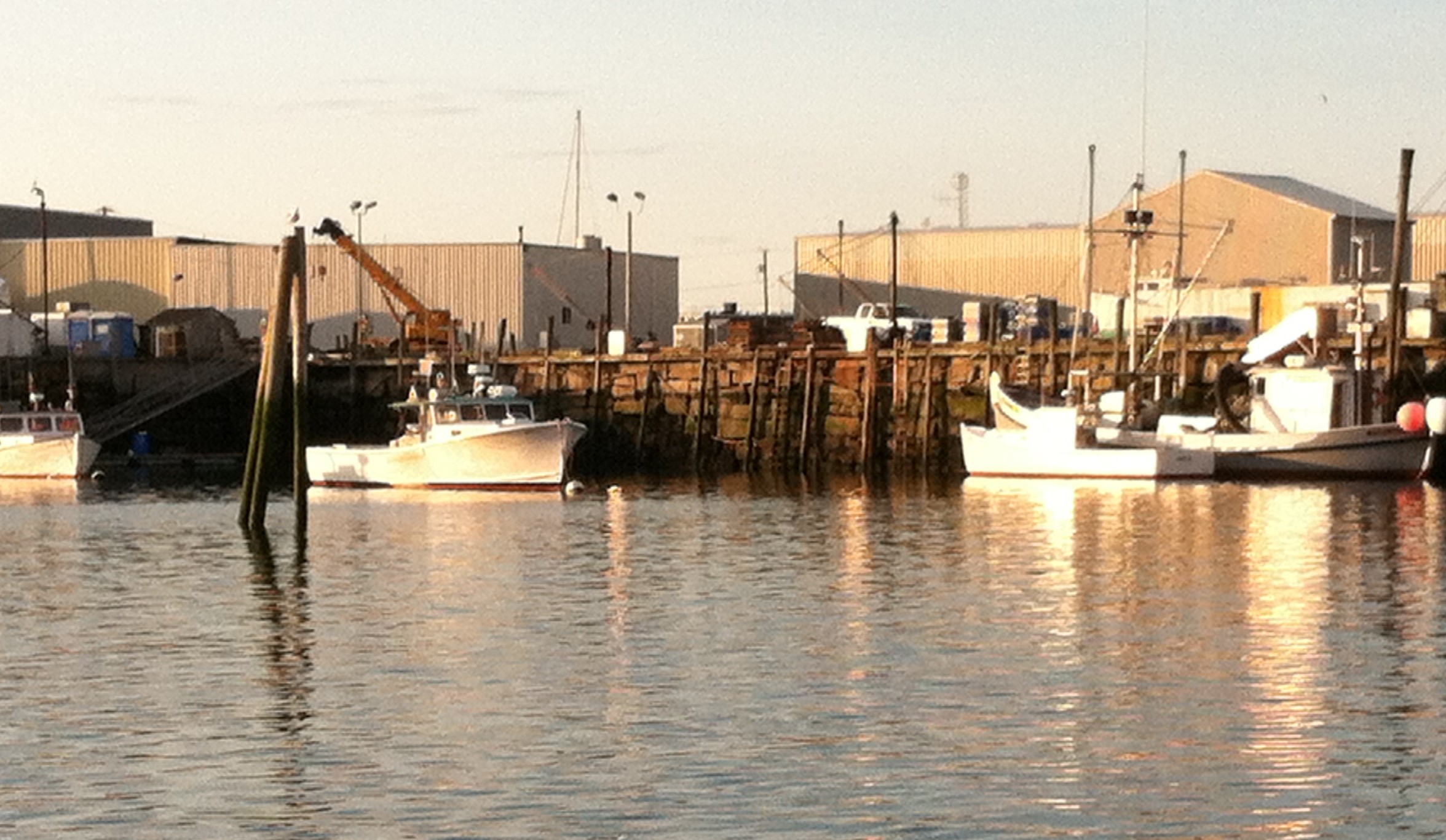
Rockland, ME, is artist colony, summer resort, tourist haven and, oh, yes, lest we forget, a working seaport.
It’s a busy harbor, bustling with lobster boats, ferries, Coast Guard vessels and yachts of all sizes and descriptions. On shore, there’s Hamilton Marine and the Wyeth Center at the Farnsworth Museum, two of many good reasons to visit. But of more importance, being there put Steadfast 25 NM closer to home.
Steadfast out.
25 August
It’s a classic image: a fleet of sloops sailing into the morning sun. And that was the view from the cockpit as Steadfast headed past the breakwater leaving Rockland Harbor. But as often is the case, the image belies the reality.
Lobster boats churned up the water as they headed to work. The big ferries that run to the islands add to the challenge. And as lovely and comforting as the sunlight may be, the sparkles on that light chop make it all but impossible to spot the lobster pots that litter the water between the harbor and Owls Head point.

Lobster pots are hard to pick-out heading into the glare of the early morning sun out of Rockland, ME.
The tension soon melted, however, when the heading shifted to 175 for the run down Muscle Ridge Channel. Ms. Wes took a break and Steadfast glided down the channel, wing-and-wing, at a relaxing three-knots. Rolling back the Bimini made it all the more enjoyable.
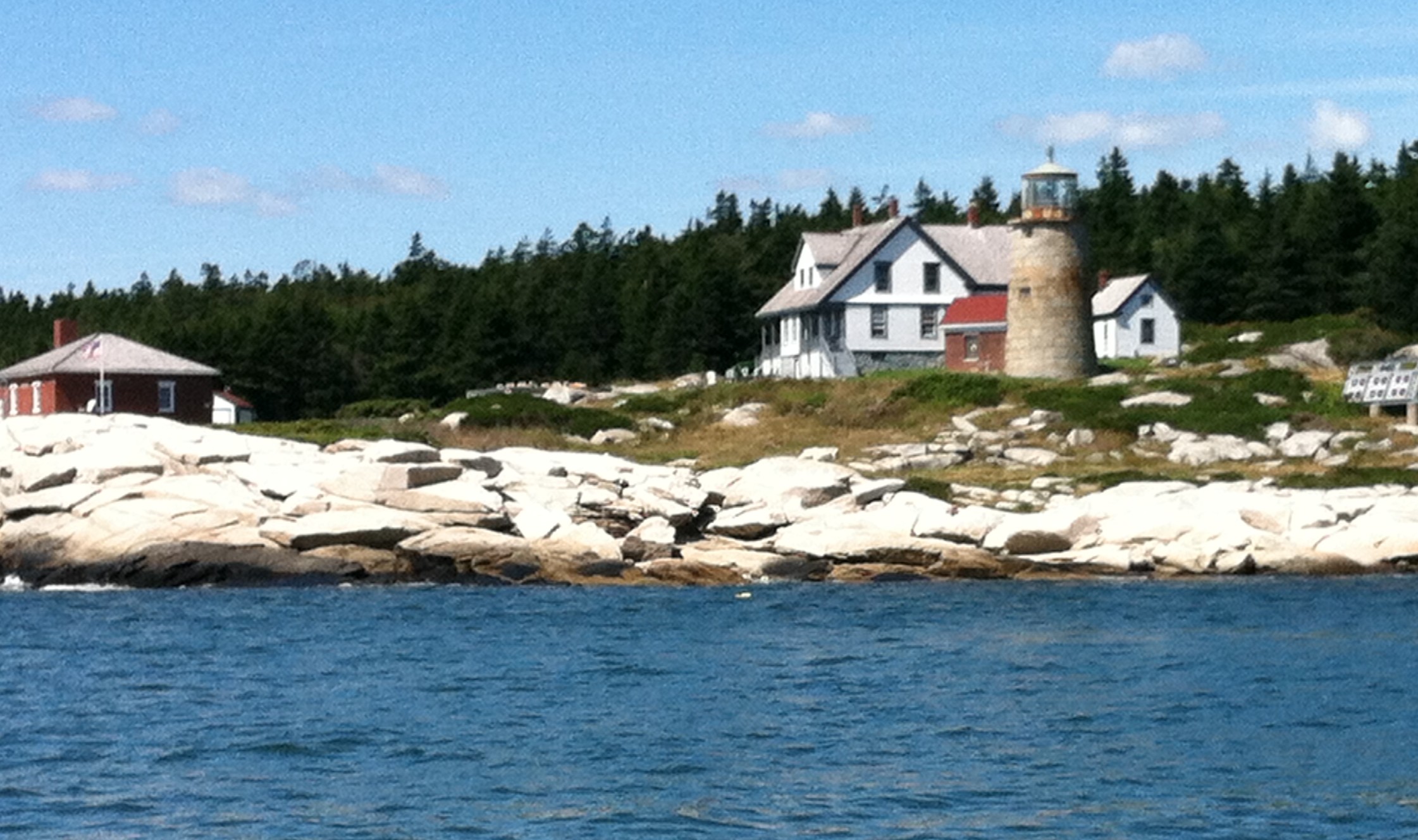
Deciding where to point the camera is nearly as much of a challenge as piloting the channel.
It was just early afternoon when the approach to Tenants Harbor opened to starboard. With so much sailing time left in the day, thought was given to pushing on, perhaps to Boothbay. But porpoise emerged off the starboard beam as if to say, “come this way,” and it was settled: Tenants Harbor it’d be.
An easy 15-mile day, made complete with a walk up the road to the Happy Clam, dining al fresco on THE BEST whole belly fried clams ev-ah. Wicked!
Steadfast out.
26 August: Dream Catcher
“Yeah, VERY familiar with the Chesapeake. I used to live in Gloucester!”
This statement was delivered with great emphasis by the bearded, bespectacled gentleman at the helm of the inflatable dinghy, his right hand firmly grasping Steadfast’s rail. It followed his inquiry as to “whereabouts IS Hallieford, anyway? It sounds familiar” and, of course, it was, given his years in neighboring Gloucester, Virginia.
The port of call “Hallieford, VA” on the transom prompts frequent questions anywhere north of Cape May but none have been so timely. Introductions were made and it evolved that Joe and his wife would start tomorrow on their way back to Jamestown, RI, where they keep their 36-foot Cape Dory cutter. Their Dream Catcher and Steadfast, it turned out, both planned to stop next in Boothbay Harbor.
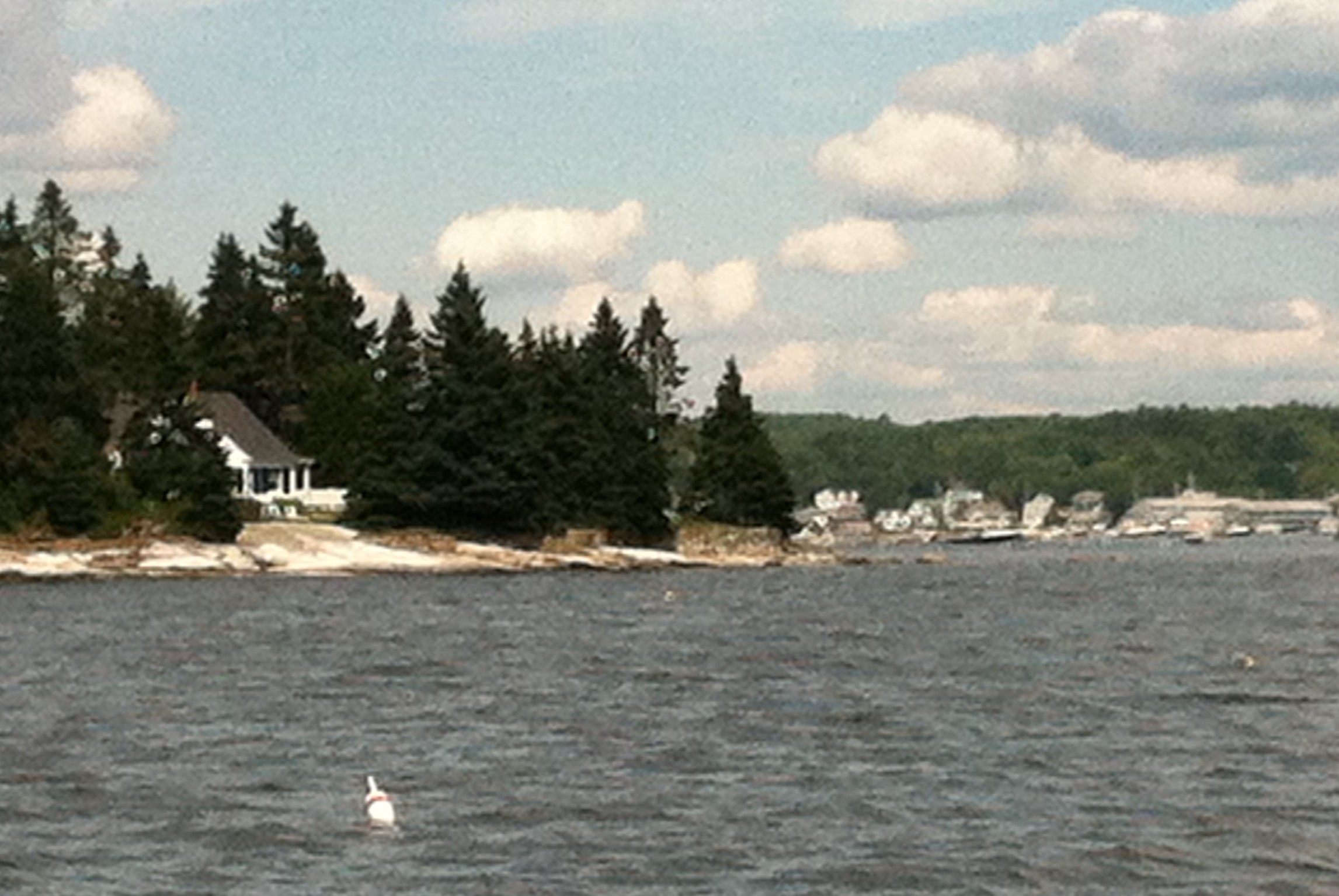
The teenager who became author-actor Sterling Hayden spent a couple of years on rocky Tumbler Island in Boothbay Harbor.
Beautiful Boothbay Harbor, by the way, was a boyhood home of the sailor-actor-author Sterling Hayden (the last of his four dozen roles was as the memorable police captain killed by Michael Corleone in “The Godfather”). Hayden’s mother and step-father rented a house on tiny Tumbler Island on the outer harbor. No doubt, the home that graces the granite now is a bit of an upgrade from what was there in the Thirties.
On the way east to Blue Hill, Steadfast cautiously stayed well off shore. But Joe planned to “go inside” through a passage among some of Maine’s gazillion islands. It made sense – fewer miles, more to see – so when Dream Catcher cast off at 0715 the next morning, Steadfast was not far behind.
Fog threatened to make it a tense passage past Mosquito Island but the fog moved more to the ocean side, giving way to blue skies, bright sun and a clear view ahead. No wind but, given the day ahead, that was okay. From wide open Penobscot Bay, Steadfast turned to round Mosquito Island and into the rock lined, relatively narrow and much shallower passage. Lovely Port Clyde went past off to starboard. A turn left to 247-degrees toward Griffin Ledges, then 260 for Seal Ledges, on to Eastern (not “Easter”) Egg Island and across Muscongus Bay. By then, Dream Catcher’s longer legs put her well beyond sight but there was plenty of other company, both eastbound and west.
Together with the dramatic scenery and frequent course changes, the 27.4 miles went by much more quickly than would have been the case off-shore. And it opened up similar possibilities for the rest of the trip.Boothbay was not just a convenient destination. Jim Crawford had “signed on” for a couple of days and would come aboard there the next morning. After fueling up to ready for the next leg to Portland, Steadfast motored to the town side of the harbor and found an open mooring. Looking up, waddya know, there was Dream Catcher.
“How’d it go?” Joe yelled from the rail. “Beautiful, ain’t it?”
Indeed. Another beautiful and rich day on the Maine coast.
Steadfast out.
28 August
This much we know for sure: people like to eat lobster. That being the case, many other people fish for lobster, hence the truly impressive number of brightly colored floats bobbing on the surface of the water along the Maine coast. (Or not. Some stay below the surface, but that’s another story.) Lobsters, it seems, huddle together where the water is 80 – 100 feet deep, or a bit more or maybe not quite so much; or so the people who fish for them seem to believe. There seems no evidence as to what hours lobsters keep or how late they sleep in the morning but to this we can attest: those who fish for lobsters start early. In every harbor from Sandwich to Blue Hill (and probably beyond), their big Cummins, Detroits and John Deeres rumble to life each morning no later than 0500 and the boats are on their way.

Lobster fishermen get an early start at the Rockport Town Pier.
In Rockport, MA, the town wharf includes a spot where all the local lobstermen can unload their catch at the end of the day. Of particular interest to those who sleep late in the morning, that spot also is used to load boats with gear at the start of the day. Were either of those aboard Steadfast prone to sleeping-in, this would’ve been an issue since her transom was about a boat length away from the busy wharf. Rockport was the third and final harbor Steadfast made with Jim aboard as crew. He signed on in Boothbay where the dawn was cool and damp, with thick clouds overhead and a forecast for showers, all of which seemed to say it wouldn’t be the best day to try for Portland. But by golly, when Jim and Mary drove up to the pier, the sun came out! Go figga.
Long gone forebears once lived on Jewell Island at the mouth of Casco Bay.
The light southerly wasn’t much but enough to make the main useful, making 5-plus knots with Ms. Wes loafing along at 2000 RPM. After turning Cape Small, Jim thought he might’ve seen a whale swim close to the surface about a quarter mile to starboard but couldn’t be sure. Steadfast again snaked through some snug passages and, with the Genoa open and drawing, too, she motor-sailed past Jewell Island (notable as the seventeenth century home of one of the King family descendants; thanks for the info, Charlie.) that now is an undeveloped state park.
Steadfast was moored in Portland by 1700, in time for cap’n and crew to enjoy a fantastic Italian dinner ashore. Another clear, sunny day followed but again, no wind. Still, the day was stunning and the escort could not be better. Just after rounding Old Anthony Rock, the sky was filled with the roar of a B-25 accompanied by five WWII vintage fighters. It was learned later that this was a wing of the Texas Air Force headed to Kennebunkport to salute President G. H. W. Bush. By coincidence, Steadfast and crew clicked off the last of 27 miles at Kennebunkport later this day–a lovely town, by the way–but did not have a chance to visit with George and Barbara.
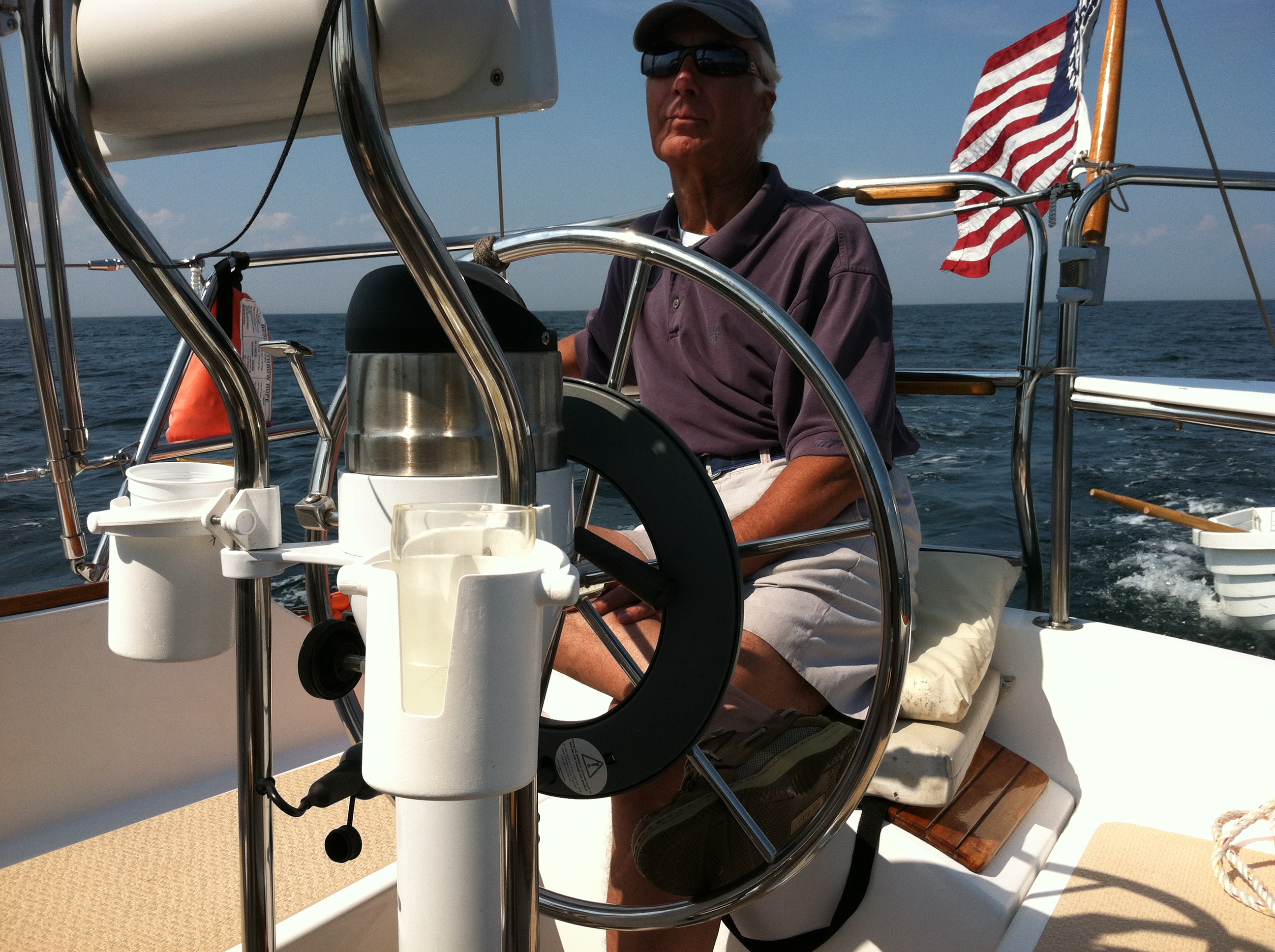
Jim takes a relaxed turn at the helm using his Sperry for hands-free steering.
Porpoise definitely were spotted on the leg to Kennebunkport and eyes were alert for more sightings on day three. Instead, at mid-morning, about 5 miles north of Boon Island, a Minke whale swam through the swells just 60 feet ahead of Steadfast’s bow. This event elicited a response from the skipper along the lines of “Golly gee!” but with somewhat more energy.
Other than whales–more were sighted along the way, too–there was little traffic, just wide open ocean. The Isles of Shoals were three miles off to starboard at lunchtime but, until Cape Ann emerged on the horizon, that was it.
Rockport Harbor was made in time to attend the day’s meeting of the 1630 Club, followed by (another) excellent seafood dinner at Roy Moore’s Fish Shack. The next morning, there was breakfast at the Red Skiff–gotta do it–Jim loaded his gear in a rental car, good-byes were said and he headed back to Blue Hill. It’s reported that his return trip took a good bit less than three days. Steadfast, on the other hand, continues pushing southward.
More later. Steadfast out.
29 August: Can’t Beat the Price
“Naw, naw, naw. Don’t go to Manchesta. Theyah’s nuthin’ theyah, Bill!”
The speaker is none other than Cap’n Bill Lee. You remember Bill: presiding officer of the 1630 Club and Rockport’s resident expert in all things nautical. “Just pick up a moorin’ at Thatcher Eye-len. Theyah free, ya know.” Bill has pulled his alongside to refuel Steadfast. (There being no fuel dock in Rockport, this is one more reason Bill is a popular guy on the harbor.) He then proceeds to pull up Cape Ann and Thatcher Island on the chartplotter in OR’s wheelhouse, pointing out the moorings. In answer to the question posed cautiously, he responds:
“Oh, yeah! They-ahs plentya wawtah in theyah! Look – 8, 12, 13 feet. You kin get in theyah easy with yaw boat!”
True. The trick, with an unforgiving rock bottom, is to be sure to find the “8, 12, 13-feet” and not the granite lurking just below the surface. But, it would shave off a couple of miles from the trip to Manchester–don’t tell Bill–to go through that narrow passage instead of going all the way around Thatcher. So, buoyed by the experiences of the last few days in Maine, Steadfast leaves Rockport at 1112, rounds the northern tip of Cape Ann and bends around the shoal to 210 degrees to make the passage Bill described.
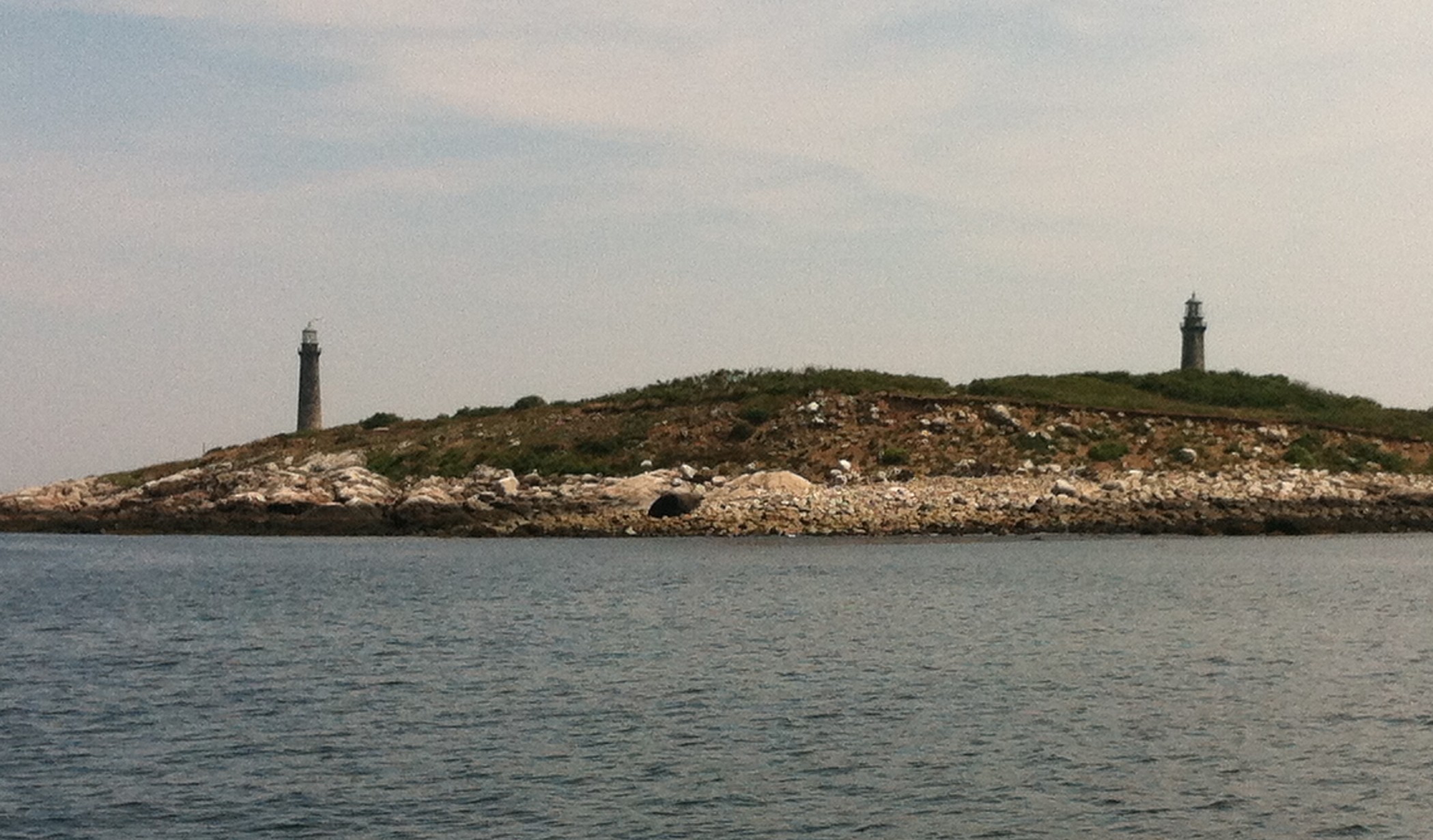
Identical twin lights leave no mistake that this is Thatcher Island.
Closing on Thatcher, the depth sounder reads 68, 72, 68…then 16, as in feet. After readings in the hundreds through much of the coast, 16 feels slim even though it’s more than four-times the depth Steadfast needs to safely clear.
This passage affords a unique perspective on what may be a unique arrangement of two (2) lighthouses on a single small island. The reason for the decision to build oh-so-long-ago awaits a future conversation with Cap’n Bill. Sails deployed, Steadfast runs wing-and-wing before a light northerly, hugging Cape Ann closely enough to hear the surf crashing on the rocky shore. Rounding Eastern Point, she passes the entrance to Gloucester harbor and turns due north for the channel into Manchester-by-the-Sea. It’s a short day–just 15.5 nautical miles–but another in a string of beautifully sunny days capped by arrival at a long, narrow and equally stunning harbor. The homes that line the banks of Manchester harbor rival those along Ocean Drive in Newport! Architecture, landscaping, each a gorgeous waterfront estate.
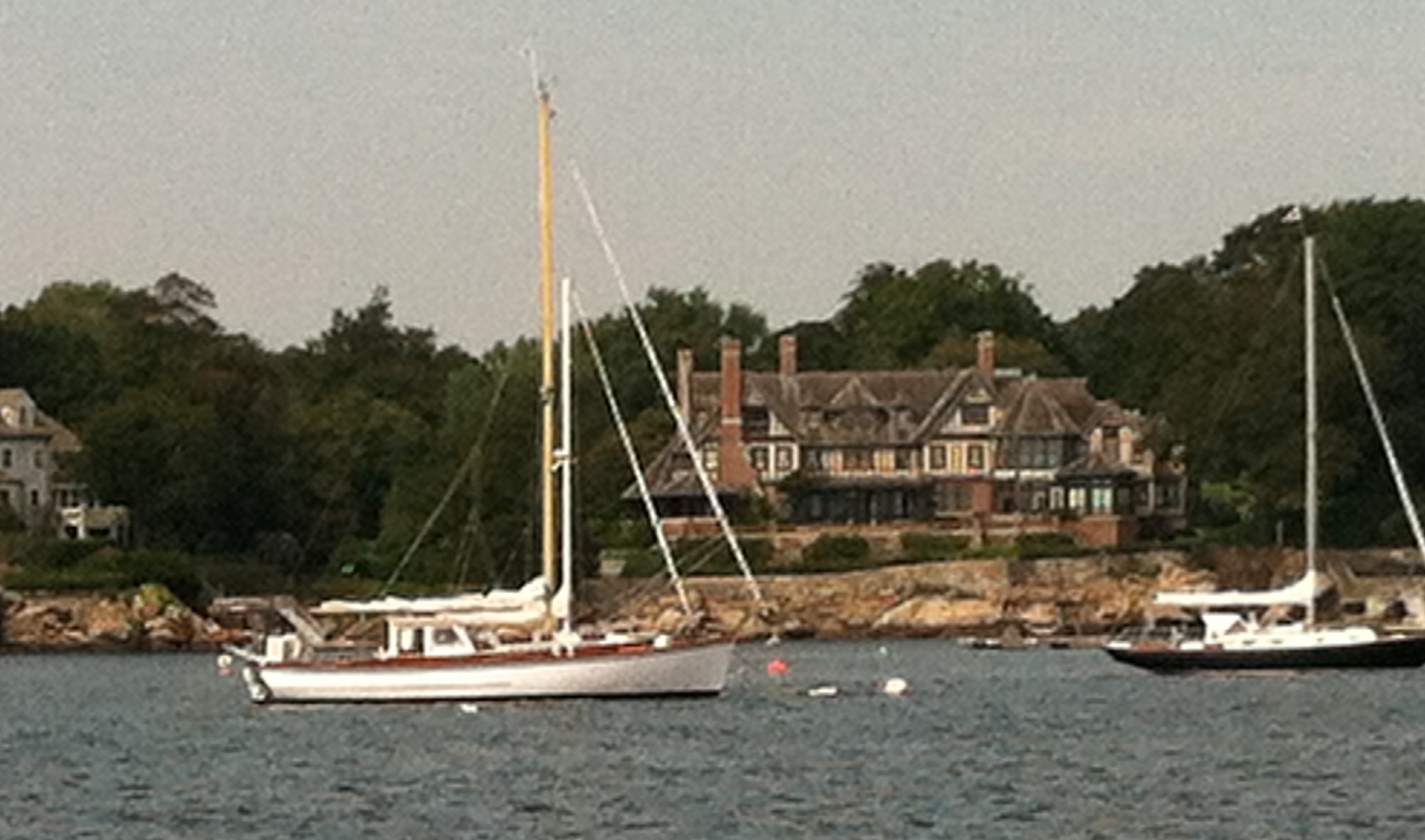
Gorgeous homes line a snug harbor filled with classic yachts at Manchester-by-the-Sea, MA.
And then there’s Manchester Yacht Club, whose launch driver explains, “Well, one night or two, doesn’t matter. We have plenty of moorings so the club stopped charging. It’s free.”
Just like Thatcher Island, but…15 miles closer to Hallieford.
Steadfast, out.
28 August: Whale of a City
“Call me Ishmael.” Well, not me, you understand. It’s just that, standing on the pier in New Bedford, it’s hard not to think of Ishmael, Ahab, Moby Dick and Melville. This, after all, once was the “whaling capital of the world” and remains one of the major fishing ports in the country.
There was little notable about the two days before Steadfast’s arrival in New Bedford, and there’s nothing wrong with that! “Uneventful” makes for a good day on the water. There was a straightforward hold the wheel at 200-degrees for the 25-miles from Manchester to Scituate; followed by a bit longer leg past Plymouth and on to Sandwich at the east end of the Cape Cod Canal. Then the fun started!
“Be advised, captain…” The voice on the VHF was that of Canal Control. Note that it is never good to be the person to whom the words “be advised, captain” are addressed. “The speed limit in the Cape Cod Canal is 10-miles-an-hour. That is 8 knots. Slow down and watch your wake!”
When your vessel is a small, slow moving, relatively under-powered sailboat, it is of some comfort to know Canal Control is watching to make sure big boats behave themselves. So after a quick stop at the fuel dock in Sandwich–it doesn’t take long to load five gallons–Steadfast nosed her way out into the canal and immediately went from motoring at 4.5 knots to 7.5. No change in engine RPM, understand. It’s all in the ebb current that had begun about an hour earlier.
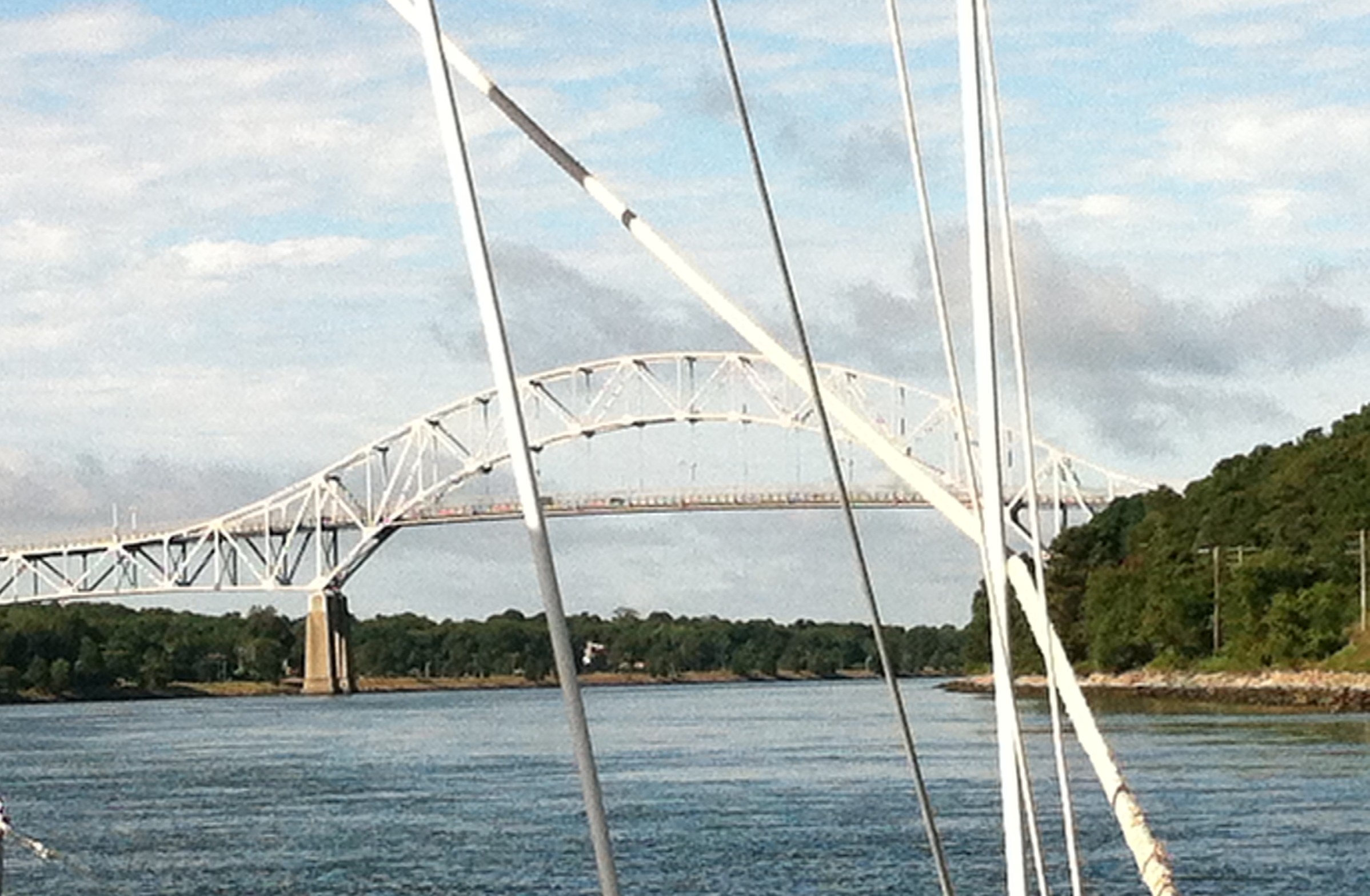
The Bourne Bridge is one of three spans that pass quickly when the current’s astern through the Cape Cod Canal.
But wait – it gets better. When Steadfast reached the point where the current was greatest, she was moving over the bottom at better than 9-knots! Speed through the water–what Control monitors–was still just 4.5. But she was on a sleigh ride through all the swirls and eddies. Even through the 3-foot chop that built at the west end, under the railroad bridge, that speed held at plus-9.
It was good to see the sights along and over the canal banks, sights that were missed in the clouds and rain that punctuated the first trip through. This day, it was sunny and, once through the canal, a so’westerly wind coaxed the sails to be unfurled and Steadfast tacked down Buzzards Bay, turned to starboard at West Island and into the five-mile channel to the busy New Bedford Harbor.
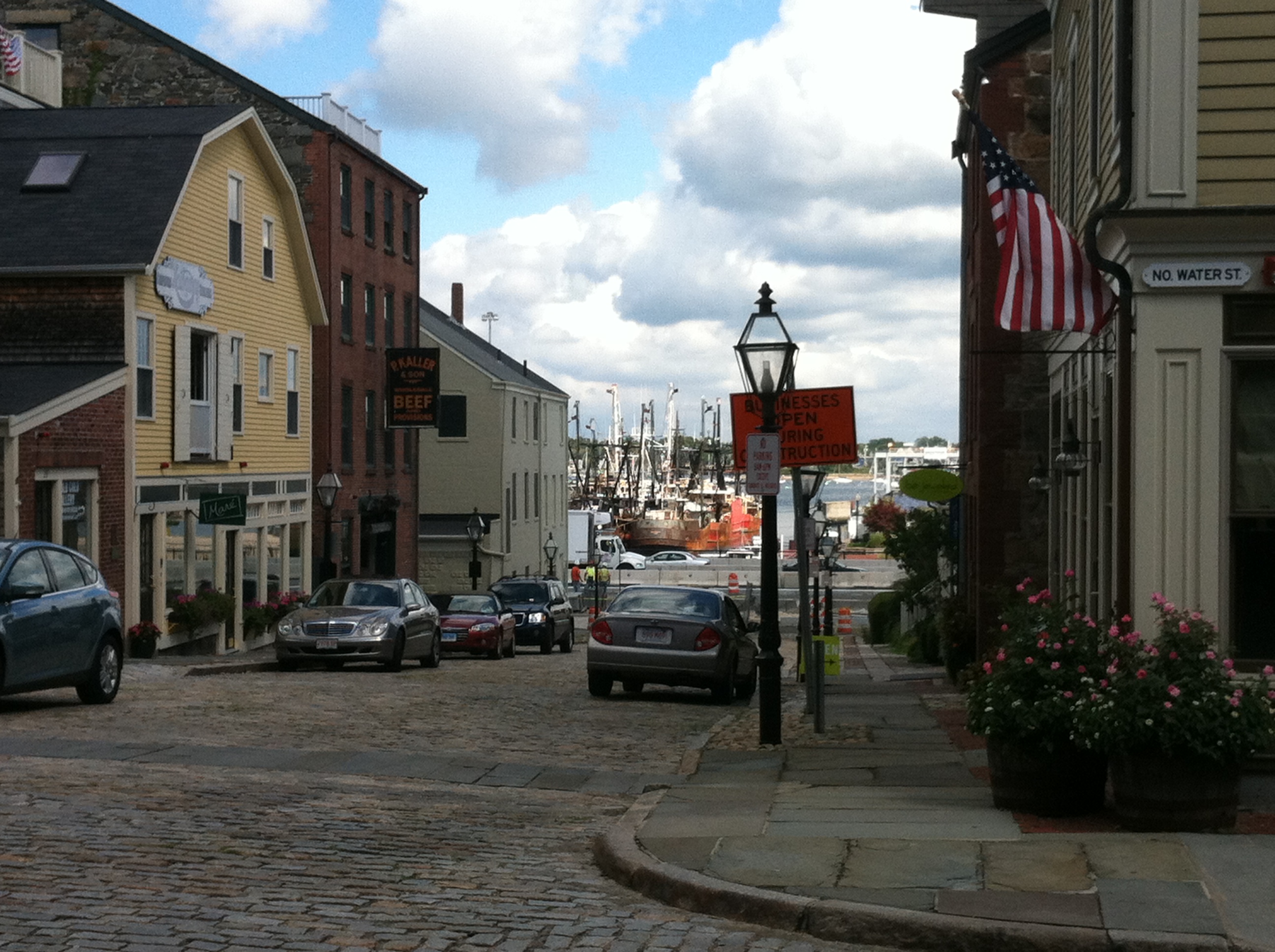
New Bedford’s cobblestone streets lead to the waterfront where whalers once departed for the hunt.
The city’s done–and continues to do–a great job of making the waterfront attractive and accessible to visitors while retaining much of the history and character of this harbor. There’s a photo op at every corner it seems.
Ishmael was not seen, may still be at sea.
Steadfast out.
29 September
“Securi-tay, securi-tay, securi-tay. Hello, all stations.”
The voice on VHF channel 16–the marine channel on which to call another boat or to call for help–was loud and clear. It was just 1000, still fairly early in this clear, sunny day, so maybe this was just a routine alert of some kind. But the voice continued.
“This is TowBoatUS New Bedford assisting a sailboat that has grounded at the Dumpling Rocks. All mariners in the area are requested to proceed with caution. TowBoat, out.”
Hmmm. Grounding on rocks. That’s not good. And to think, that being the most direct route out of Buzzards Bay to Newport, that was the plan for Steadfast this morning. But, as lovely as it was sailing on a broad reach, the two-foot seas on the starboard quarter made it a challenge to steer, read the chart AND pick out the distant markers, so the decision was made to take the “safe route” and skirt the main shipping channel instead of ducking past Dumpling Rocks. Prudence prevails.

As Steadfast motors out of New Bedford Harbor, these women practice for their next dory race, a popular sport in New England harbors.
Steadfast had been tardy in shoving off from Pope’s Island and New Bedford Harbor at 0845. Still, other than the commercial fleet, she was about the first boat out past the hurricane barrier this day. The light northerly was dead astern but with the tide running, she was making better than six knots while Ms. Wes churned over at 2200 RPM.
As the wind picked up, prudence–there’s that word, again–dictated putting a reef in the main, still on a reach, wind over the quarter and Ms. Wes took a well deserved break. The wind abated, the full main was up and shortly after noon, Ms. Wes was called on to enhance the wind, as it were.
Unlike the eastbound passage, Steadfast this time stayed closer in shore and with the bright sun, familiar landmarks from the past were easy to pick out. The enormous boulders at Tiverton Point where a college boy perched and dreamed of sailing oceans. Sachuest, the favorite beach. Marble House, The Breakers and all the other mansions whose “back yards” spill down to the Cliff Walk. Then finally, Brenton Reef, Castle Hill Light and Fort Adams, home of the Newport Jazz Festival.
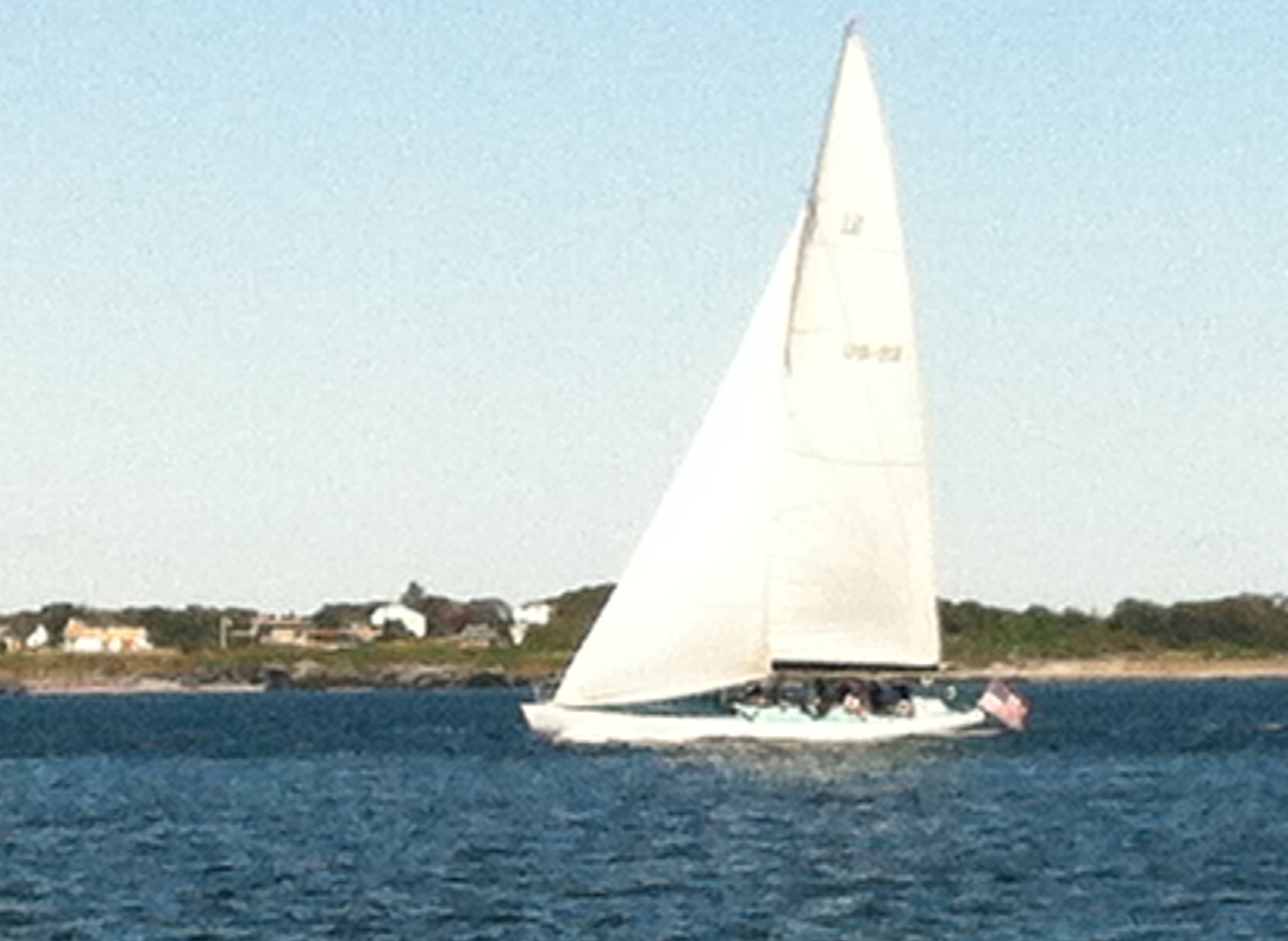
One of the several classic 12 Meter America’s Cup veterans thrills a crew of tourists out for a day-sail past Aquidneck Island.
A beauty day, 35.4 nautical miles averaging 5.5 knots along the way. And this time, with the miles that lie ahead, the night will be spent aboard, not ashore.
Prudence dictates.
Steadfast, out.
01 September: Plans
Spartina is on the prowl. Spartina is a well-cared for 31-foot Pearson sloop of mid’80s vintage whose skipper reported yesterday, “I left home this morning at four-o’clock so I could get a mooring and look: nothing!”
That’s because, as noted previously, Labor Day weekend began Thursday on Block Island. A few of those town moorings opened early Friday but not many. So when Spartina got there late Friday morning, he was out of luck. His expression was one not so much of disappointment–although he clearly was disappointed–as simple disbelief. How could this be?
So now, 0600 Saturday morning, he is on high alert for that first mooring that becomes vacant. As Spartina slides by, he is informed that Steadfast will cast off soon, will call to let him know and, hearing this, his sense of relief–and appreciation–are clear.
Once through the channel and into Block Island Sound, clouds begin to consume the morning sun to create the cover image for a future volume from Deepak Chopra, perhaps.
No description needed for the view looking back toward Block Island and Great Salt Pond.
The nor’east wind picks up enough to make sailing a reality and the Sound waters froth off the bow and hiss past Steadfast’s beam. It only gets better when a dozen porpoise swim from their pod of a hundred to say hello. They criss-cross under the keel, streak along side and briefly cavort in the bow wave. Then they’re off to entertain the crew on another boat.
The crossing goes from the sublime to the ridiculous at Watch Hill Passage, the easternmost entry to Long Island Sound. It is jammed with boat traffic of all kinds–workboats, families out fishing, a regatta of one-design sailboats and big yachts–underway to their holiday destinations. Combined with the suddenly strong current, wakes from powerboats, a bloom of seaweed and an attack of biting flies, the traffic makes it easy to forget that this is supposed to be fun!
Stonington slides by to starboard, a great harbor to visit but it’s too early in the day to stop. Steadfast presses on and is rewarded with a freshening breeze that carries her by mid-afternoon, instead, to New London. She spends the night on the Thames River in the shadows cast by the Coast Guard Academy and the Cutter Eagle.
There was little about this day that was planned, including the destination, but it seems all to have worked out, moving Steadfast another 35 miles closer to home while Spartina and many others move toward a memorable holiday.
Steadfast, out.
02 September: What’s the Hurry?
The Thames River is barely rippled by the light zephyr that comes from the east. There are some clouds but more of the sky is blue when Steadfast sets off downstream making 5.5 knots as Ms. Wes hums along at her now familiar frequency of 2200 revolutions a minute. It’s just a few minutes after 8 o’clock when the holiday morning calm is shattered by an angry voice calling frantically from an unidentified nearby harbor, seeking justice on channel 16. “Hey, buddy! SLOW DOWN! It’s a ‘no wake’ zone, you know. Watch what you’re doin’!”
There’s no indication of where the call is made but it appears the intended recipient did hear. “Kiss off!” is the simple suggestion offered, one assumes, by the perceived offender.
And so this last Sunday of the summer season begins, fellow boaters enjoying their time together on the water.
For Steadfast, the combination of favorable current and a rising so’easterly push her speed over ground to a fairly startling 7 knots. Eights then become frequent and she ultimately starts hitting speeds in the nines! For a couple of hours, motor sailing this way, the miles click off in most encouraging fashion. A course change passing Faulkner Island moves the wind astern and the speed backs down into the five-and-a-half range but, had it not been for the earlier numbers, five-and-a-half would feel pretty good! By 1400, she slides south of Branford Reef and shortly afterward turns for the breakwater guarding New Haven. Forty-four nautical miles, in all, at an average 5.9 knots, make this one of the most productive days of the summer.
The thought had been to anchor in Morris Cove, a broad bight on the eastern shore just north of the breakwater that’s home to New Haven Yacht Club. At 1500, there’s no way there’d be an open mooring but, hey, what the heck – give ’em a call. The first try on 16 yields no response. Nor the second. Nothing comes back after calls on channel 68, either. So anchor it…
Then a faint voice announces “Na Haven Yot Club.” The mooring inquiry quickly follows. “What size boat? Yeah, we got a moorin’ for ya. Come on in.”
Once on the mooring, the club “launch”–a somewhat tired flat-bottomed skiff adorned with a half dozen formerly white fenders on the port side–arrives with Phil–an 80-year-old in navy polo and matching Kangol cap–at the helm of the outboard. “I’ll need ya life hist’ry now,” he chuckles. “We need to know if tha police ah lookin’ for ya.”
Once he’s made note of the usual info, Phil is asked about amenities. “Sorry. No dinin’ room. Not even a bah! Can you believe that? A yot club with no bah!” and he chuckles again. “No showha, eitha. They just tore it out to replace it.”
Hmmm. So what exactly is the charge, then, one wonders?
“Oh, thayh’s no chahj. The moorin’s free. And let me know if you need any ice. No chahj for that, eithah. I’ll bring some out for ya.”
There’s a lot to like about the New Haven Yacht Club. Just the basics. With apologies to Kenny Chesney – no shower, no bar, no problem. And there’s no hurry, either. Phil likes to take it slow, the way life on the water ought to be.
Steadfast, out.
05 September
Redheads have a reputation, so it goes, for being, well, explosive, might we say? Think Maureen O’Hara in “The Quiet Man,” Rita Hayworth in any role and, of course, Lucy. But the redhead on board Steadfast has been hard-working and, as long as the skipper does his part, dependable. You know her as Ms. Wes but, as much time as we’ve spent together this summer, that now seems a bit stilted, impersonal. So she’s become “Little Red” or just “Red.” And she’s given no indication she minds in the least. For Red, Labor Day, as it turned out, was no holiday.
By 0714, as Steadfast slipped her mooring, the thick cover of dark, forboding clouds had given way to bright sun over “the second oldest yacht club in the country.” Phil proudly proclaimed this tidbit about New Haven Yacht Club the evening before, adding offhandedly “Some club in New Jersey is the oldest but I don’t know what.”
Nosing out into Long Island Sound, there were ripples on the two-foot swells rolling in from the east but not much wind to speak of, maybe five knots. So it would be up to Red to get us to Stamford, some 34 miles away. The main went up in hopes it would help counter some of the rolling motion induced by the seas moving under the port quarter. With the main drawing and a favorable current, Steadfast was making six-and-a-half knots or better by the time she crossed the bar at Stratford Point. She still needed Red to run her 2200 RPM, though, or she’d end up wallowing in the troughs. Not pleasant.

Motor-sailing along the Connecticut shore, the dinghy strains at her painter.
Two miles south of the South Norwalk Light, the wind had built into the teens, brewing Guinness-like seas: dark and foamy. The motion had become much like a ride at Kings Dominion, going side-to-side, up-and-down and forward all at once. All this while speed over ground hovered near 7 knots, maxing out at plus-9 along the way! Turning a few degrees to starboard at the rocks known as The Cows, it became clear the couple of miles into Stamford Harbor would be a wild ride. Catching on the beam what by then was a steady 20 knots, gave Red a chance to catch her breath as Steadfast sped along at plus-5 under just the main! Once past the breakwater, the water immediately flattened out, enough to allow the main to be furled even though the wind continued to howl. Red took over from there completing the day at an average speed of 6.2 knots, probably the fastest overall run yet.
With the threat of rain and thunderstorms through mid-week, Red gets some well-deserved rest. And attention. A clean fuel filter, fresh fuel, a little more coolant, maybe, and a thorough check of all her clamps and fittings. This in preparation for the run down the East River and through New York City when, once again, it’ll pretty much all be up to her!
Since departing in mid-June, Red now has been on the job more than 300 hours. That’s a lot of work for her two little cylinders with another couple of weeks still ahead. With that resume, she deserves an Oscar!
Steadfast, out.
07 September: What would Jimmy Buffett do?
The rigging howls. A halyard slaps unceasingly on the mast of the neighbor’s otherwise tidy 45-foot Beneteau. That’s what happens when a southerly blows at 20-plus knots up the Hudson River at whose mouth Steadfast sits tonight. She’s on the Jersey side, in a slip not far from the Statue of Liberty. The thought was the train ride(s) for JB to get from here back home to Connecticut would be fairly straightforward, and, likewise for me to lay-over and visit Bowe in Brooklyn.
The storms brewing this morning on the western horizon only confirm the wisdom of that decision. Whether this is an RV park with a marina or a marina with an RV park doesn’t matter at the moment. It’s just a relief to be secure. The view across to lower Manhattan is a bonus.
Steadfast arrived uneventfully (always a plus) but not with as much dispatch as had been anticipated. This leg, keep in mind, was to include the rush through Hell Gate and down the East River. After three days idle, waiting for the weather to settle, Steadfast was itchin’ to get underway again. JB was most gracious in opening her home as base of operations for these days in Stamford but there remained a few last minute tasks (stocking perishables and ice in the ice box, for instance).
It was 1242 by the time Steadfast cleared the Stamford breakwater, later than planned but still in time, it seemed, to ride the favorable current down the East River. A heading of 240 would take her to the Old Hen, on the Queens side, just east of City Island. The bimini was much appreciated as bright sun sent temperatures into the upper 80s. For the first 15 miles, Little Red was working hard to push Steadfast at just five knots. Finally, passing under the Throggs Neck Bridge at 1600, there was a discernible one knot boost. Clouds began to roll in, skies darkened but there’d been no mention of rain in the forecast so Steadfast pushed on. A so’east wind coaxed out the genny for a while and speeds moved past 6-and-a-half. It didn’t last long–not that it’d be needed–since rounding Lawrence Point to port put the wind dead ahead. That’s when the current took over.
Once into the East River, speed through the water fell to just 3.5; speed over ground was more than 7! The turbulence increased, too, and not just from the passing ship, tug, motor yacht and Police boat traffic. Swirling eddies tried to exert their will on Steadfast, briefly changing her heading first one way, then another. And the now strong southerly blowing up river against the ebb current pushed up a four-foot chop. All the same, the speed over the bottom kept climbing – 8.3, 8.8 and then approaching Hell Gate, into the 9s. Those speeds held down past Roosevelt Island and the UN. A quick glance to starboard and there was the Chrysler Building, then the Empire State. Right about there, with boat traffic of all kinds around, the sound of a loud engine grew to a roar as the sponsons of a seaplane plowed into the waves about 100 yards to port!
It’s easy to ignore the seaplane port on the Lower East Side until one sets down a hundred yards off the port quarter!
It was hard to see the pilot through the glass. It might’ve been Joe Merchant, who knows? At a moment like this, I can’t help but wonder, what would Jimmy Buffet do…after he changed his shorts, that is.
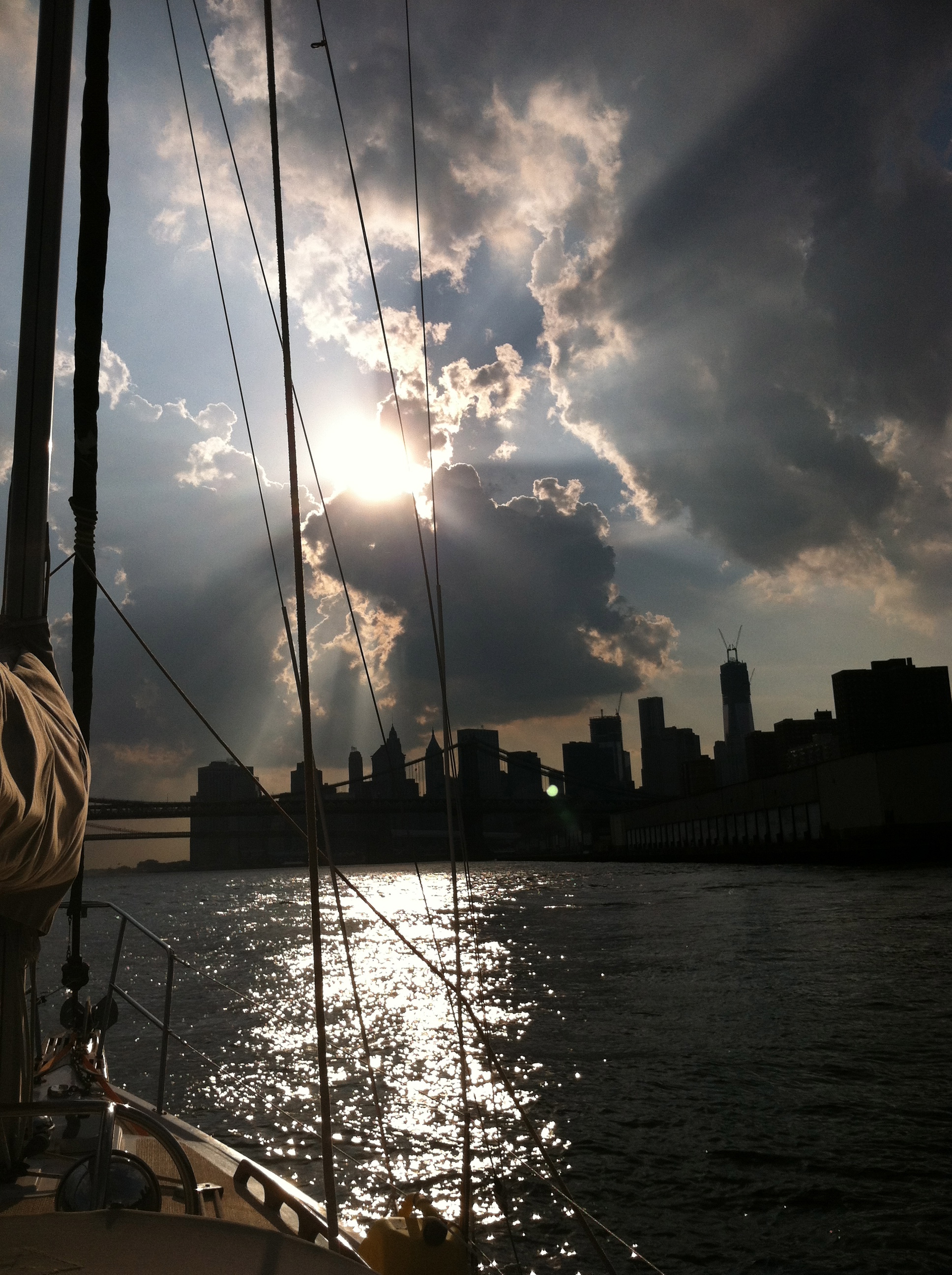
A passing front shielded the setting sun for a dramatic close to the trip down the East River.
Despite threatening clouds and the occasional spritz, it had now become apparent that as long as Red kept up her steady thrum, Steadfast would make Jersey City before dark. And she did! Rounding The Battery, at Manhattan’s southern tip, the ferry traffic multiplied–it was rush hour, after all–and the speed quickly dropped. Other than dodging the Staten Island ferries and the high speed ferries from who-knows-where, it was a straight shot across the mouth of the Hudson, past the big “Colgate” at the water’s edge and into Morris Canal.
Once tied up, Jimmy’s voice could be heard telling his tales at the Surf City Megabar looming over the pier. Dogfish IPA proved a more than worthy substitute for Landshark and the toast was raised to Steadfast, her crew and another successful 34 mile leg on her way home.
Steadfast out.
09 September: Another Island
“Good morning, Captain. Where ya headed?”
The question is shouted across from the helm of a Coast Guard boat patrolling the entrance of Morris Channel. Once assured that Steadfast is headed to Staten Island, he nods. “That’ll be fine. Just take a right and follow the Jersey shore.”
Simple enough, as simple as any attempt to pilot New York Harbor can be. This day, for instance, Coast Guard, NYPD and fire boats are on patrol directing vessel traffic away from the area off The Battery. It’s closed ’til after 1500 for a J-24 regatta. This causes some inconvenience for those transiting between the Hudson and East Rivers, their irritation apparent on the marine radio.
Steadfast, however, is taking this warm Sunday morning to slide south. After tending to Little Red, coiling the power cord, walking the key to the office and other routine tasks, it was 1057 by the time Steadfast backed away from the pier at Liberty Harbor Marina & RV Park. Morris Canal is just about a half-mile north of Ellis Island. As familiar as the image may be, it is difficult not to pause when passing the small island to its south.
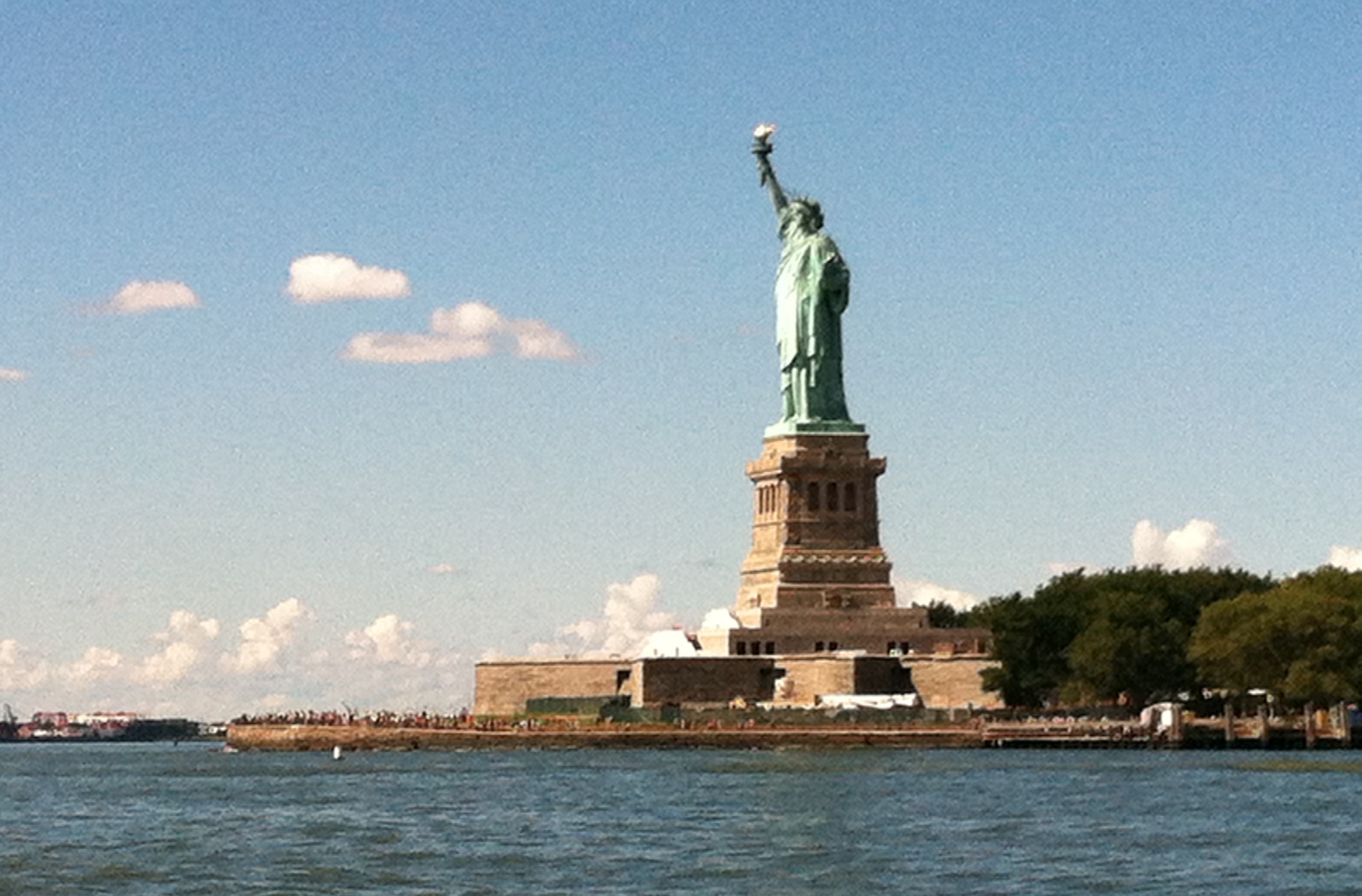
The image may be familiar but seeing her up close, she is impressive, nonetheless.
Don’t pause long, though. While waves on the Upper Bay were barely a foot, the steady flow of ferries, tour boats and tugs keep the waters churning. Ships, yachts, fishing boats and, this day, the patrol boats make vigilance the by word.
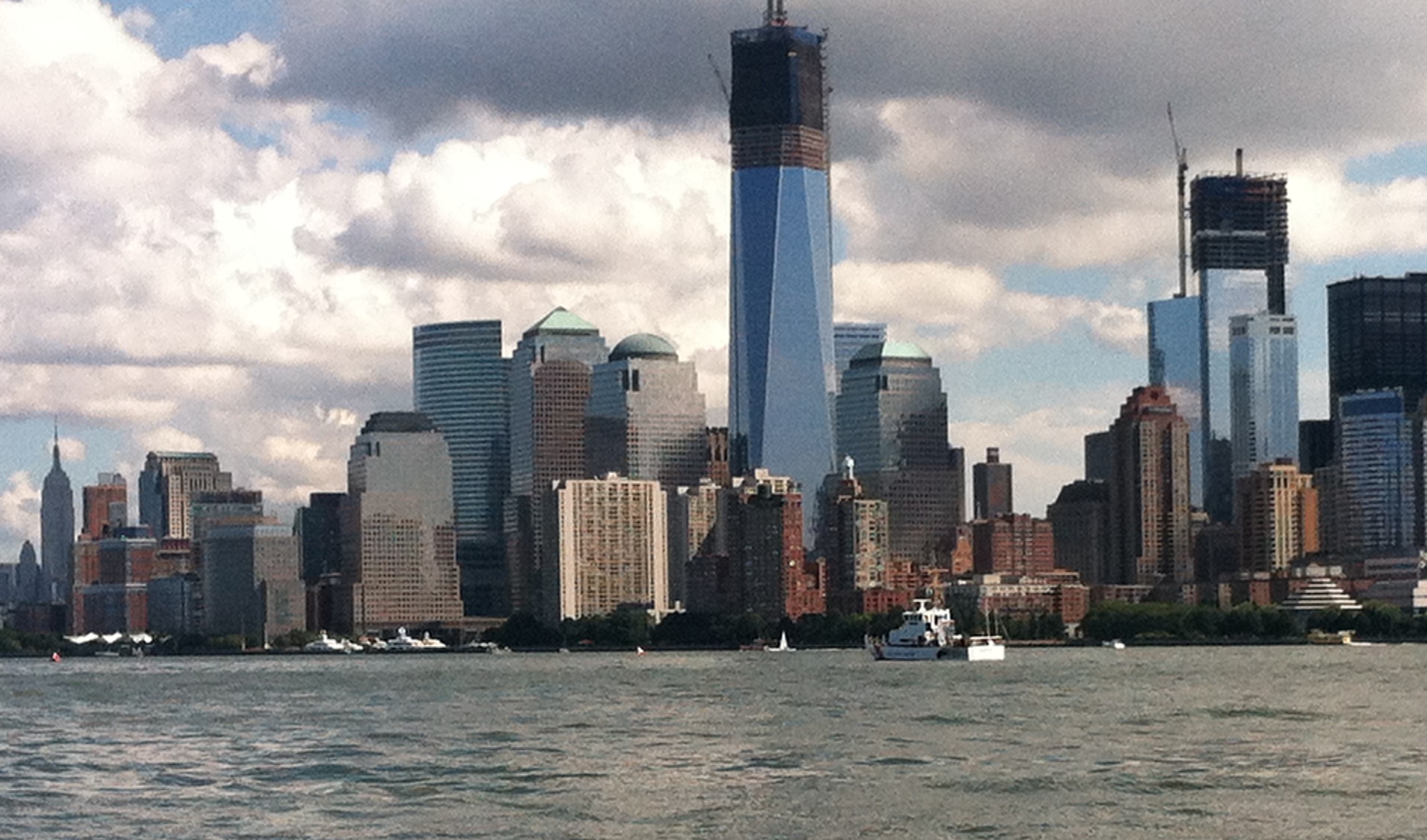
Still rising to its full 1,776 feet, the Super Tower at Ground Zero was easy to spot heading south from Jersey City.
Once under the Verrazano-Narrows Bridge, the waters of the Lower Bay are wide open, flat and quiet, a striking contrast with the hectic pace just a few miles to the north.
At 69-feet, it’s easy to spot the West Bank Light. From there, the heading shifts from 200 to 270, due west to the entrance to Staten Island’s Great Kills Harbor. A narrow channel opens to a harbor less than a mile long and roughly a half-mile wide. There’s plenty of depth, plenty of room to anchor and there’s shelter from wind and seas in every direction. Bill, driving the launch for Richmond County Yacht Club, says this is “The best kept secret in New Yawk City. It’s two-fifty fa da bus to da ferry, then da ferry’s free. Ya can’t beat it!”
Simple, too. A welcome respite before heading down the Jersey Shore.
Steadfast, out.
10 September: Harbinger of Fall
The experience of being underway in a small boat for an extended period provides the opportunity for many lessons. For instance, you may not have tried yet but, take it from one who knows, when you hang towels outside in sun and 30 knots of wind, they will dry quickly and smell fresh when you take them in! That is, assuming the towels are still there to be taken in.
Bill, the retired New York cop who now drives the launch at Richmond County Yacht Club, saw the blast of northerly wind as “a hint of fall in the air.” Hardly. More like getting hit with a club!
NOAA had posted a small craft advisory for Monday and its forecast was spot on: northwest at 15 to 20 knots, gusting to 30. Battalions of thick clouds marched in step across an otherwise blue sky, as if led by John Phillip Sousa and the Marine Band playing “Stars and Stripes Forever.”
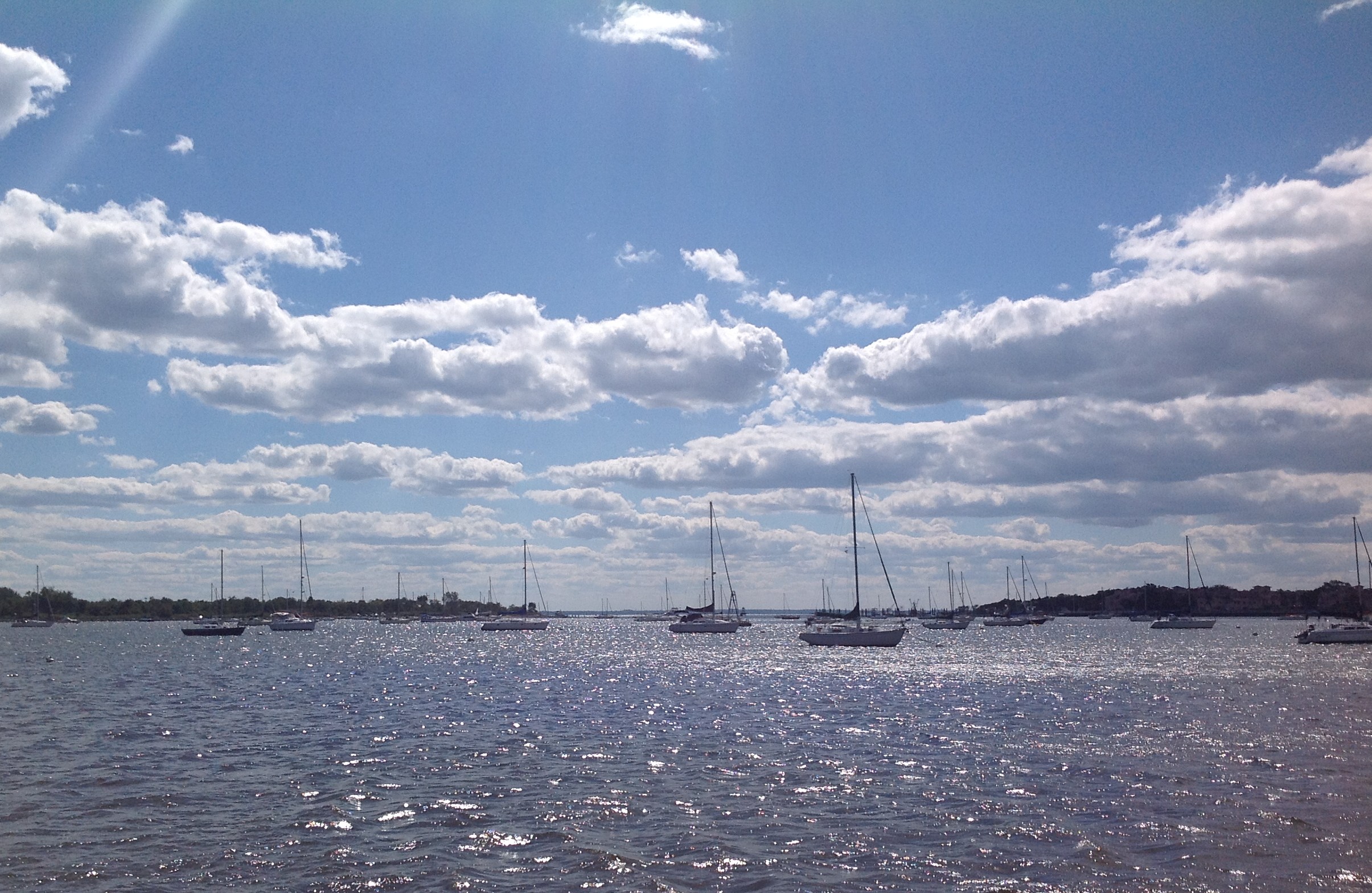
Though pinned down by a persistent northerly, Steadfast was well protected in Great Kill Harbor.
Below, the boats on Great Kills Harbor were listening to the Glenn Miller Orchestra. They were “In the Mood” to swing, first one way, then the other. Steadfast took the lead, in her little fox trot, and the dinghy followed.
It went on that way, all day and into the night. It was, in other words, a good day to stay in harbor. The following day, nine-eleven, too. A similar forecast gave the opportunity to try the Staten Island ferry for a quick run into Manhattan for the day. It turned out to be much warmer than forecast, as long as the sun was high in the sky.
Once the sun closed on the horizon, that “hint of fall” was in the air once again, wind or no.
Steadfast out.
12 September
“Hey, Cap’n! Come in this way,” the instruction yelled out across Manasquan Inlet from the fuel dock at Hoffman’s Marina.
Mike, the dockmaster, moved one arm in horizontal circles suggesting Steadfast lay her port side to the pier. Fenders and lines already were on the starboard side, but he insisted. “It’ll be betta faw ya this way. Thaihs a strawng curren trunnin in heea.”
That’s typical with the inlets on the Jersey shore, the current running two, three or more knots with the tide, ebb or flood. Of little concern to the 30, 40 and 50-foot power boats that are the vessel of choice here but a big deal to Little Red and her 18 horses. On this Wednesday evening, near closing time at Hoffman’s fuel dock, Steadfast was “on time” with the tide running in. She ripped through the inlet hitting a surf-and-tide-assisted 7-plus knots. And Mike and his crew, of course, were correct about tying up port-side to the pier.
Manasquan is about the only navigable inlet for the 80-mile stretch of the Jersey Shore between Sandy Hook and Atlantic City. That entire run can be made in daylight during June but not in September, so Manasquan becomes an important stop over for boats bound for the Chesapeake and beyond. Hoffman’s is a first-class operation bisected by the Conrail tracks that cross the inlet on a bascule bridge that’s just 13-feet off the water when it’s closed.

The siren sounds whenever the railroad bridge lowers for the frequent commuter trains that cross the Manasquan Inlet.
The bridge closes only when a train approaches. That’s the good news. Less pleasant is the realization that the commuter trains are frequent and, as is appropriate, a warning siren sounds whenever the bridgetender readies to open or close. A loud siren. Throughout the night. Steadfast tied up about 70-feet upstream from this bridge.
But that’s okay! Manasquan has all the appearances of a charming New England seaside town and, as noted above, has the added attribute of being a convenient and safe stop between Sandy Hook and Atlantic City. The run south from Great Kills Harbor had been straightforward, Steadfast laying a mile or two offshore, moving easily over the Atlantic swells at close to 6 knots while Red chugged along at her usual 2200RPM. By midafternoon, off Asbury Park, the southerly wind had built to around 10 or 12 knots, pushing up a chop that sent spray over the bows. So when, after more than 34 nautical miles and six hours underway, Manasquan Inlet came into view at 1650, it was a welcome sight. (to be continued)
13 September
Mike the Dockmaster wasn’t kidding about the strong current in Manasquan Inlet. The water gurgled and slurped around the hull and the pilings of the pier ’til slack water, took about an hour break, then started to flood in, gurgling in the opposite direction, the sound of a round-the-clock fountain.
Slack tide came just before the sun was due to rise over New Jersey’s shore. There was enough light, though, to cast off from Hoffman’s pier and move, with a half-dozen other boats of various sizes and designs, toward the actual Manasquan Inlet. The Catalina 27 Patience, homeport Fairhaven, MA, motored under the bridge and into the tangerine sun just ahead of Steadfast.
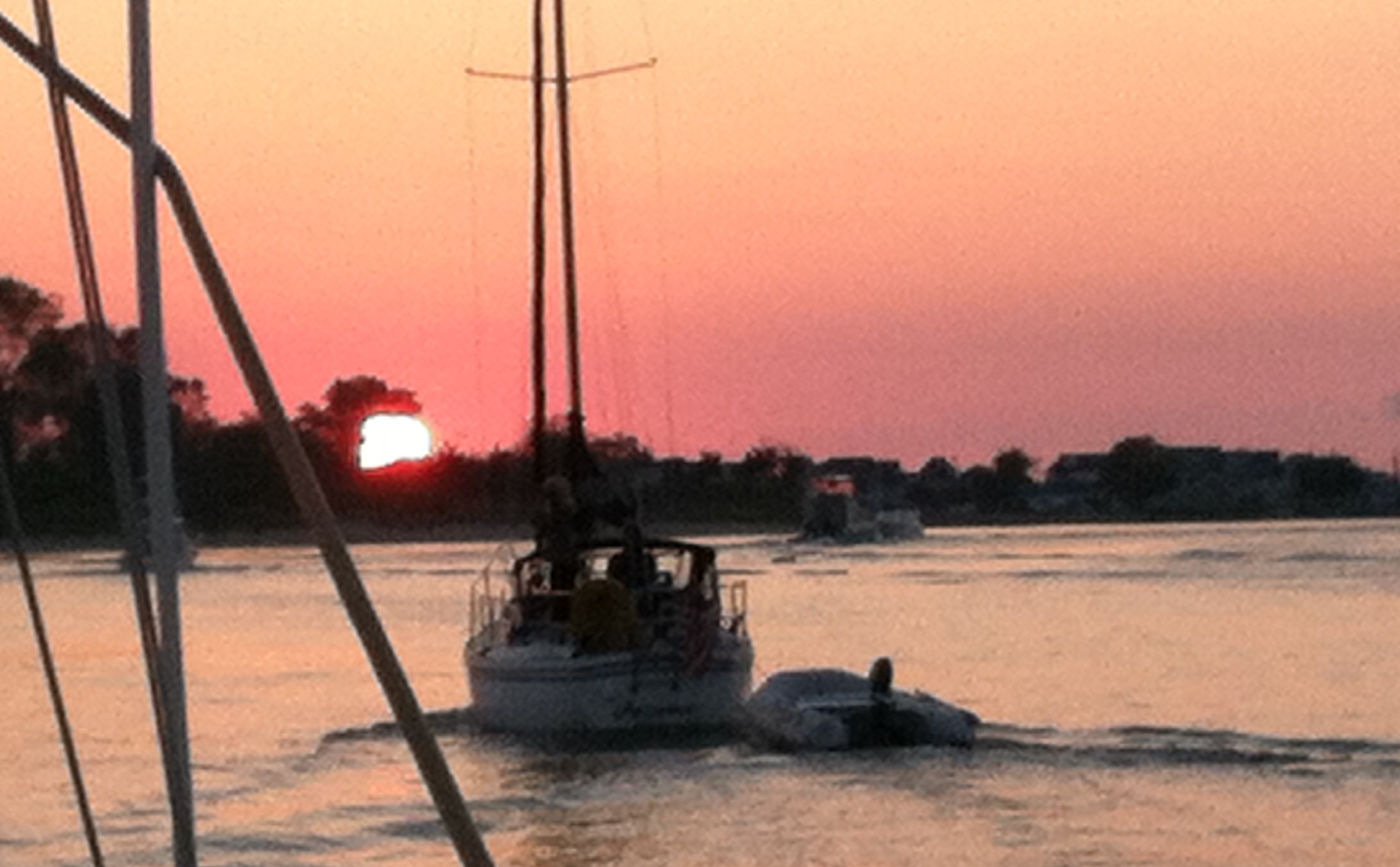
Patience leads the way under the Manasquan (NJ) bridge for an early start into the Atlantic.
A lovely start to what would be the longer run down the Jersey shore, nearly 54 nautical miles, meaning roughly ten hours underway. But then there’s that current-thing: a knot or knot-and-a-half push from a favorable could cut the time of the trip by about 20-percent. It did appear to be just about ideal conditions for motoring – sunny, clear, 70s with little wind and virtually flat seas. Then to confirm expectations, the sailors’ companion, the porpoise, appeared in numbers, dozens dancing and playing in the swells just off to starboard almost as soon as Steadfast cleared the breakwater and turned to a heading of 205 magnetic.
The hoped-for knot-and-a-half current kicked in to boost speeds to near six over the bottom. The inlets appeared in sequence off to the west – Barnegat, Beach Haven, Little Egg, Brigantine and finally Absecon, the inlet to Atlantic City. For the last thirty miles or so, maintaining the proper heading was fairly easy – just aim for the enormous slate gray monolith that looms on the horizon, the $2.4-billion Revel casino that now guards the Boardwalk. And yes, even on a hazy day, it can be seen from 30-miles away.
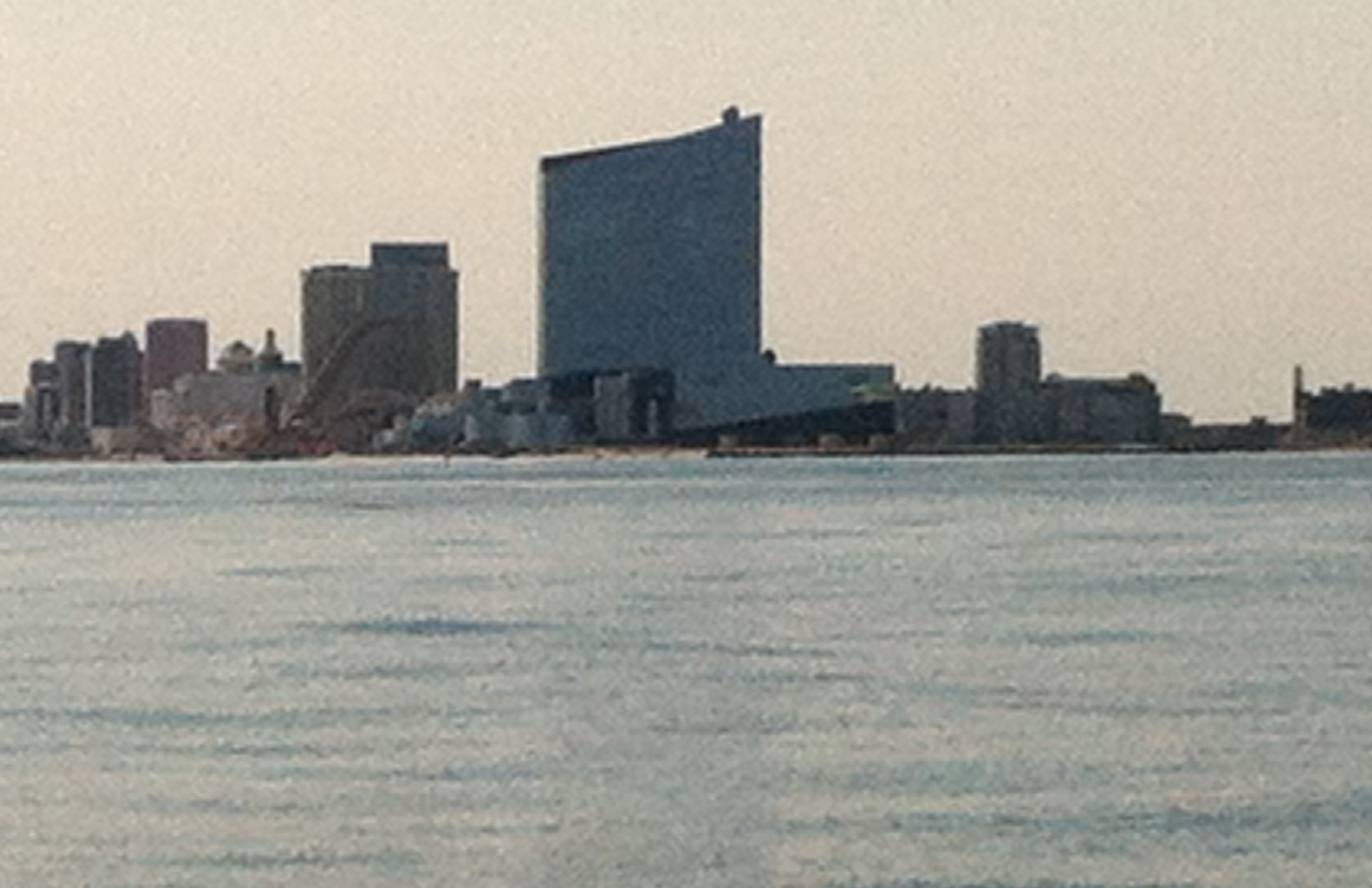
The then-new Revel ocean-front casino towers over the boardwalk, making it easy to steer to Atlantic City.
There’s much less traffic on the water on a weekday in mid-September than a weekend in June. That means the Absecon Inlet waters are far more docile, even riding the flood tide into Clam Creek. Once at the creek entrance, a turn to port put Steadfast — and Patience — on the pier at Historic Gardiner’s Basin, without question the best value in Atlantic City: 25-bucks a night versus $4-a-foot at the state-owned piers across the way.
Another gorgeous day followed for the relatively short 37-mile run south to Cape May, again motoring all the way. Then a weekend in port to tend to Red, re-provision and other tasks to get Steadfast ready for the last big hurdle on the way home: Delaware Bay and the Chesapeake & Delaware Canal, and the promise of yet more “current events.”
Steadfast out.
18 September: Anticipation
The marine VHF radio screeches like a startled heron, then screeches at a higher frequency, a signal that shrieks through the cabin. It does its job. It gets your attention.
“The National Weather Service has issued a severe thunderstorm warning…” The digitally-generated voice adds that a tornado watch exists for the same areas of Maryland and northern Delaware, areas bisected by the Chesapeake and Delaware (C&D) Canal. That happens to include the pier where Steadfast lies this day, tied securely (one hopes!) in the snug boat basin about three-quarters of the way through the canal.
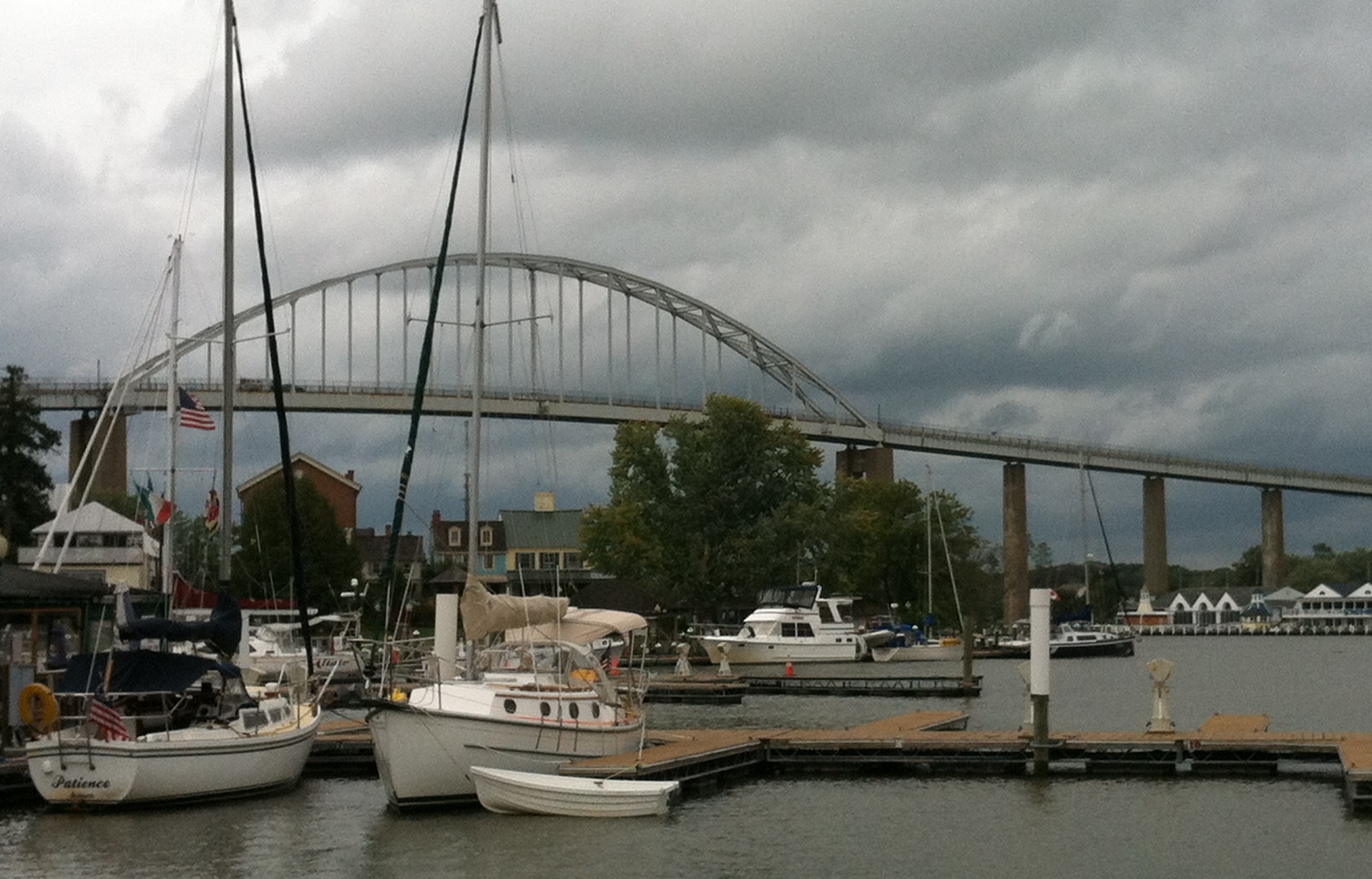
There’s not much room to anchor but with dockage on both sides of the canal, Chesapeake City is a good place to wait out the weather.
At the same time, dark clouds race eastward over Chesapeake City. Thirty knot gusts roar through the rigging, the boat rocks and docklines squeak. They also cause skippers and crews to gather on the pier, swapping some tales but mostly just waiting. Waiting to see how much more the weather may have in store.
All this is in stark contrast to the benign conditions that prevailed yesterday on the passage up Delaware Bay. Kate had surprised, suggesting she drive up to Cape May for the weekend to spend a couple of nights on board. The timing couldn’t have been better. There was a lot to do to get Steadfast ready for the final legs of the trip and, of course, being in Kate’s company buoyed your correspondent’s spirits to be ready, too. Delaware Bay is a big day in the best of conditions and can be a bear in weather. But the forecast looked good for Monday and the flood tide would provide a boost, assuming the boat was there to meet it. So Kate helped cast off the lines at 0600 and Steadfast motored off into the still dark Cape May Canal in concert with Jane and Tony aboard Patience. The two boats sailed serendipitously at the same time from Manasquan, remember, and have continued in tandem since. When you’re alone on 27-feet of deck, it is of great comfort knowing another crew is traveling nearby at the same pace and able to lend a hand, if needed.
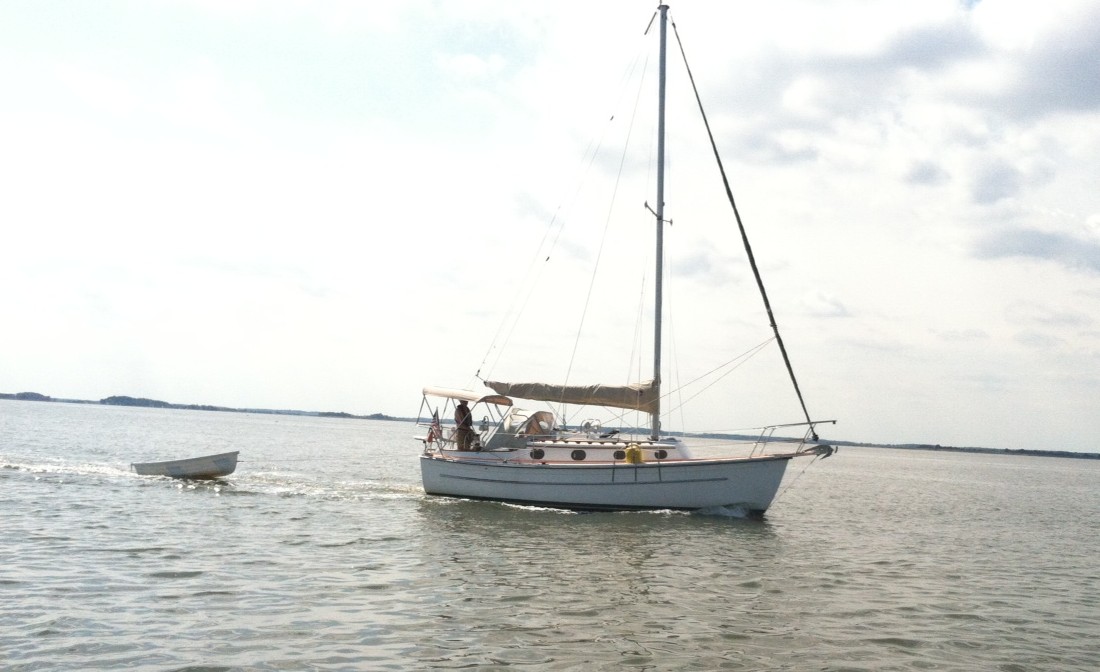
With flat water and a favorable current boosting speed to 7+, the trip up Delaware Bay was all “down-hill.”
The boat’s actual speed in the canal waters was less than 4 knots but tidal current boosted the velocity to more than seven (7!). What a great start. The bay was all but flat with a light northerly that clocked later to the south.
Once through the western breakwater and turning to the nor’west, the speed-made-good continued to be north of six all day. An early haze lifted under what became a bright sunny day. There was a good bit of company for a while from bigger, faster yachts heading for the C&D, including Queens Creek neighbors Chris and Bill aboard their ketch, Plover. Tankers, container ships, tugs and barges completed the procession. A sharp watch was maintained and Steadfast was well out of the way of the latter group at all times.
The current lost some of its oomph just as Steadfast approached the entrance to the C&D but then, as soon as she passed green #1, she was on her way again at bottom speeds at or above 7 for most of the roughly 14 nautical miles she transited yesterday (another five or so remain for tomorrow).
Now, at the pier at Chesapeake Inn & Marina, the total 62.2 NM seem like a blur. Of the entire cruise, only the June leg up the Jersey shore–some ninety miles–has been longer.
Home waters await, the Chesapeake Bay just an hour or so west. Tomorrow. Right behind the weather.
Steadfast out.
19 September: Chesapeake Chuckles
It’s been three months to the day since the keel of Steadfast last slid through the water of Chesapeake Bay. She generally doesn’t have much to say but on this day, you could hear her sing. This evening, she wears a discernible smile.
After all the warnings and wind, last night turned out to be fairly mundane. A couple of 40-knot gusts around midnight, a light sprinkle of rain off and on, but that’s about it. And no one in Chesapeake City was complaining. The air this morning was crisp, the sky cleared early and a cool 12-15 knots blew down out of the nor’west. All that was needed to start the day in earnest was for the C&D Canal to reach high tide and the dozen or so southbound boats in the basin would be on their way, Steadfast and Patience, among them.
The crew of a 48-footer apparently grew tired of waiting for the tide to turn, cast off from the pier and promptly put her 7-foot keel in the mud. There she sat for the hour-and-a-half it took for the tide to rise sufficiently to lift her off the bottom.

The C&D’s an easy trip, unless you meet a big girl like Ocean Challenger.
The tide was not a problem for the two 27-footers that cast off at 1256, just as the water was at its highest and ready to start its westward ebb. Even at idle speed, Steadfast was making five-knots, which became more when a reefed main was hoisted a half-hour later. By 1337, where the canal joins the broad, shallow and muddy Elk River, the genoa was unfurled and Little Red took a break altogether. The rest of the day was spent just under sail, and Steadfast loved it!
She heeled to the blustery nor’westerly, dipping her port rail to the water from time to time and ripping along at times at more than seven-knots over the bottom! Patience, of course, had no trouble keeping pace. The farther south they went, the more the wind moved aft, to a reach and then a broad reach until an easy gybe to port and Steadfast led the way through the field of crab pots that guard the entrance to the Sassafras River.
The wind by then had all but disappeared. The setting sun soon striped the horizon with bands of pink and orange. The only sound was the shlurp-shlurp of the dinghy bobbing a few feet off the transom.

Sassafras River, our first stop back in the Chesapeake Bay, proved to be a quiet anchorage and a quick jumping-off point for the next day.
Or wait. Is that the satisfied sound of Steadfast chuckling?
It’s too chilly tonight to go check. Steadfast, out.
21 September: Slings & Arrows: Part I
Sailing–sailing, not motoring–right up to the point where the anchor goes down, letting the boat coast to a stop and then letting the anchor slide over the roller and down to the bottom. Paying out the rode, snubbing it off and then feeling the anchor settle, dig in as the boat swings gently to the breeze.
It’s the way it was always done, of course, “back in the day,” but it’s somewhat of a lost art that’s fun to practice now and again. The simplicity, the quiet of it. There can be no more perfect way to end a day underway. That was the experience Wednesday night off the north shore of the Sassafras River, summed up succinctly in the photo Jane got with the moon high in the sky as last rays of the sun colored the horizon. It’s nearly as much fun to sail off the anchor in the morning, and the five or six-knots of easterly that rippled the Sassafras early Thursday were just enough to allow that to occur.
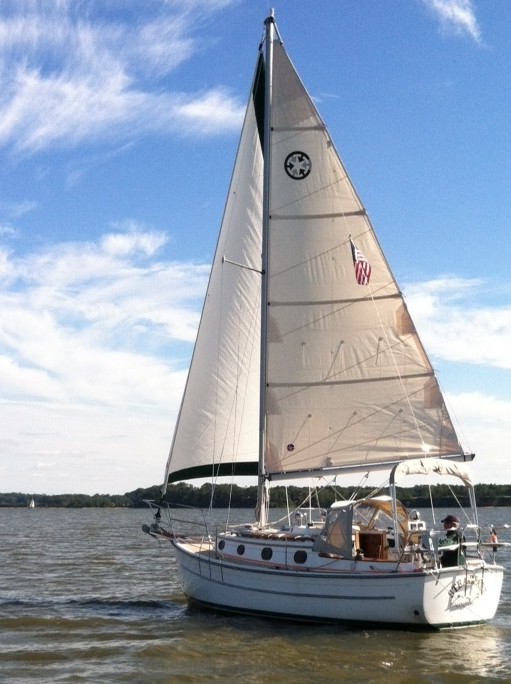
With a favorable tide, it doesn’t take much wind to sail the muddy water of Sassafras River.
There were several tacks to get out of the river and into the Bay where Steadfast and Patience turned to port on a heading of 215 magnetic, hoping to continue sail on a broad reach. The wind, however, had other ideas as to how to spend the day. It elected to back first to the nor’east, then north and nor’west and right around counterclockwise, ’til a steady 10-knots was blowing up the bay from the south which meant, of course, sails furled and engines on.
Right about then… “Bill, would you like to join us for lunch? We’re having salad.”
Oh, that Jane has a sense of humor. You see, Steadfast and Patience were underway at the time, motoring just east of the shipping channel on the upper Bay, somewhere south of Worton Point.
“No, we’re serious, Bill.”
Now it’s Tony’s voice on the VHF, explaining that Jane’s fixing a big salad, will put some in a ZipLoc and he’ll use his new 12-foot boat hook to pass it over. Well, what the heck? Worth a try!
And so it was that Patience slowed, Steadfast came alongside, Tony extended the salad in a bag tied to the end of his brand new, never been tested boat hook and the salad, in fact, DID make it aboard Steadfast as intended.
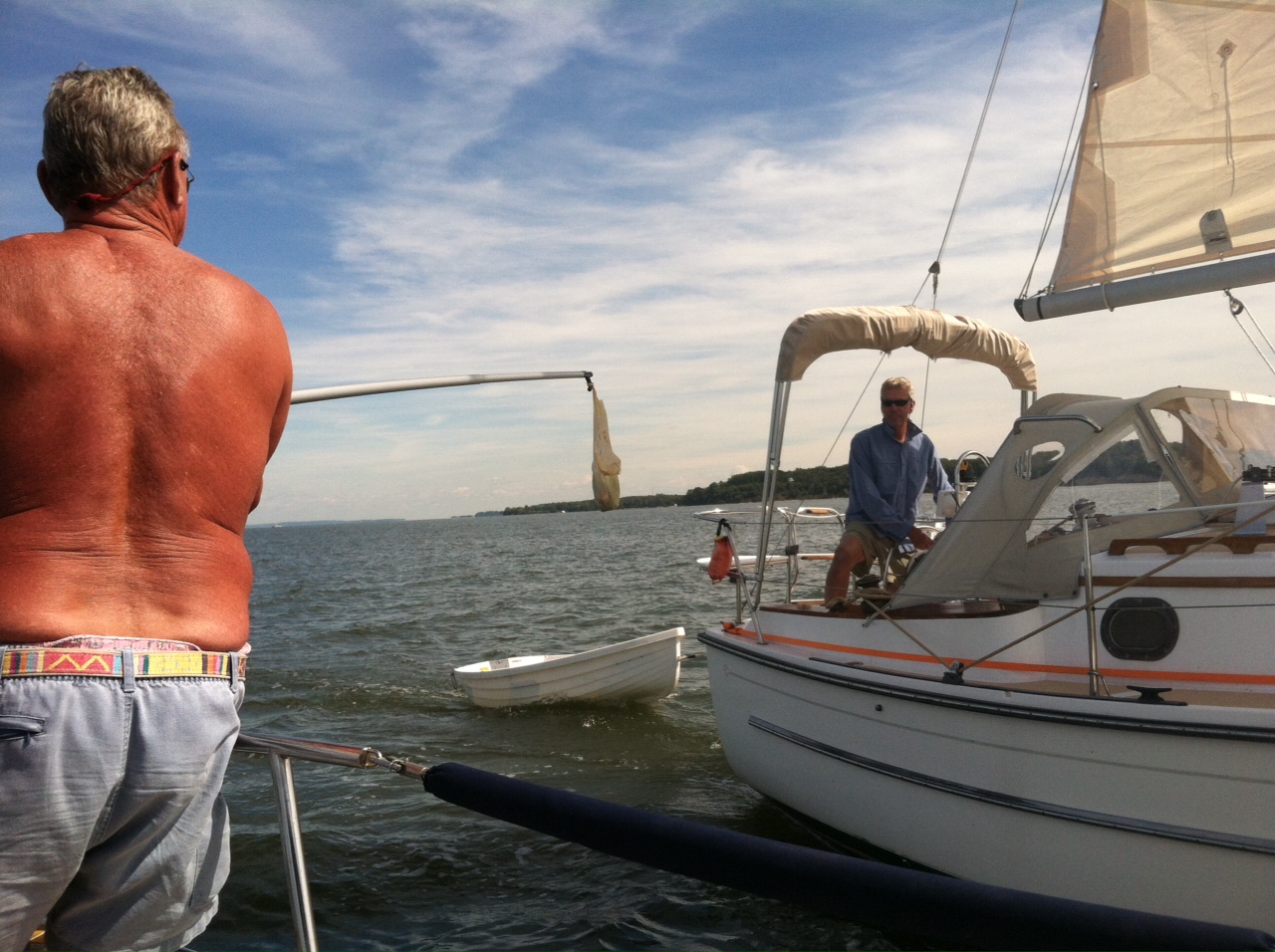
You may not find this maneuver recommended in Chapman’s but it worked and lunch was delicious.
What you don’t see in the photo is the nifty new boathook, after making the transfer successfully, snagging a lifeline on Steadfast, thereby being yanked out of Tony’s hands and splashing into the Bay. Neither will you hear the associated narration which went something like “Oh, golly gee whiz. Isn’t that a shame” or words to that effect.
However, both boats quickly reversed course, the boat hook from Steadfast–which had been baptized, twice in one evening, in New London–was put to work and it quickly snagged the runaway!
And if that were the end of the day’s adventures, that would be sufficient. But wait! There’s more… (to be continued)
22 September Slings & Arrows: Part 2
So, after the day’s idyllic start, the comedy of the salad exchange (and by the way, it was perfecto! Mmm, mmm good.) the two little yachts continued to motor down the Bay toward Rock Hall, a snug and lovely harbor on Maryland’s eastern shore that lists heavily toward rag-boaters.
“So, Bill,” says Tony on the VHF, “I’m thinkin’ we can cut across Swan Point Bah where the chot shows… Uh-oh. Bill, I just heard a big clunk! I’ll have to call you back.”
Ah, outrageous fortune strikes…literally. Patience has just struck something submerged, out of sight, probably large and definitely heavy. The good news is she’s not taking on water. But Tony reports she’s lost all thrust. Going nowhere. Drifting. After a quick assessment of the situation, he calls the man in the red shirt, AKA TowBoatUS, who is on the scene in 20-minutes. Within moments, the tow line is deployed and Patience is being towed–at seven knots, mind you!–toward Rock Hall.

TowBoat was quick to respond when Patience needed help getting into port at Rock Hall.
The next morning, the able crew at Sailing Emporium had her up in the slings of the travel lift, identified the problems–damaged prop, broken prop shaft–and got to work finding parts and completing repairs. The plan had been for Steadfast to spend Thursday night there, too, but given the opportunity, arrangements were made Friday for the yard to do some needed fuel system maintenance. Kudos to Sailing Emporium for extending dockage Friday night at no charge and then, with the wind howling out of the south and seeing Steadfast at anchor in the harbor, inviting her back in for Saturday, too!
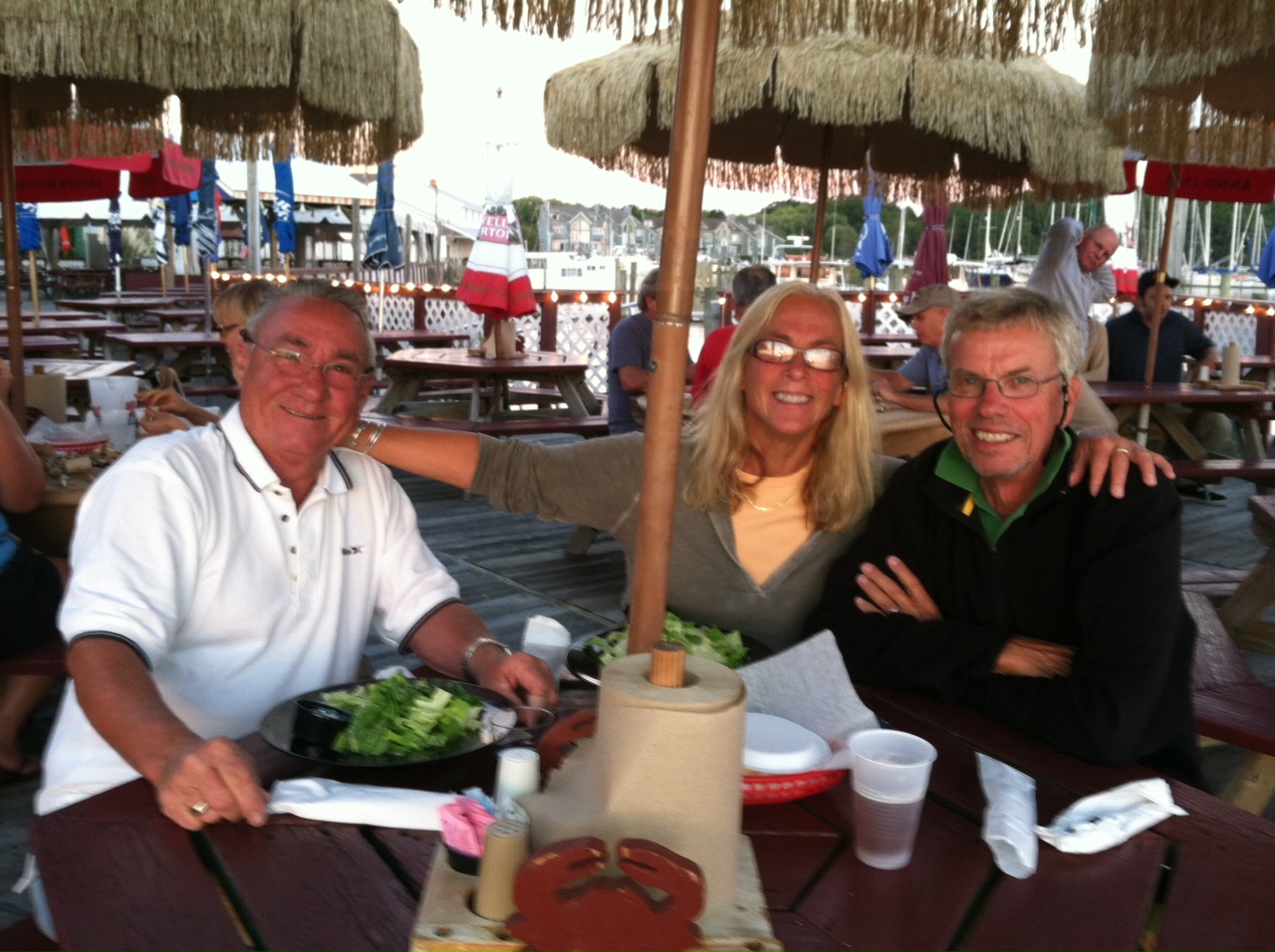
After pulling into Rock Hall for repairs, the crews of Patience and Steadfast make the most of it at the Waterman’s Bar & Grill.
Patience was back in the water early Saturday afternoon, all systems “go,” and the plan is for both boats to head to the western shore Sunday, maybe Annapolis.
Steadfast out.
25 September
The half-moon is surrounded by wispy puffs of cloud cast in the color of a pale rose, a perfect halo. Certainly, that means something, a la “red at night, sailor’s delight” or some such. But the only signal on Steadfast this night says it’s time to “splice the main brace.” It’s a dark and stormy night, for sure.
And the day? It was a day like any other day, just a lot more of it. A southerly wind in the upper teens, unrelenting in its determination to stack up a three-to-four-foot on Chesapeake Bay and Tangier Sound. While doing its work, it whined or howled or screamed, however that constant wail might be categorized, as if to say “I’m still here!” Not that anyone on the Bay yesterday could forget.
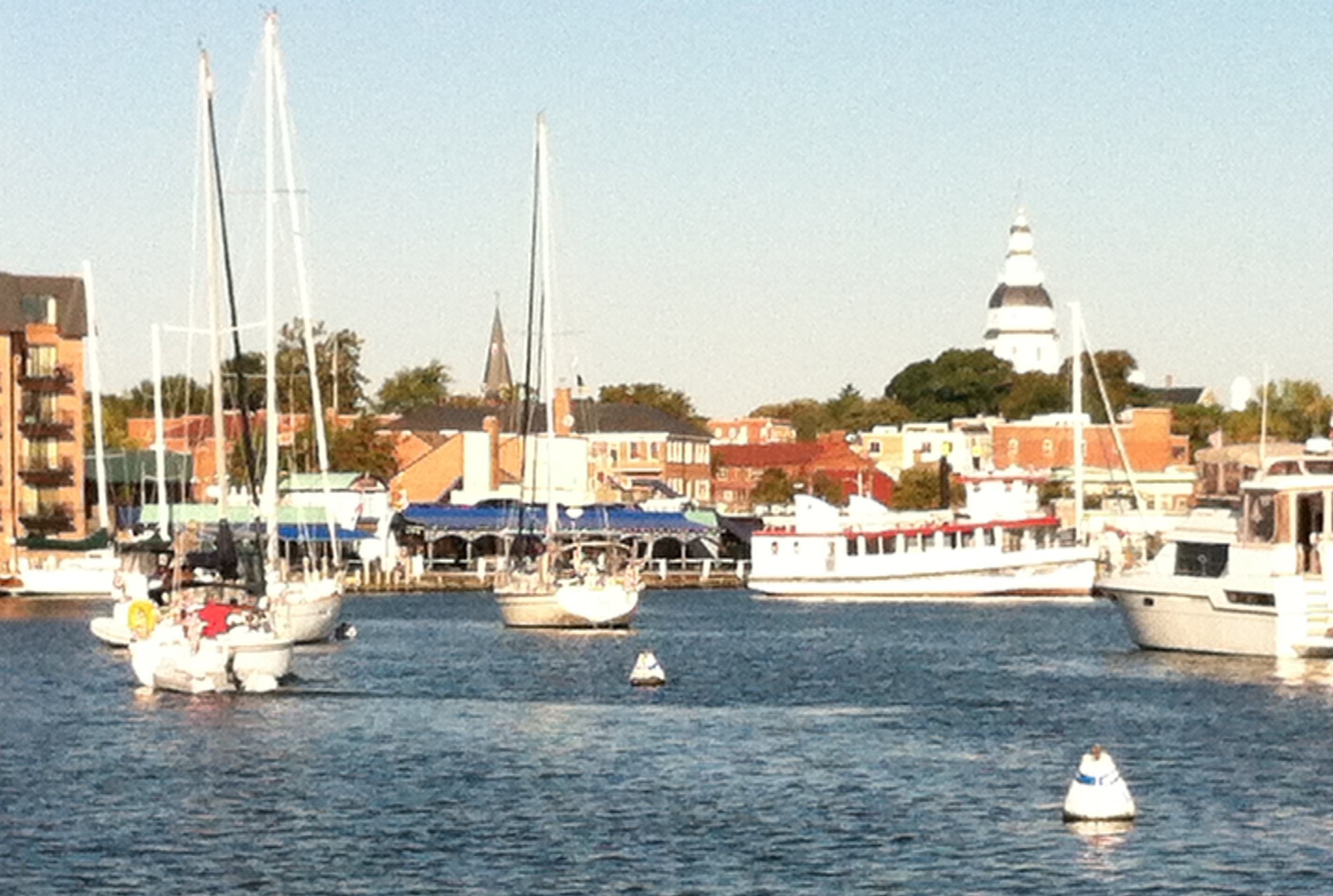
It’s always a relief to spy an open mooring close to the action at the City Dock in Annapolis.
All this, in total contrast to the experience of sailing Sunday and Monday.
Shoving off Sunday from Rock Hall, there was a nifty little breeze out of the north, gusty, too. But given that Patience and Steadfast both were headed across the Bay and 16 miles to the so’west, it made for a pleasant mid-morning reach across Swan Point Bar that became more of a broad reach when the boats headed toward the Bay Bridge. Wending their way up the Severn River among yachts of all descriptions, including a dozen engaged in a classic yacht regatta, the two seemed pleased to call it a day earlier than usual as each rode to a city mooring just off “Ego Alley.” There was a trip to Pusser’s, a stroll around town, good eats at Federal House and an all around great day. Monday meant more blue, sunny skies with temperatures again in the mid-70s. But this day, the wind was in the mood to tease a sailor.

The Thomas Point Light may be the most famous and photographed on Chesapeake Bay.
Off Thomas Point, enough blew up to coax out the main but it soon was luffing and came down again. From the west, what wind there was clocked to the north, then east and eventually south before dying out altogether, only to wake up and blow right down the Patuxent River just as Patience emerged from the lee of Cove Point with Steadfast off her port quarter.
Not that this was a problem, by any means. After running for more than 38 miles, Red looked forward to getting the final five behind her. And a more lovely fall evening could not be had. The two anchored up Back Creek, just off the Calvert Marine Museum among several other sailboats that appeared to be cruisers headed southward.
Crisfield seemed a good target yesterday, what with the forecast calling for 12-14 out of the south, so’west, meaning–in theory–the two little yachts could beat across the Bay to Kedges Strait and then motor the few miles down Tangier Sound to the Little Annemessex and into the snug harbor at Somers Cove. ‘Cept it didn’t work out that way (go figga!).
Aeolus decided to work the early shift, earlier than NOAA expected, and blow from an angle that preempted sailing to Kedges Strait. Instead, the more northerly Hooper Strait became the alternative. Snaking the way through that passage between Bloodworth and the Hooper Islands, depths ranging from 54 to 12 feet and with beam to the wind and waves, took more time–and effort–than anticipated. Emerging into Tangier Sound and turning south, the chop was dead on the bow, slowing progress at times to a crawl. The half-mile before the turn to the Little Annemessex leading to Crisfield, that last little bit took nearly half-an-hour to negotiate.

Visitors to Crisfield enjoy the sunset over Tangier Sound, regardless of regulations posted on the town pier.
By then, the sun was below the horizon. All that was left of the day’s light was a glimmer. The moon was up and that helped. But it was, ahem, “interesting,” as they say, groping through the dark for the channel markers. Sometime after 2000, the howling stopped as the boats motored slowly into the basin and up to the tee-head at “D” dock, salt caked on the foredeck, stanchions, deckhouse, dodger AND the crews.
But again, what a day. What an experience. And praise God, no damage to the boats, no injuries to crew, just another memorable day on the water!
Steadfast out.
26 September
“Thar ain’t no NAPA staw heeyah but Tee’s is ’bout three, fo’ mile up the ro-edd. You finished breakfas’? I kin tike ya up they-ah, if you wont. Gla’ to do-it.”
And thus began Jane, Tony and Bill’s next day-long adventure.
It started with Tony’s desire to get a couple of things–oil, fuel stabilizer, feeler gauge–to tackle the starting issue with the engine on Patience, a venerable four-cylinder Atomic-4 gas engine that has been a bit balky the last few days. So the question was put to the gentleman seated on the stool next to Jane at Gordon’s Diner on West Main, just a couple of blocks from Somers Cove.
The gentleman turned out to be Tangier-native and former island policeman (police department, if truth be know) Chip Parks. You may know his uncle Milton. It’s Milton’s “marina” where boats tie-up for the night when visiting Tangier. So anyway…
Chip leads the three sailors to his Grand Marquis and onto a ninety-minute tour of Crisfield to include three hardware stores, the Legion Post, town pier, and-ah, the shop at Chesapeake Boats, Inc. In progress this day are two 46-foot power boats, a 27 and the bottom of a good-sized fourth.

The up-close introduction to boat-building in Crisfield was a real education.
David Mason, the owner, came out to answer questions. The hulls are plywood over pine stringers and ribs, the keelson a run of 8X8s, all of which then is glassed over, making them impervious to rot, all-but indestructible and…not inexpensive.
On the way back to the marina, the question naturally arose–us being sailors and all–as to dinner recommendations, it then being nearly lunch-time.
“Well, that’s not a bad place, they-ah. But ah like to go ta the Legion Post. They have sof’ shells now and the best crab cakes you’ll evah have. I’ll be happy to brang ya ovah they-ah, if you’d like,” Chip offered. “What time’dja wanna go?”
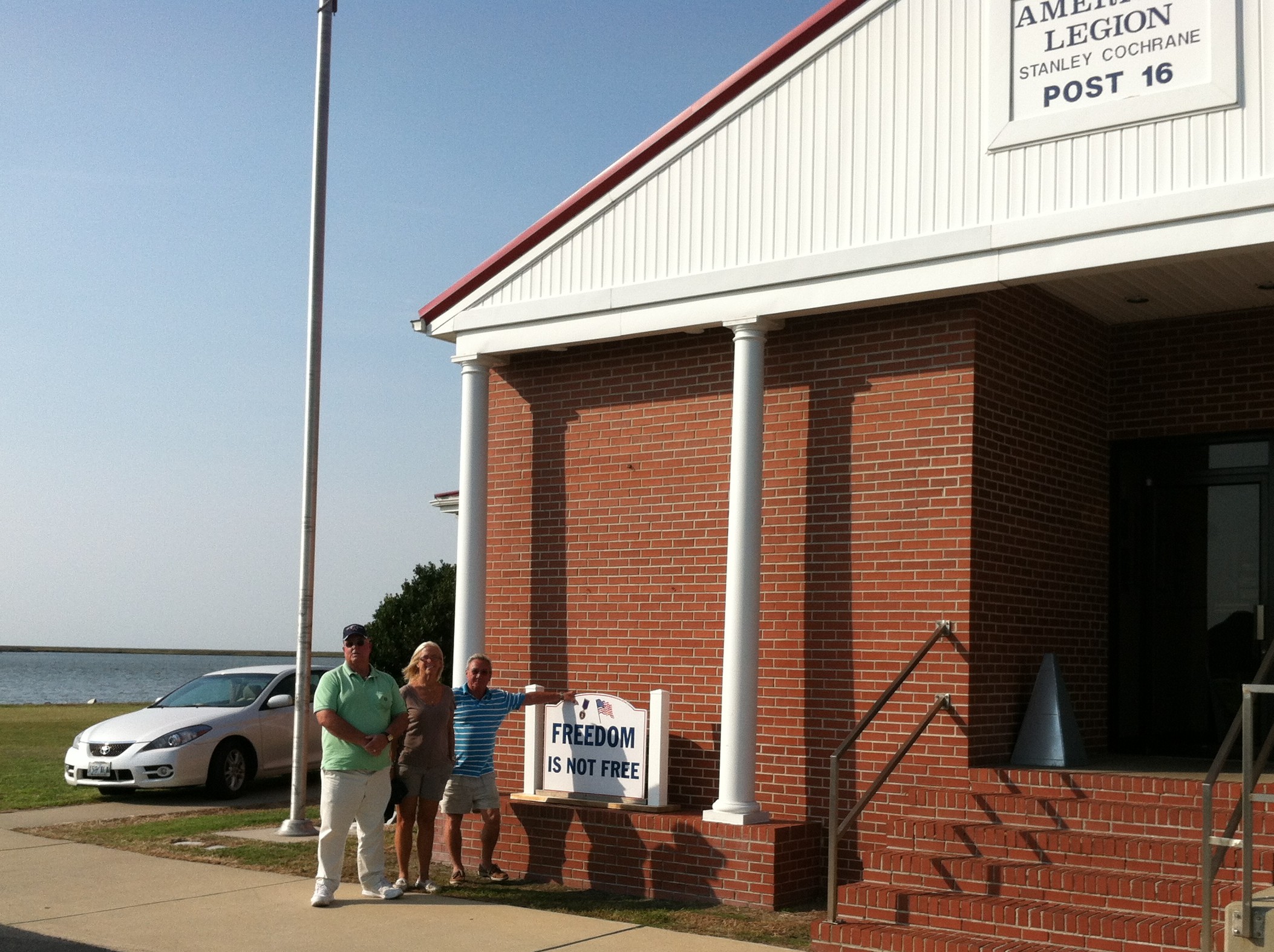
Chip, Jane and Tony pause on the way to dine at the American Legion Post on the Crisfield waterfront.
A wonderful experience, meeting Chip, getting the grand tour, dining at the Post. But it’s a pleasure to report, based on the hospitality offered this stranger the last many weeks, not a unique experience by any means.
Does the heart good, it does.
Steadfast out.
27 September
There are six or seven 35-40-plus-foot boats anchored a quarter-mile upstream from here. “Here” is a lovely 12-foot deep cove just nor’west of green number-five, the last marker on Mill Creek. This Mill Creek, one of a half-dozen or so on the Bay, is off the Great Wicomico River and miles from anywhere. It’s a couple of miles up a dusty road to the nearest crossroads, Wicomico Church. Not town or even village, mind you. Crossroads. So this is fairly remote. But then, it’s been that kind of a day, somewhat off the beaten path, so to speak.
It started, remember, in Crisfield, Maryland, at the state park that is Somers Cove Marina. It is a huge marina with most of its hundreds of slips vacant. Crisfield is not huge but is mostly vacant, too, since it’s raison d’etre–the crab business–is, shall we say, not what it used to be. Neither is Crisfield.
So after yesterday’s grand tour, and an afternoon spent cleaning up and drying out the boats, Patience and Steadfast shoved off this morning at 0945, out the Little Annemessex and into a decidedly more placid Tangier Sound than was the case the previous two days. Turning south to 220 magnetic, the boats motored easily in the slick calm toward Tangier Island. Once into the thorofare, Jane was busy snapping photos as Tony let me know what might’ve been expected of a first time visitor, “I’ve nevah seen ANYthing like this! This is unbelievable!”
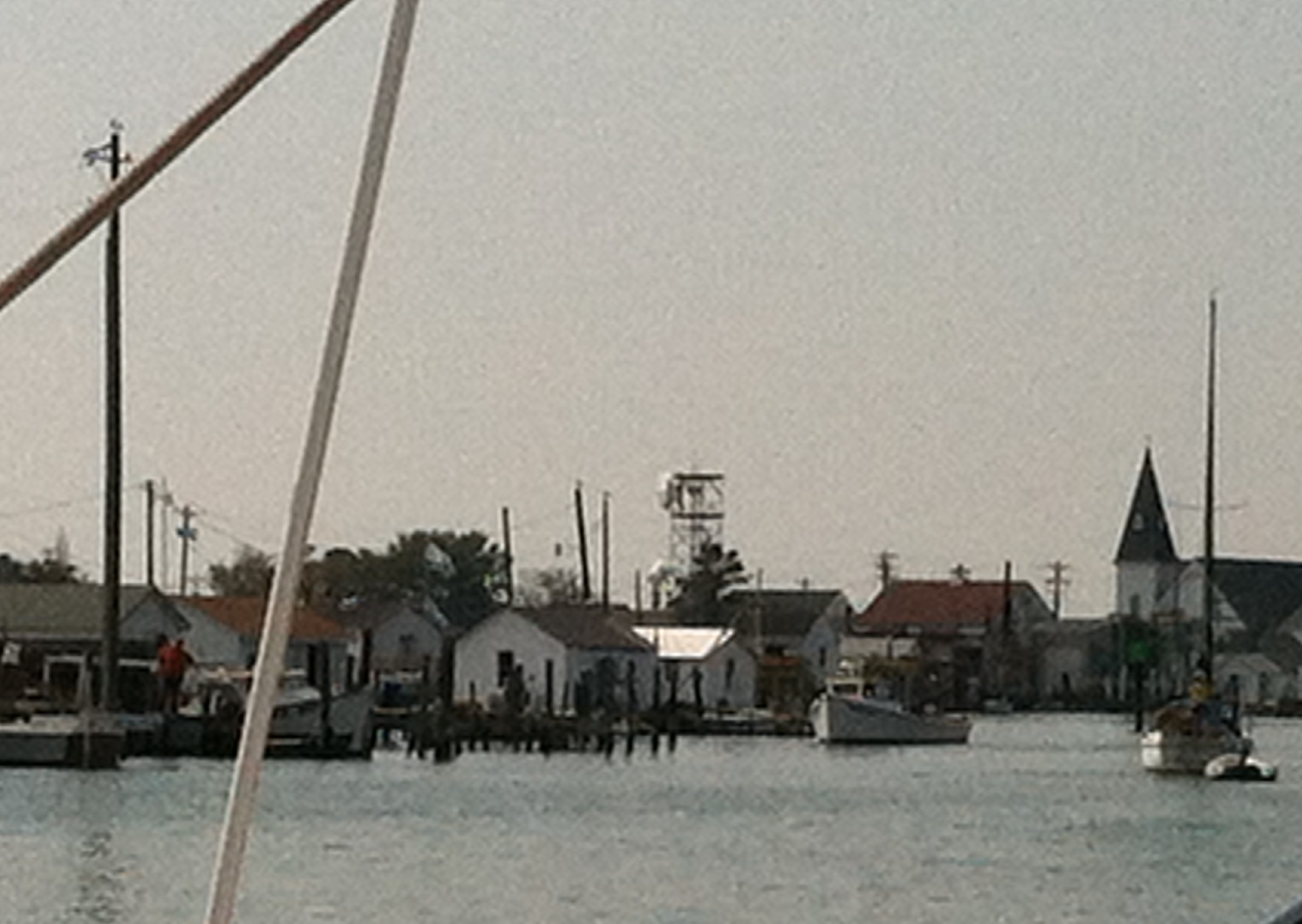
Patience glides slowly past the crab shacks that line the east channel into Tangier Island, VA.
Passing the oil dock shortly after noon, Patience turned to port to meet Chip’s uncle Milton Parks, proprietor of Parks Marina, who then helped her tie-up and her crew get oriented to their unique surroundings. Dinner at Chesapeake House awaits.
Steadfast, however, wants not to be tied to a pier again ’til she’s in her own slip at home. So, waves were exchanged and she motored on through the Island’s western entrance to cross Chesapeake Bay to the western shore. The crossing was easy, a light southerly cooling the cockpit under the warm afternoon sun that beat down on the opened Bimini.
And so she sits quietly now in Mill Creek, another 27-nautical miles under her keel. It’s not clear why others choose to anchor farther upstream and not here but it’s nice that they don’t. It adds to the sense of seclusion, despite the quaint little farm on the cove’s west bank and the three homes that stand on the other shores. This place feels far away. Previous nights in this spot have all been pleasant and memorable, for the simplicity and solitude more than anything, and it’s expected that this night’ll be the same.
Home beckons, but not for another night or two.
Steadfast out.
28 September: Odds On
Hard rain on a tin roof is a sound unlike any other, certainly any other rain. Somehow, despite the volume and tenor, it’s a sound that soothes, comforts. Rain falling on a fiberglass boat deck, when you’re below, is something like that. Not an unpleasant sound at all. That’s the rain. The lightning strikes could be done without, were there a choice, but there’s not. You spend time on the water, you will encounter a thunderstorm. So one assures oneself by contemplating the mathematical odds–fairly remote–of a bolt striking a sailboat mast. Or tries to persuade oneself that lightning, a notoriously unpredictable force, will choose to strike the taller trees on shore or the taller masts of the larger boats nearby, not the inconsequential aluminum pole that serves as the mast on Steadfast.
One does that even now, as the rain falls and thunder and lightning punctuate the evening sky, and one sits a couple of feet away from the base of the mast. But then, setting off on a three-and-a-half-month sailing “adventure” to Maine, on a boat of 27-feet on deck, is not among the more reasonable undertakings a person might consider.
Nor is trying to pilot said boat toward her intended destination in five knots of wind with two-foot seas on the bow, as one attempted this morning.
Steadfast was underway shortly after 0900 with NOAA’s promise of 10-to-15 knots out of the so’west, enough to move her smartly toward Indian Creek and a re-fueling stop at Chesapeake Boat Basin. Despite the boats anchored nearby last night in Mill Creek, there was little traffic on the Bay, although it appeared the lunch whistle blew early for the Menhaden fleet.

The menhaden fleet from Reedville trolls the length of the Chesapeake Bay.
Six of these left their posts just off the Great Wicomico and headed into Reedville all at the same time, their holds full, no doubt, and the Bay fishery a little less so.
The wind seemed enough to lift the boat southward, and Steadfast certainly tried her best. But by 1100, the GPS calculated she was still ten miles from Indian Creek. That’s after being just 7.5 NM away when she weighed anchor. Go figga. So Red was called into service yet again and performed admirably as she’s done for nearly 400 hours on this trip. What a gal! Patience, meantime, motor-sailed on to Broad Creek to spend the night there. Martha and George brought Quintan up to rendezvous off Long’s Cove, across from ICYCC, and here we sit.
The front now has moved on. The rain has abated, for now, and so, of course, has the pleasant drumming on the deck along with the calculating of odds.
But then, what are the odds?
Steadfast out.
01 October: Home
The hum of the refrigerator flows faintly down the hall from the kitchen, much like the sound of the compressor that keeps the icebox cold on the boat. But there’s no rhythmic lapping of water on the bedroom walls, nor is the floor rocking slowly and steadily, side to side. One would think those last two facts would be reassuring. The cottage is designed to be both stable and dry. But Saturday night, the first back home in three-and-a-half months, the stability and lack of harbor sounds made for fitful sleep, at best. It is so good to be home, no question, but it will take a few days to re-acclimate to life ashore.
The final 15-mile-leg of the trip started early, not long after the showers ended at dawn and gave way to another dramatic sunrise, this time with Quintan anchored in the rosy glow.
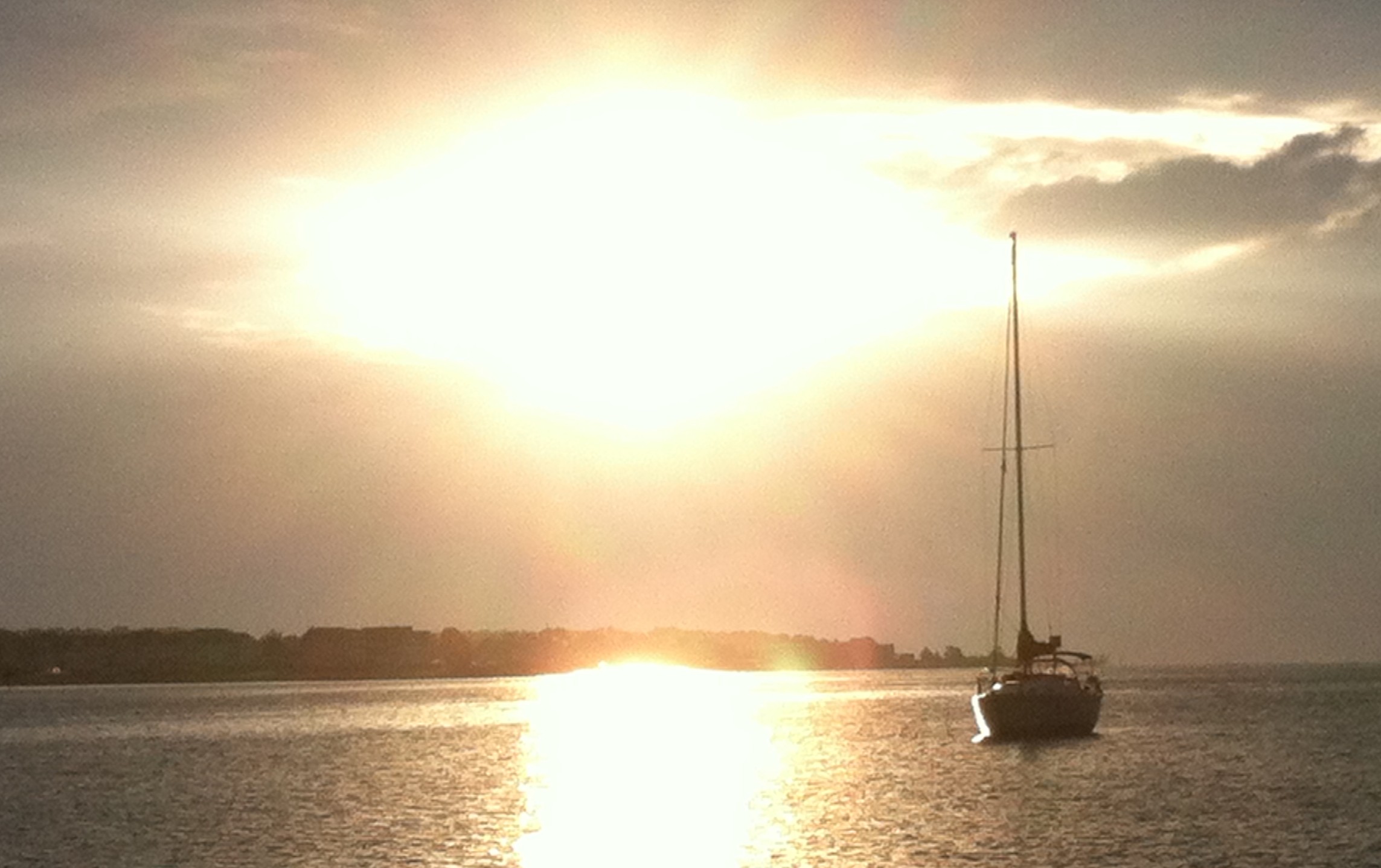
A quiet evening with the crew of Quintan was the perfect prelude to the final few miles home. Quintan lay silhouetted against the morning sun.
The nor’west wind, such as it was, came over the starboard quarter, offering no help for the day’s first six miles. But once rounding Windmill Point, it was a steady ten knots, so the genny unfurled, Red took a breather and Steadfast reached across the mouth of the Rappahannock and down into Hills Bay.
It was good to finish off the cruise under sail, almost right up to the entrance markers for Queens Creek. Chris and Bill Burry brought their dinghy across the creek, Kate joined them and they buzzed down the creek, saluting Steadfast’s return with a blast from the signal horn.
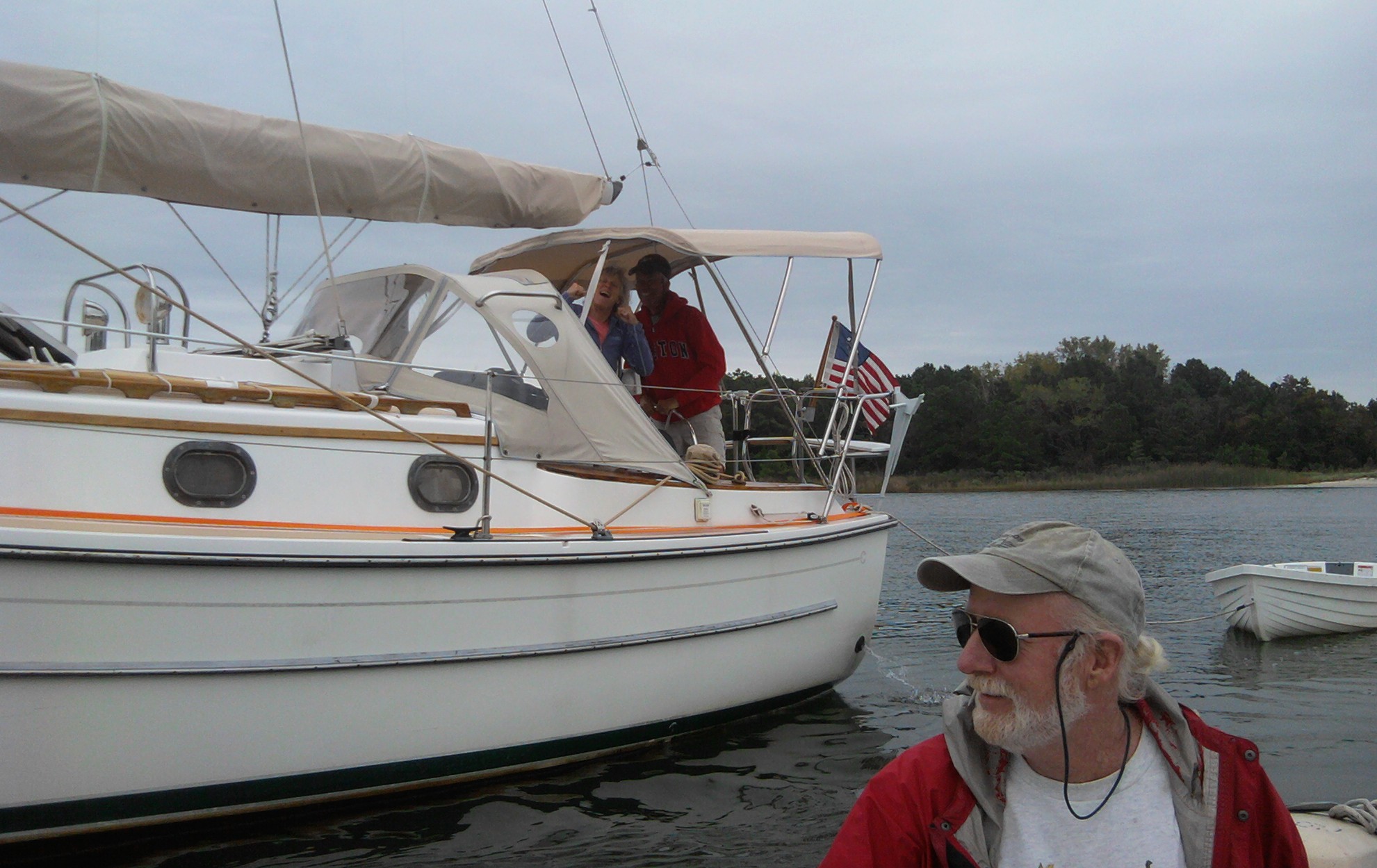
Cap’n Burry helmed Plover’s dink down the creek, Chris saluted with the signal horn and Kate climbed aboard Steadfast for a welcome home!
Many smiles and waves all around, as you might expect, as Kate climbed aboard for the last few hundred yards and all hands helped with lines ’til Steadfast once again was secure on her own pier.
After all these past weeks and miles and places and people, there are so many thoughts and memories. Sorting through them will take a few days, probably a good bit longer. But one thought is clear: it’s good to be home.
Now, if I can just get used to walking again on solid ground.
Steadfast out.
Epilogue What I Learned on Summer Vacation
“So, how was it? Was it everything you expected it to be?”
The natural questions come now as the holidays bring us together, family and friends not seen in six months or more. How does one explain to a ‘lubber, “No, it was NOT everything I expected. It was so many things I NEVER could’ve expected!”
So your tolerance is asked with these random thoughts, none profound, few if any original: First, you can do stuff you didn’t think you could do, but, you have to start; most of us are capable of more than we do, more than we think, even.
As daunting as it may seem to cast off and leave, one quickly settles into routines on a boat; life is simplified, pared down to the basics. The hard part is getting reacclimated to the complexities of life ashore.
Once home, one hopes to retain some of the “boat life” mindset, as in: Simple entertainments. Heightened awareness of the natural world. A keen sense of the day. Self reliance.
When you’re on your own, you’re not really “on your own.” Tom in Sandwich, Bill and the 1630 Club in Rockport, Chip in Crisfield. There’s a long list of those who lent a hand along the way. Perhaps the Harbormaster in Plymouth offered the best description of how it is out there, traveling up the coast. You may remember, Steadfast was without power that evening, piloting a narrow twisting channel as the wind faded. When advised that Steadfast would be under sail the 8 miles in, the Harbormaster came out to check, offered a tow, arranged a mooring, cautioned ferry captains to throttle back when passing. Certainly, he deserved a statement of thanks but when it was made, his response was “That’s what we’re here for.”
Ain’t that the truth. That’s what we’re here for, to help whoever, wherever, whenever we can.
So with that in mind, thanks go to each of you who’ve accepted this correspondence. Above all, Kate who asked “Why not?” and offered constant encouragement. Jim, with whom this wacky plan was hatched on a ride aboard Miss Ella across Blue Hill Harbor. John Schnoering whose advice went something like “Go. I’ve never seen anyone’s epitaph that said “I wish I’d gone to more meetings.” Waddy whose “local knowledge” helped in so many ways Down East. And Tom and Bill and David and Bob and Steve and all those whose support made all the difference along the way.
Thank you!
Steadfast out. ‘Til next time.


 At Sea with Steadfast
Oh man . . . THAT’S QUINTAN!!!